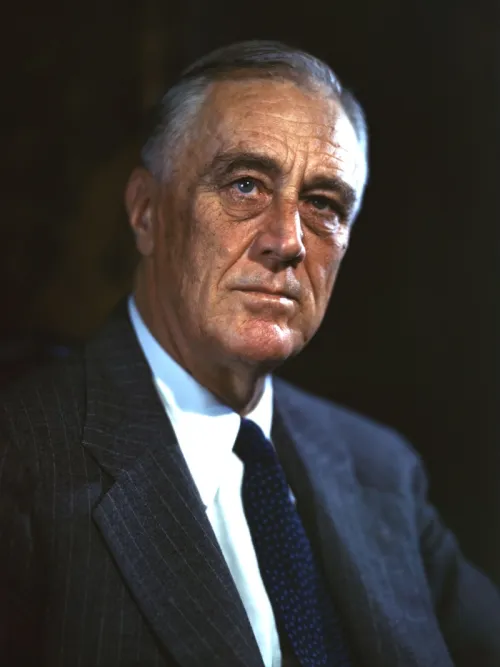
Franklin Delano Roosevelt was born on January 30, 1882, into one of New York's most patrician families, at the Hyde Park estate that would be both his birthplace and burial ground. His childhood was a gilded education in American aristocracy: private tutors, European tours, Groton, Harvard. He was not a spectacular student — he was charming, socially fluid, and politically perceptive in ways that formal education didn't measure. At Columbia Law School he passed the bar before completing his degree and saw no reason to finish. He served in the New York State Senate, as Assistant Secretary of the Navy under Woodrow Wilson (where he developed a taste for managing large organizations and a deep belief in American sea power), and ran unsuccessfully for Vice President in 1920 — an educational loss that taught him how campaigns actually worked.
In August 1921, at thirty-nine, Roosevelt contracted poliomyelitis while vacationing on Campobello Island. The paralysis was devastating and permanent — he would never walk unassisted again. His mother Sara Delano Roosevelt, a dominant force throughout his life, wanted him to retire to Hyde Park and live as a gentleman invalid. Eleanor Roosevelt and his political advisor Louis Howe refused to allow it, and the decade of grueling rehabilitation that followed transformed Roosevelt fundamentally. He spent years at Warm Springs, Georgia, developing experimental therapies with other polio patients, and the experience of genuine physical vulnerability — of depending on others for the simplest movements, of understanding limitation and endurance from the inside — gave him an empathic intelligence that his earlier self, the confident patrician, could never have possessed.
Elected Governor of New York in 1928 and President in 1932, at the absolute depth of the Great Depression — with 25% unemployment, thousands of banks failing, and genuine despair about whether democratic capitalism could survive — Roosevelt used his first hundred days to pass fifteen major pieces of legislation now known as the New Deal. Social Security, the Securities and Exchange Commission, the Federal Deposit Insurance Corporation, the National Labor Relations Act, the Public Works Administration: institutions so deeply embedded in American life that it is now impossible to imagine their absence. He communicated directly with the American public through radio 'fireside chats' that transformed the presidency's relationship with ordinary citizens, speaking with the intimate directness of someone sitting in your living room rather than the institutional distance of an emperor.
Roosevelt led the United States through World War II with the same combination of political creativity, strategic vision, and personal magnetism that had characterized his New Deal years. His management of the Allied coalition — Churchill's wounded pride, Stalin's paranoia, the competing demands of the Pacific and European theaters — was among the most consequential diplomatic enterprises of the twentieth century. He died on April 12, 1945, in Warm Springs, Georgia, from a cerebral hemorrhage, just eighty-three days into his unprecedented fourth term, with German surrender still weeks away. He was sixty-three. The man who had entered the presidency in a wheelchair and who had hidden the extent of his disability from the public throughout his twelve years in office left behind a country transformed — the social contract between American citizens and their government permanently and irrevocably altered by his conviction that the suffering of individuals was a national, not merely personal, concern.