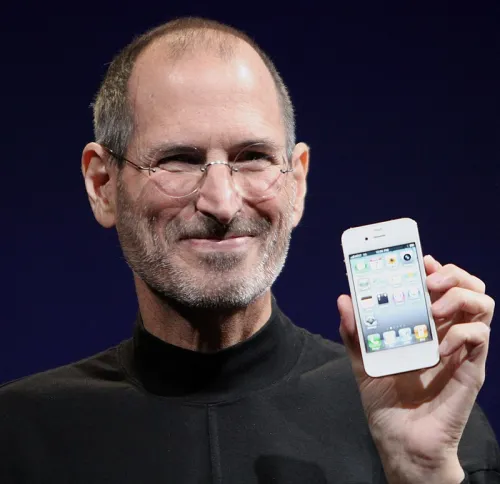
Steven Paul Jobs was born on February 24, 1955, in San Francisco, California, and placed for adoption immediately after birth. He was adopted by Paul and Clara Jobs, a machinist and accountant who moved the family to the Santa Clara Valley — what would later become Silicon Valley. Jobs grew up surrounded by garage tinkerers and hardware engineers, absorbing a culture where the gap between imagination and manufactured reality felt almost nonexistent. His adoptive father taught him to work with his hands; electronics became the language through which Jobs first learned to transform ideas into objects. At Reed College in Oregon, he attended a calligraphy course after dropping out after one semester — a seemingly useless aesthetic detour that would, ten years later, give the Macintosh its revolutionary typography and launch his lifelong conviction that technology and the humanities were inseparable.
Jobs co-founded Apple Computer with Steve Wozniak and Ronald Wayne in 1976 in the Jobs family garage. Where Wozniak was the engineer, Jobs was the visionary product architect and relentless salesman — the ENTJ who understood not just what was technically possible but what humans would desire if it were placed in front of them. The Apple II became the first commercially successful personal computer. The Macintosh, launched in 1984 with the legendary Ridley Scott Super Bowl commercial, introduced the graphical user interface to mainstream consumers. Then, in 1985, Jobs was forced out of Apple by the board he had recruited — a humiliation that became the crucible in which his most extraordinary qualities were forged.
The exile years transformed Jobs from a brilliant product manager into something categorically different. He founded NeXT Computer, whose operating system would later become the foundation of macOS. He purchased a small animation studio from George Lucas for $5 million and renamed it Pixar — the company that would produce Toy Story, Finding Nemo, The Incredibles, and eleven consecutive billion-dollar films. When Apple acquired NeXT in 1997 and Jobs returned as CEO, he found the company ninety days from bankruptcy. Within three years, the iMac, iPod, and iTunes had restored profitability. The iPhone in 2007 and the iPad in 2010 didn't merely create new product categories; they fundamentally restructured the global economy of media, communication, and personal computing in ways that are still unfolding.
Jobs represented the ENTJ personality at its most extreme: visionary, strategically brilliant, ruthlessly demanding, and capable of the paradoxical combination of deep artistic sensitivity and absolute managerial hardness. His famous 'Reality Distortion Field' — the ability to convince engineers, designers, and investors that impossible timelines were achievable — was equal parts charisma and coercion. He insisted on the elimination of every unnecessary physical button, every superfluous menu option, every obstacle between a person and what they wanted to do — a philosophy rooted not in minimalism as an aesthetic but in deep empathy for the user's experience. Diagnosed with pancreatic cancer in 2003 and operated on after an inexplicable nine-month delay, he died on October 5, 2011, at fifty-six — just one day after the iPhone 4S announcement.