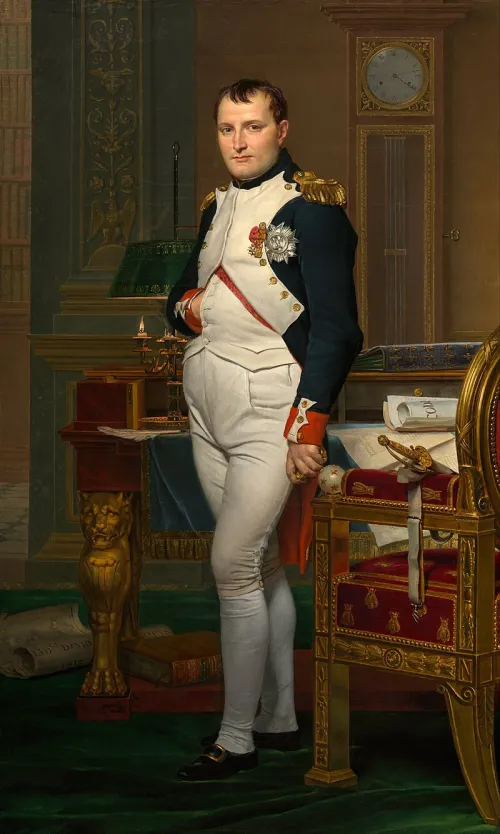
Napoleone di Buonaparte was born on August 15, 1769, in Ajaccio, on the island of Corsica — which had been transferred from the Republic of Genoa to France just the year before his birth. He was the second of eight surviving children of a minor Corsican noble family, speaking Italian as his first language and French barely at all when he was sent to French military school at age nine. The humiliation of his arrival — mocked for his accent, his poverty, his small stature, and his foreignness — seems to have ignited in him a rage that would never fully extinguish and that he would spend the rest of his life converting into strategic energy. He graduated from the École Militaire in Paris in one year instead of the usual two, was commissioned as a second lieutenant in the artillery at sixteen, and spent the years of the French Revolution reading voraciously — Plutarch, Machiavelli, Rousseau, military history — preparing himself, consciously or unconsciously, for a role that didn't yet exist.
Napoleon's military genius announced itself at the Siege of Toulon in 1793, where the twenty-four-year-old artillery officer designed the bombardment strategy that retook the city from British-backed royalists and earned him promotion to brigadier general. His Italian campaigns of 1796-97 were a masterclass in the ENTJ's defining strategic gift: the ability to see the entire system — troop positions, supply lines, enemy psychology, diplomatic consequences — while executing each tactical component with speed that his opponents could never match. He defeated five Austrian armies in a single campaign through maneuver rather than mass, negotiated peace terms that doubled France's territory, and returned to Paris as the most celebrated man in Europe at twenty-seven. When the Directory government was collapsing in 1799, Napoleon executed the Coup of 18 Brumaire and made himself First Consul — effectively France's ruler.
The Consulate years (1799-1804) revealed Napoleon's genius for civil construction equal to his military genius for destruction. He reorganized French law into the Napoleonic Code, a detailed civil law system that remains the foundation of legal systems across Europe, Latin America, and Quebec. He established the Banque de France, standardized a national education system, signed the Concordat with the Catholic Church that ended a decade of religious conflict, and built the administrative infrastructure of the modern French state. He crowned himself Emperor in Notre-Dame in 1804 — with Pope Pius VII present but conspicuously not the one placing the crown on Napoleon's head, that gesture being Napoleon's own deliberate signal about the relationship between temporal and religious authority. At his strategic peak, after the crushing victories at Austerlitz (1805) and Jena (1806), he controlled an empire stretching from Spain to the borders of Russia.
The catastrophic Russian campaign of 1812 — in which Napoleon led 685,000 soldiers into Russia and returned with perhaps 100,000 — marked the turning point. He had violated the ENTJ's deepest strategic rule: do not extend a line of force beyond the capacity to sustain it. The remaining three years were a fighting retreat against a coalition that his earlier victories had welded together. Defeated at Waterloo on June 18, 1815, by Wellington's British forces and Blücher's Prussians, he was exiled to the remote island of Saint Helena in the South Atlantic, where he spent six years dictating his memoirs, managing his legend with the same strategic care he had once given to his campaigns, and dying slowly of what is believed to have been stomach cancer on May 5, 1821, at fifty-one. His legend — the Corsican outsider who rewrote European history through sheer force of will — has never diminished.