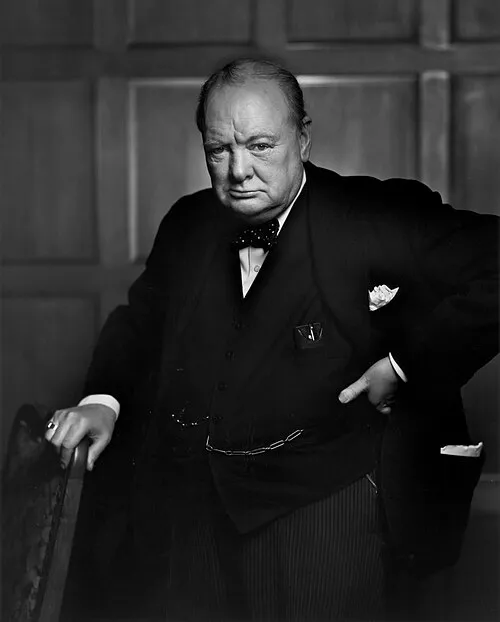
Winston Leonard Spencer Churchill was born on November 30, 1874, at Blenheim Palace in Oxfordshire — the ancestral home of the Dukes of Marlborough — the son of Lord Randolph Churchill, a prominent Conservative politician, and Jennie Jerome, an American socialite. His childhood was marked by relative parental neglect — his parents were consumed by London society, and Winston was raised primarily by his nanny Elizabeth Everest, to whom he remained devoted — and by a learning style that his schoolmasters found difficult. He was a poor student at Eton's rival Harrow School before finding his element at the Royal Military College, Sandhurst.
Churchill's early career was shaped by the Victorian soldier-journalist archetype: he combined military service with dispatches to newspapers, creating a public profile from his military adventures in Cuba, India, Sudan, and South Africa that would have been impossible for an officer without his journalistic facility. His escape from Boer captivity in 1899 made him briefly famous throughout the British Empire. He entered Parliament in 1900 and began what would prove to be one of the most turbulent and consequential political careers in British history: multiple party switches, a disastrous responsibility for the Gallipoli campaign in World War I, years in the political wilderness during the 1930s when his warnings about Hitler's intentions were dismissed as alarmism.
Churchill's appointment as Prime Minister on May 10, 1940 — the same day Germany invaded France and the Low Countries — placed him at the center of what would be either the last act of British civilization or its finest hour. The speeches he delivered in the summer of 1940 — 'We shall fight on the beaches,' 'Their finest hour,' 'Never in the field of human conflict was so much owed by so many to so few' — were not merely rhetoric but acts of political will, redefining what was possible by refusing to accept the definition that circumstances seemed to be imposing. His partnership with Roosevelt and his management of the relationship with Stalin in the Grand Alliance that defeated Nazi Germany were exercises in diplomatic skill as remarkable as his oratory.
Churchill was voted out of office in 1945, in the general election called immediately after Germany's surrender — a shock to himself and to international observers that the British public chose this moment to remove their war leader. He returned as Prime Minister from 1951 to 1955, during which time he gave his Iron Curtain speech (actually 1946) and continued to influence the shape of postwar Europe. He was awarded the Nobel Prize in Literature in 1953, for his historical writings as much as his oratory. He died on January 24, 1965, at age ninety, and was given a state funeral attended by representatives of 112 countries.