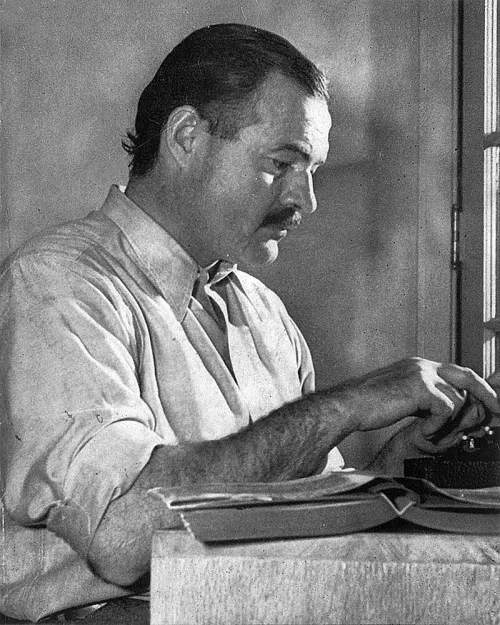
Ernest Miller Hemingway was born on July 21, 1899, in Oak Park, Illinois, a prosperous suburb of Chicago, to Clarence Hemingway, a physician with a passion for the outdoors, and Grace Hall Hemingway, an opera singer and music teacher. His childhood divided between his father's world of hunting, fishing, and outdoor life in northern Michigan and his mother's world of culture and performance gave him the dual sensibility — the physical and the aesthetic — that would define his work. He graduated from high school in 1917 and, unable to enlist due to poor eyesight, took a job as a cub reporter at the Kansas City Star, where he absorbed the newspaper's style guide — short sentences, active verbs, concrete specificity — that would shape his literary style.
Hemingway's experience as an ambulance driver for the Italian Red Cross during World War I — he was severely wounded near Fossalta di Piave in 1918, receiving over 200 shrapnel fragments in his legs — became the foundational experience of his early writing. His return to America, his move to Paris in 1921 as a foreign correspondent for the Toronto Star, and his immersion in the expatriate literary world of the 1920s — he knew Gertrude Stein, F. Scott Fitzgerald, Ezra Pound, and James Joyce — produced the Lost Generation milieu that his early work would define. The Sun Also Rises (1926) and A Farewell to Arms (1929) established him as the defining voice of his literary generation.
Hemingway's prose style — the iceberg theory of omission, the short declarative sentence, the surface simplicity that requires depth of the reader — was both technically fresh and immediately influential. He had understood something about how literary language could work that previous writers had not articulated: that what is left out creates the emotional weight that what is said cannot carry alone. His subjects — war, love, death, masculinity, the natural world, courage in the face of inevitable defeat — were as consistent as his style, and together they created a literary world that is immediately recognizable as Hemingway regardless of where the reader enters it.
Hemingway's later life was marked by the extraordinary public legend he had cultivated — the big-game hunter, the deep-sea fisherman, the war correspondent who had covered four conflicts, the Nobel laureate of 1954 — alongside deteriorating physical and mental health. His final novel, The Old Man and the Sea (1952), won the Pulitzer Prize and contributed to his Nobel Prize; A Moveable Feast, his memoir of Paris in the 1920s, was published posthumously in 1964. He died on July 2, 1961, of a self-inflicted gunshot wound, at his home in Ketchum, Idaho, two weeks after his sixty-second birthday. His influence on American prose style remains pervasive and largely unacknowledged, precisely because it has been so thoroughly absorbed.