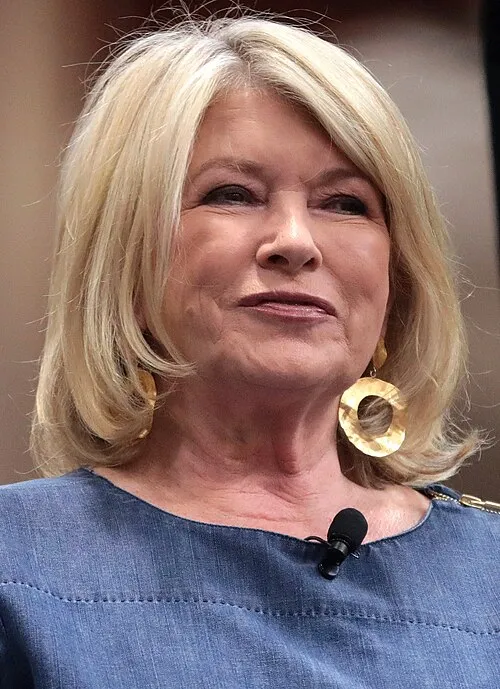
Martha Helen Kostyra was born on August 3, 1941, in Jersey City, New Jersey, the second of six children of Edward Kostyra, a pharmaceutical salesman and gardener, and Martha Ruszkowski, a school teacher. She grew up in Nutley, New Jersey, in a family where homemaking was taken seriously as craft — her father cultivated an ambitious garden; her mother canned, preserved, and cooked with systematic care. Martha absorbed these standards and internalized them as the basis of a personal and professional philosophy: that the domestic arts, properly practiced, are not lesser activities but expressions of knowledge, taste, and skill. She worked as a model while attending Barnard College, graduating in 1962 with a degree in History and Architectural History, and married law student Andrew Stewart in 1961; they had one daughter, Alexis, before divorcing in 1987.
Martha Stewart worked as a stockbroker in New York in the 1960s and early 1970s, leaving Wall Street when she and Andrew purchased a farmhouse in Westport, Connecticut that became both a home and a laboratory for the systematic exploration of domestic arts — cooking, gardening, preservation, entertaining, renovation. The catering business she developed from this base grew into Something Special, which catered events in the New York area through the 1970s and led to her first book, Entertaining (1982), which combined accessible instruction with aspirational photography and established the template that would become a media empire. By the late 1980s, she had become the country's most recognizable domestic lifestyle authority: multiple cookbooks, television appearances, and a consulting arrangement with Kmart that brought her products to mass-market retail.
Martha Stewart's media empire — Martha Stewart Living Omnimedia (MSLO), which went public in 1999 and briefly made her the first female self-made billionaire listed on the New York Stock Exchange — was built around the systematization and elevation of domestic knowledge. Her television program Martha Stewart Living, which ran in various forms from 1991, combined instruction with the aesthetic sensibility that her cooking, gardening, and entertaining books had established: the idea that doing things beautifully was not more work than doing them carelessly but was, rather, the expression of genuine knowledge. She was simultaneously beloved by the audience she served and satirized by those who found her perfectionistic standards intimidating — a tension that itself was a form of cultural commentary on the ambivalent relationship between American culture and domestic expertise.
Martha Stewart's 2004 imprisonment — five months in federal prison for lying to investigators about a stock sale (the underlying insider trading charge was not pursued) — was one of the most dramatic corporate falls of its era. She was released in March 2005, was photographed leaving the Alderson Federal Prison camp in West Virginia wearing a poncho she had knitted while inside, and returned immediately to her work. The comeback was more complete than almost anyone predicted: new television shows, new product lines, and the cultural authority of someone who had faced genuine public humiliation and returned without apparent diminishment. She was in her 60s and 70s when she continued to set cultural standards: appearing on the cover of Sports Illustrated's Swimsuit Issue at 81 in 2023, demonstrating a relationship with aging and personal presentation that was itself a kind of statement.