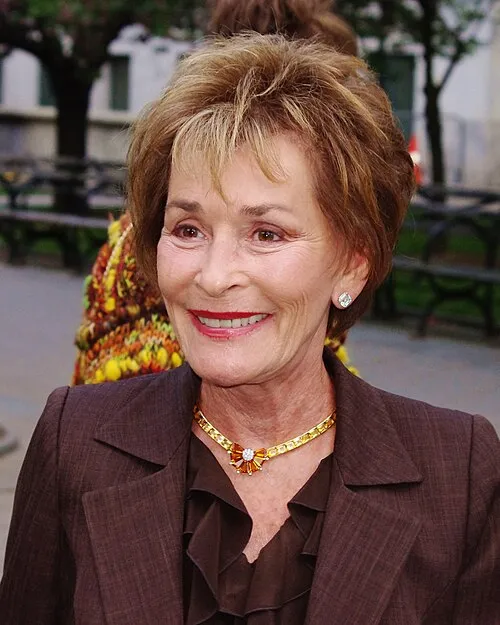
Judith Susan Blum was born on October 21, 1942, in Brooklyn, New York, the daughter of Murray Blum, a dentist, and Ethel Blum, a homemaker. She was raised in a Jewish family in the Flatbush neighborhood of Brooklyn and was, by her own account, a difficult, argumentative child who drove her parents to distraction — qualities that would eventually make her enormously wealthy. She attended American University in Washington, D.C., where she studied government, intending at first to become a teacher, but changed course and enrolled at New York Law School, graduating with her JD in 1965. She married Ronald Levy that year, had two children, divorced in 1976, married Judge Gerald Sheindlin in 1977 (they divorced and later remarried), and built a legal career in New York that took her from law school to the Manhattan District Attorney's office to a private practice specializing in family law.
Judith Sheindlin was appointed to the New York Family Court in 1982 by Mayor Ed Koch, and she developed a reputation for direct, impatient, often abrasive judicial style that was simultaneously effective and controversial. She dealt with the most difficult cases in the family court system — abuse, neglect, juvenile crime — with an efficiency and frankness that some admired as necessary and others criticized as insufficiently compassionate. A 1993 Los Angeles Times Magazine profile brought her national attention, and CBS and Big Ticket Productions approached her about developing a courtroom arbitration television program. Judge Judy premiered in September 1996 and became one of the most successful syndicated television programs in American history, running for 25 seasons and consistently reaching over 10 million viewers at its peak.
Judge Judy Sheindlin's television success was built on a specific formula: real small claims disputes resolved through binding arbitration, presented within the framework of a courtroom presided over by Sheindlin, whose blunt, often withering assessments of parties' behavior provided entertainment value while delivering, in most cases, genuine legal and moral clarity. She was particularly relentless with deception — her ability to identify inconsistencies in testimony and confront them immediately was remarkable — and with what she considered poor personal responsibility. She received a salary of $47 million per year from CBS at the program's height, making her the highest-paid television personality in American history. When Judge Judy ended its CBS run in 2021 after 25 seasons, she immediately launched Judy Justice on Amazon's IMDb TV, demonstrating the same energy and commercial instinct.
Beyond her television career, Sheindlin has been a consistent and somewhat unexpected advocate for family court reform, arguing that the American family court system is fundamentally broken — underfunded, overwhelmed, and poorly equipped to deal with the complex family dysfunction it encounters. She has written several books including Don't Pee on My Leg and Tell Me It's Raining and Beauty Fades, Dumb Is Forever. She and her husband Jerry divide their time between multiple homes and remain figures of some cultural controversy — beloved by a large audience for her directness and efficiency, and criticized by others for a style that can read as contemptuous of vulnerability. Whatever the assessment, she is a genuinely significant figure in American television and judicial culture: a woman who achieved unprecedented commercial success in a domain — legal authority — that was almost exclusively male when she entered it.