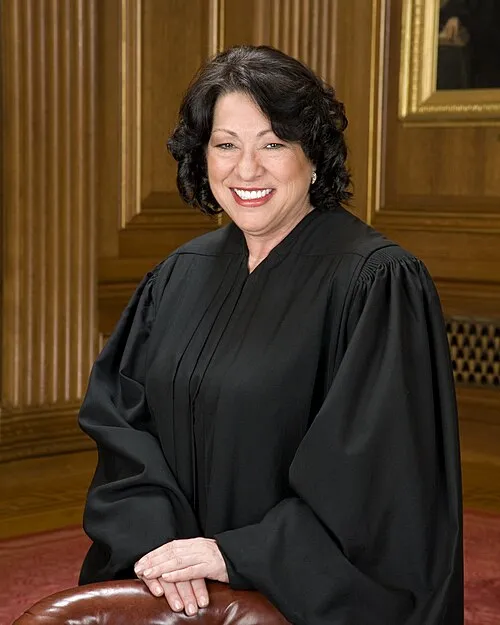
Sonia Maria Sotomayor was born on June 25, 1954, in The Bronx, New York, the daughter of Juan Luis Sotomayor, a factory worker who had completed only third grade in Puerto Rico, and Celina Báez, a nurse. Her father died of heart disease when Sonia was nine, and her mother raised her and her brother Juan in the Bronxdale Houses public housing project on a nurse's salary. Sonia was diagnosed with Type 1 diabetes at age eight; rather than retreating from ambition, she embraced it with greater urgency — her mother told her the diabetes would not define her, and she internalized this so completely that she chose law specifically because the doctors told her a lifetime of insulin management would prevent her from being a surgeon. She attended Cardinal Spellman High School on scholarship, graduating as valedictorian, and won a scholarship to Princeton University, where she graduated summa cum laude in 1976 and then attended Yale Law School, where she was an editor of the Yale Law Journal and graduated in 1979.
Sonia Sotomayor began her legal career as an assistant district attorney in Manhattan under District Attorney Robert Morgenthau — an experience she later described as irreplaceable for understanding how the criminal justice system actually functions, as distinct from how it is theorized in law schools. She moved to private practice at the firm Pavia & Harcourt, specializing in intellectual property litigation, before being appointed to the United States District Court for the Southern District of New York in 1992 by President George H.W. Bush — a Republican appointment that reflected her reputation for legal quality beyond partisan considerations. She was elevated to the Second Circuit Court of Appeals in 1998 by President Bill Clinton, where she served for eleven years and wrote opinions in more than 3,000 cases, developing a reputation as a judge who applied the law carefully and whose opinions were technically precise.
President Barack Obama nominated Sonia Sotomayor to the Supreme Court of the United States in May 2009, to fill the seat vacated by the retiring Justice David Souter. Her Senate confirmation hearings became a cultural moment: the 'wise Latina' phrase — taken from a 2001 speech in which she said 'I would hope that a wise Latina woman with the richness of her experiences would more often than not reach a better conclusion than a white male who hasn't lived that life' — became the subject of extensive national debate, exposing the contradiction between the legal fiction of judicial objectivity and the reality that judges, like all humans, bring their backgrounds to their judgments. She was confirmed 68-31 on August 6, 2009, becoming the first Latina and the third woman to serve on the Supreme Court.
As a Supreme Court Justice, Sotomayor has been consistently in the liberal bloc, writing important opinions in areas including civil rights, immigration, and criminal justice, and writing notable dissents when the conservative majority reaches conclusions she finds legally unjustified and morally troubling. Her 2013 memoir My Beloved World — written with evident pleasure and autobiographical frankness — became a New York Times bestseller and brought her background in The Bronx to wide public attention, demonstrating the relationship between her personal history and her judicial approach. She announced her retirement from the Supreme Court in 2025, providing President Biden's administration with the opportunity to name her successor. Her legacy is the combination of technical legal excellence and the humanizing of a legal philosophy that takes seriously the relationship between the law as written and the lives the law actually touches.