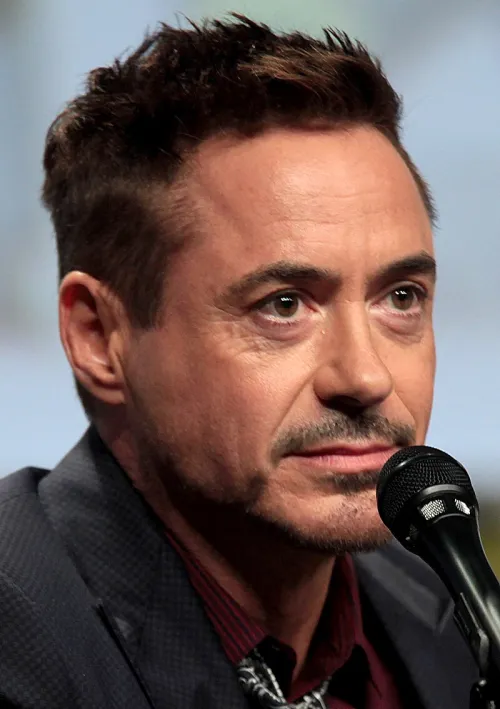
Robert John Downey Jr. was born on April 4, 1965, in New York City, to Robert Downey Sr., an underground filmmaker and actor, and Elsie Ann, an actress. He grew up in a household where chaos was ambient and unconventional was the baseline: his father began giving him marijuana at age six, framing it as a bonding activity. He appeared in his first film at age five and gave his first substantial performance at ten. The family relocated to California when he was a teenager, and Robert dropped out of Santa Monica High School at sixteen to pursue acting full-time. He made his first notable screen appearance in John Hughes's Weird Science (1985) and a string of Brat Pack-adjacent films established him as one of the most naturally gifted actors of his generation — present, witty, and technically precise in a way that looked like pure spontaneity.
His career in the late 1980s and early 1990s produced work that critics recognized as exceptional even as it remained commercially unpredictable. His performance as Charlie Chaplin in Richard Attenborough's Chaplin (1992) — a role requiring him to master Chaplin's physical comedy vocabulary while simultaneously portraying the man's psychological complexity — earned him his first Academy Award nomination for Best Actor. He was twenty-six. What followed was a decade-long descent into substance abuse and legal consequences: multiple arrests for drug possession and weapons charges, a period of incarceration in the California Substance Abuse Treatment Facility, and a professional rehabilitation that took most of Hollywood a long time to trust. He was considered, in the early 2000s, the most talented unemployable actor in the industry.
The comeback that began with Gothika (2003) and accelerated through Kiss Kiss Bang Bang (2005) — where his natural wit and self-awareness were deployed meta-cinematically by director Shane Black — culminated in one of the most commercially life-changing casting decisions in Hollywood history: Jon Favreau casting him as Tony Stark in Iron Man (2008). The character was almost perfectly calibrated to Downey's actual personality: a brilliantly intelligent, emotionally guarded, compulsively witty man whose defensive humor masked genuine vulnerability and whose technological genius was in constant creative tension with his ethical blind spots. He played the character for eleven years across ten films, concluding with Avengers: Endgame (2019), which grossed $2.79 billion and became the highest-grossing film in history at the time of its release.
Robert Downey Jr.'s career is the ENTP story in its most dramatic form: a mind of extraordinary natural gifts that nearly destroyed itself through the restlessness and compulsion that the ENTP type cannot easily manage, followed by a second act built on the wreckage of the first with greater self-awareness and deliberately chosen constraint. Tony Stark is the ENTP avatar made explicit — the genius who builds himself an iron suit because he finally understood that his greatest enemy was his own undisciplined energy, and decided to channel it rather than be consumed by it. Downey's post-recovery interviews reveal a man who has systematically cultivated the discipline and commitment that do not come naturally to the ENTP temperament, and who understands exactly what he is doing and why.