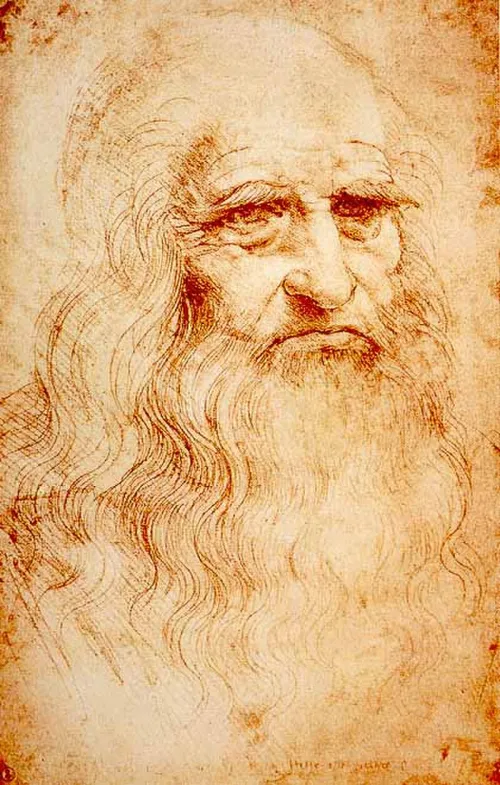
Leonardo di ser Piero da Vinci was born on April 15, 1452, in the small town of Anchiano, near Vinci, in what was then the Republic of Florence. He was the illegitimate son of Ser Piero da Vinci, a prosperous Florentine notary, and Caterina, a peasant woman who married another man shortly after Leonardo's birth. The circumstances of his birth — which left him outside the guild system that regulated most professions and unable to follow his father into law — paradoxically freed him from the professional specialization that constrained more legitimate children. At fourteen, he was apprenticed to the Florentine painter and sculptor Andrea del Verrocchio, whose workshop was among the most technically sophisticated in Italy, producing work across painting, sculpture, goldsmithing, and engineering.
Leonardo's early career in Milan, where he served Ludovico Sforza as court artist and engineer from approximately 1482 to 1499, was where his notebooks — the extraordinary visual-intellectual diaries that survive in some 7,200 pages — began their most intense development. He designed military fortifications, hydraulic systems, theatrical stage machinery, and architectural schemes while simultaneously producing the paintings that would define his reputation. The Last Supper (c. 1495–1498), painted on the refectory wall of Santa Maria delle Grazie, achieved something unprecedented in the history of Christian art: a psychological portrait of each apostle's individual response to Christ's announcement that one of them would betray him, rendered with an emotional precision that owed more to Leonardo's systematic study of human expression than to any iconographic tradition.
The Mona Lisa, begun around 1503 and worked on intermittently until his death, represents the summit of Leonardo's technical achievement in painting: the sfumato technique — the imperceptible blending of tones without visible edges — that gives the figure her famous atmospheric quality of existing at a slight remove from the viewer's certainty. But his notebooks reveal that his scientific work was equally remarkable. His anatomical studies — conducted through the illegal dissection of human corpses — produced drawings of human musculature and skeletal structure that were not surpassed in accuracy for three centuries. He designed a proto-helicopter, a solar power concentrator, a calculator, a tank, a textile machine, and dozens of other devices, most of which would not be built until the nineteenth and twentieth centuries.
Leonardo is the ENTP archetype in its most extreme and most celebrated expression: a mind so restless with curiosity that it could not stop adding new branches of investigation long enough to complete most of its existing projects. He left the Adoration of the Magi, Saint Jerome, and dozens of other commissions unfinished because a new problem had demanded his attention. His notebooks are the record of a mind in continuous lateral motion — a thought about the flight of birds leading immediately to thoughts about the dynamics of water, leading to the mechanics of the human shoulder, leading to a new idea for a stage design. His genius was not the genius of concentration but of connection: he saw the same principles operating across anatomy, hydraulics, aeronautics, and perspective because he was looking at them all simultaneously.