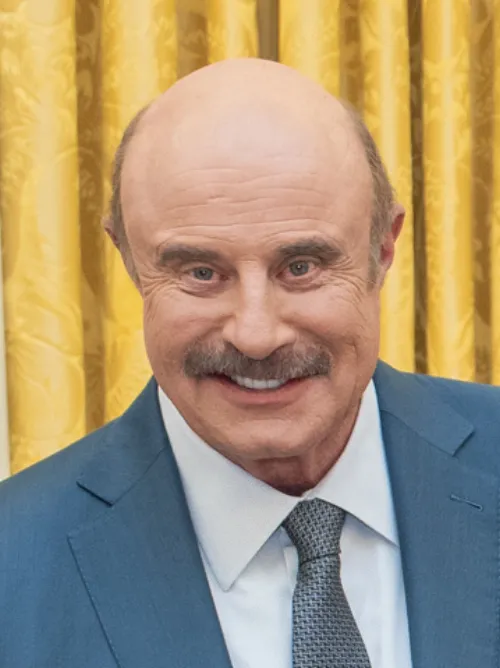
Phillip Calvin McGraw was born on September 1, 1950, in Vinita, Oklahoma, and grew up across several states as his father's career moved the family from Oklahoma to Kansas to Denver to North Texas. He attended Midwestern State University on a football scholarship, transferring to the University of North Texas, where he played linebacker before injuries ended his athletic career. He completed his PhD in clinical psychology in 1979 at North Texas and opened a private practice, later co-founding the trial consulting firm Courtroom Sciences, Inc., which prepared witnesses and developed trial strategy for attorneys. It was this work that brought him to Oprah Winfrey's attention — Courtroom Sciences prepared her defense team for the 1998 Texas beef industry lawsuit — and Oprah subsequently invited him to appear regularly on The Oprah Winfrey Show as an expert in human behavior.
Dr. Phil McGraw's daytime television show Dr. Phil premiered on September 16, 2002, and ran for 21 seasons. At its peak, it was one of the highest-rated daytime programs in American television history, consistently reaching 3-4 million viewers. The show's format — McGraw interviewing guests about personal problems and delivering direct, sometimes blunt assessments and advice — was explicitly modeled on his personality: the self-described 'straight talker' who would tell guests what they needed to hear rather than what they wanted to hear, in language that prioritized accessibility over clinical accuracy. He wrote multiple bestselling books including Life Strategies (1999), Relationship Rescue (2000), The Ultimate Weight Solution (2003), and Family First (2004), each applying his direct, behavioral approach to common personal challenges.
McGraw's television career and approach attracted both enormous popularity and genuine criticism. Mental health professionals frequently objected to the gap between his television persona and clinical best practice — the show's production of dramatic confrontations for entertainment value was seen as antithetical to the therapeutic process; his direct, advice-giving style was criticized as superficial relative to evidence-based treatment; specific episodes involving vulnerable guests generated ethical controversy. He surrendered his Texas psychology license in 1990 after a Texas State Board of Examiners complaint involving a former patient (a matter he attributed to the commercial realities of leaving clinical practice for consulting) and has consistently emphasized that his television work is not therapy. The distinction between therapeutic intervention and television advice-giving is one he has maintained, though critics have argued that viewers do not always make this distinction.
McGraw ended Dr. Phil in 2023 and launched a new television venture — a news and opinion program called Merit Street Media — in a move that reflected his evolution from television therapist to public commentator. He has been a vocal participant in political commentary, making public statements on criminal justice, mental health policy, and public figures that have sometimes attracted significant criticism for their factual accuracy and framing. His son Jay McGraw produced multiple television projects, and the family has maintained significant media presence. Whatever the critiques of his methods, McGraw's contribution to the national conversation about mental health — his normalization of discussing psychological issues in public contexts, his reach into households where professional mental health services were not accessible — represents a form of public education that is difficult to dismiss entirely, even by those who object to its format.