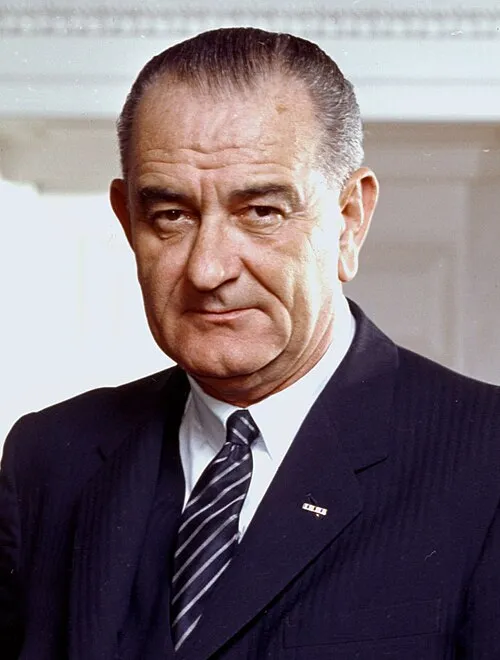
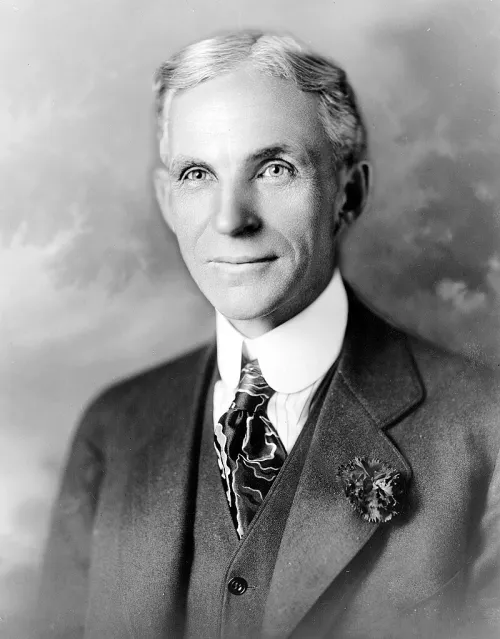
Henry Ford - ESTJ Personality Type

Henry FordESTJ - المدير التنفيذي

Founder of Ford Motor Company

الأصل

USA

مستوى الثقة في التصنيف

مقبول على نطاق واسع

Quick Facts

Born
July 30, 1863
Birthplace
Dearborn Township, Michigan, USA
Nationality
American
Height
5'9" (175 cm)
Zodiac Sign
Education
McGuffey Readers (self-educated); Goldsmith, Bryant & Stratton Business College (briefly)
Known For
Ford Motor CompanyModel TAssembly line manufacturingFive-dollar workday$5 day wage reformAntisemitic publications (dark legacy)

Who is Henry Ford?

Henry Ford was born on July 30, 1863, on a farm in Dearborn Township, Michigan, the eldest of six children of William Ford, an Irish-American farmer, and Mary Litogot Ford. He grew up on the farm during the Civil War era, developing the mechanical aptitude that would define his career — he was dismantling and reassembling pocket watches at age 13. He left the farm at 16, working as a machinist's apprentice in Detroit, and eventually joined the Edison Illuminating Company, rising to chief engineer of the main Detroit plant by 1893. The stable income and access to machine tools allowed him to experiment in his spare time with gasoline engines, and in 1896, working in a shed behind his house, he completed the Quadricycle — his first self-propelled vehicle. He left Edison in 1899 to work full-time on automobiles, formed and dissolved two early companies with investors who wanted racing cars rather than practical transportation, and incorporated the Ford Motor Company in June 1903.

The Model T, introduced in October 1908, was Ford's masterpiece of design philosophy: a vehicle simple enough for any competent farm mechanic to repair, using standardized parts that could be manufactured economically and repaired cheaply. He priced it to fall — from $825 at introduction to $360 by 1916 — as manufacturing efficiencies allowed, explicitly committed to making the automobile accessible to ordinary American workers rather than preserving it as a luxury. The moving assembly line at the Highland Park plant, introduced in 1913, transformed not just automobile manufacturing but manufacturing globally: by synchronizing sequential operations on a continuously moving line, Ford reduced the time to assemble a Model T from over 12 hours to 93 minutes. This productivity gain allowed wages that were unimaginable in industrial contexts: the 'five-dollar day,' introduced in January 1914, doubled the average industrial wage and transformed Ford's workers into consumers of the products they built.

Henry Ford's legacy is one of the most genuinely complicated in American business history. His manufacturing innovations were real and life-changing — the assembly line and mass production changed the structure of industrial civilization. His social vision was real and partly genuine — he wanted workers to be able to afford the cars they built. His pacifism was sincere — he personally financed a 'peace ship' to Europe during World War I in an effort to negotiate an end to the conflict. But he was also the publisher of the Dearborn Independent, which between 1920 and 1927 published virulent antisemitic content, including the circulation of the fabricated 'Protocols of the Elders of Zion,' which was explicitly praised by Adolf Hitler in Mein Kampf and influenced Nazi ideology. Ford's The International Jew was translated into German and distributed widely in Germany; this is not a minor footnote but a central historical fact about the consequences of his beliefs.

Ford remained in control of Ford Motor Company until 1945 — far longer than his abilities in his last decade warranted — and his management in the late 1930s and 1940s, including his reliance on Harry Bennett's thuggish Service Department to suppress union organizing, created genuinely brutal labor conditions at the company he had previously made famous for progressive wages. He was forced to sign a union contract with the UAW in 1941, eventually, after a violent campaign of intimidation failed. He suffered a serious stroke in 1938 and declined significantly, dying in April 1947 at his Fair Lane estate in Dearborn, Michigan. He left behind a manufacturing revolution that genuinely changed the world, a social vision that was partly enlightened and partly dark, and a legacy that requires the holding of genuine contradictions rather than simplification in either direction.
نوع شخصية Henry Ford: ESTJ

Henry Ford، المعروف/ة بعمله/ها كـFounder of Ford Motor Company، يُجسّد سمات نوع الشخصية ESTJ - المدير التنفيذي.

السمات الرئيسية لـESTJ في Henry Ford

كـESTJ، يُجسّد Henry Ford الخصائص الجوهرية المرتبطة بهذا النوع.

لماذا يُصنَّف Henry Ford كـESTJ

السلوك العام لـHenry Ford وأنماط القرارات وأسلوب التواصل يتطابق مع هذا التصنيف.

Henry Ford's Career Highlights

1896

Quadricycle

Built first self-propelled vehicle in shed behind his house; demonstrated concept to a skeptical Thomas Edison

1903

Ford Motor Company

Founded with $28,000 in investor capital; began production of small, affordable automobiles

1908

Model T Introduction

Launched the vehicle that would democratize automobile ownership in America

1913

Moving Assembly Line

Introduced Highland Park moving assembly line; reduced Model T assembly from 12+ hours to 93 minutes

1914

Five-Dollar Day

Doubled industrial wages to $5/day; transformed workers into consumers; revolutionary labor policy

1927

Model A Launch

Replaced the Model T with the Model A after 15 million units; retooled the entire manufacturing system

Awards & Recognition

\u2605Henry Ford was not a recipient of conventional awards; his influence is measured in global industrial transformation

Henry Ford's Mystic Profile

Discover Henry Ford's cosmic connections through zodiac, tarot, crystals, and spirit animals.

leo

Zodiac Prediction

Henry Ford's Leo sun burns with both the light and shadow of that sign's energy. Leo is the sign of creative authority, of the vision that can see what should be built before it exists, of the sovereign will that makes things happen through force of personality and determination. Ford's Leo energy built the Model T, the moving assembly line, the five-dollar day — all genuine creations of a genuinely powerful vision. But Leo's shadow is the authoritarian quality that will not tolerate challenge or limit: the Ford who refused to sign a union contract for decades, who kept Harry Bennett's thugs to enforce loyalty through fear, who held on to control years past the point of competence. Leo rules the self-belief that enables great creation and the ego that resists the checks that would prevent catastrophe.

🃏

the emperor

Tarot Card Match

The Emperor — the tarot archetype of institutional authority, the systematic imposition of order, and the construction of structures that outlast any individual — is Ford's card. The Emperor builds systems: hierarchies, processes, institutions, rules. Ford built systems — the assembly line, the supply chain, the River Rouge complex (the largest industrial facility in the world at its completion) — on a scale that was genuinely unprecedented. The Emperor's shadow is the tyrant: the ruler who cannot distinguish between the legitimate authority of the master builder and the illegitimate authority of the man who will not be checked. Ford crossed this line repeatedly in his later decades, and the Emperor's shadow explains both the achievement and the failure.

💎

pyrite

Crystal Match

Pyrite — 'fool's gold,' the stone of willpower, ambition, and the material manifestation of vision — is Ford's crystal. Pyrite is associated with the determination to build tangible things from raw materials, to transform vision into structure, to manifest the ideal in the physical world. This is Ford's defining capacity: the ability to look at a mechanical puzzle (how do you manufacture a car that ordinary people can afford?) and solve it by reimagining the entire process from the ground up. Pyrite is also associated with confidence that can tip into overconfidence — the willingness to act that enables creation, and the certainty that can close the mind to what it doesn't want to know.

🦁

stallion

Spirit Animal

The stallion — the powerful, driven, often ungovernable animal that has transformed human civilization through its energy and speed — is Henry Ford's spirit animal. The stallion is the creature that pulls civilization forward; it is the engine of history. Ford made the horse obsolete (the Model T killed the urban horse-drawn economy within a decade of its introduction) by channeling an even more powerful form of the same energy: raw mechanical force disciplined by human intelligence. The stallion also represents the quality of Ford's character: the enormous creative power combined with the independence that cannot be easily governed, the force that is productive when directed and destructive when it is not.

مزيد من مشاهير ESTJ

حول هذا التحليل

يستند تحليل شخصية Henry Ford إلى معلومات متاحة للعموم ومقابلات وملاحظات سلوكية.