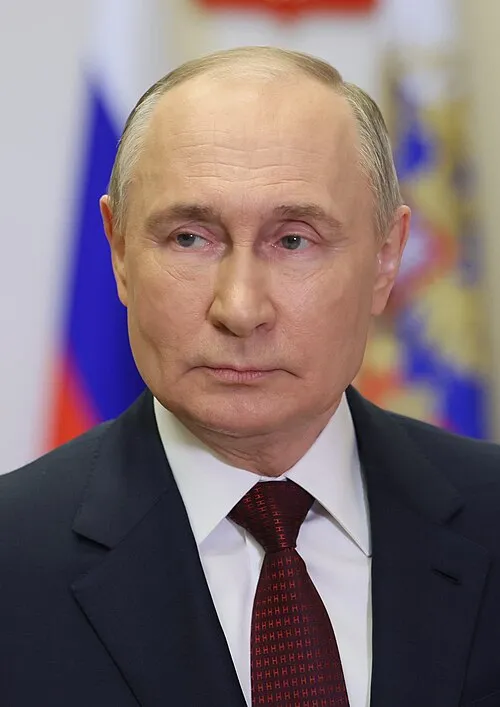
Vladimir Vladimirovich Putin was born on October 7, 1952, in Leningrad (now St. Petersburg), Russia, the youngest of three children of Vladimir Spiridonovich Putin, a conscript in the Soviet Navy who later became a factory worker, and Maria Ivanovna Shelomova, a factory worker and domestic worker. Two older brothers both died before Vladimir was born — one as an infant, one during the Siege of Leningrad during World War II — and he grew up as an only child in a communal apartment in a Leningrad working-class district. He took up judo as a teenager, eventually earning a black belt, and studied law at Leningrad State University, where KGB recruiters identified him. He joined the KGB after graduation in 1975 and served as an intelligence officer for 16 years, including nearly five years in Dresden, East Germany (1985-1990) — an experience that shaped his view of the Soviet collapse when he witnessed East German crowds overwhelming the Stasi headquarters and the Russian consulate received no response from Moscow.
Putin returned to Leningrad after the Soviet collapse and entered politics under Anatoly Sobchak, the reformist mayor of St. Petersburg, initially as an aide and then as head of the Committee for Foreign Liaison. His administrative competence and discreet, effective management of difficult situations attracted the attention of Boris Yeltsin's circle in Moscow; he moved to the Kremlin in 1996, was appointed Director of the Federal Security Service (FSB, the KGB's successor) in 1998, and became Prime Minister in August 1999. Yeltsin's unexpected New Year's resignation on December 31, 1999, made Putin acting President, and he won the March 2000 presidential election with 52% of the vote against a fragmented opposition.
Putin's presidency — his first two terms from 2000 to 2008, a period as Prime Minister under Dmitry Medvedev from 2008 to 2012 while maintaining actual authority, and his return to the presidency in 2012 and subsequent continuous rule — has produced one of the most complete consolidations of state power in modern Russian history. He has suppressed political opposition through a combination of legal harassment, imprisonment, and, in numerous cases, the deaths of critics through what many governments have attributed to state action (Alexander Litvinenko, Boris Nemtsov, Sergei and Yulia Skripal's attempted poisoning, Alexei Navalny's imprisonment and death in 2024). Russia's annexation of Crimea in 2014 and full-scale invasion of Ukraine in February 2022 have produced the most significant sanctions regime imposed on a major economy in modern history.
Putin's February 2022 invasion of Ukraine — launched under the stated justification of 'denazification' and the prevention of NATO expansion — failed to achieve its initial objectives of a rapid Ukrainian capitulation and has produced a prolonged war that, as of early 2025, has caused hundreds of thousands of military casualties on both sides, the displacement of millions of Ukrainian civilians, and the destruction of significant portions of Ukraine's infrastructure and cities. The International Criminal Court issued an arrest warrant for Putin in March 2023 related to the alleged deportation of Ukrainian children to Russia. He won a presidential election in March 2024 with 87% of the reported vote, in an election that Western governments characterized as neither free nor fair. He remains one of the most consequential — and most destructive — political figures of the early twenty-first century.