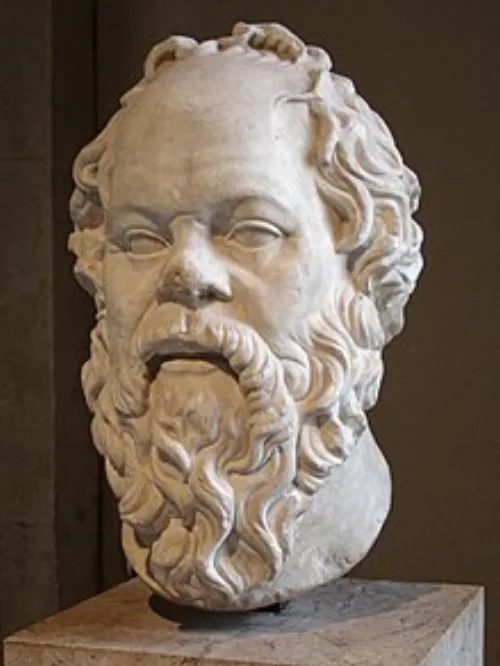
Socrates - INTP Personality Type

SocratesINTP - Nhà tư tưởng

Philosopher

Xuất xứ

Greece

Mức độ tin cậy khi xác định loại

được chấp nhận rộng rãi

Quick Facts

Born
January 1, 470
Birthplace
Athens, Ancient Greece
Nationality
Athenian Greek
Height
Unknown (described as short and stocky by contemporaries)
Zodiac Sign
Education
No formal education; self-taught through dialogue
Known For
Socratic MethodWestern Philosophy FoundationTrial and Death for IdeasDialectical Inquiry

Who is Socrates?

Socrates was born around 470 BCE in Athens, the son of a stonemason and a midwife. He received a basic Athenian education in music, gymnastics, and grammar, and may have worked as a stonemason in his youth — ancient sources suggest he carved the draped Graces on the Acropolis road. What distinguished him from contemporaries was not academic training but a relentless intellectual curiosity that drove him to spend his days in conversation, systematically interrogating everyone from politicians to craftsmen to poets about the nature of virtue, justice, courage, and piety. He wrote nothing himself — everything we know comes through his students, primarily Plato and Xenophon.

The Socratic method — the practice of asking probing questions to expose contradictions in interlocutors' beliefs — was not merely a rhetorical technique but a philosophical conviction: genuine knowledge begins in the recognition of one's own ignorance. The Oracle at Delphi had declared that no man was wiser than Socrates; when Socrates investigated this claim by questioning those reputed to be wise, he concluded that the Oracle meant only that he, unlike them, was aware of his own ignorance. This foundational humility — that intellectual honesty requires constant questioning — is the purest expression of the INTP's dominant Introverted Thinking: the relentless internal auditing of one's own belief systems.

Socrates was a bizarre figure in Athenian public life — ugly by Athenian standards (contemporaries compared him to Silenus, a satyr-like creature), dressed shabbily, and frequently found in the marketplace or at drinking parties engaged in earnest philosophical discussion with anyone who would participate. He refused payment for his teaching, a gesture of integrity that set him apart from the Sophists who charged fees for instruction in rhetoric and persuasion. His magnetic intellectual presence attracted a devoted circle of young Athenians, including Plato, Alcibiades, Xenophon, and Critias — several of whom went on to play dramatic and sometimes destructive roles in Athenian politics.

In 399 BCE, Socrates was tried by an Athenian jury of 501 citizens and convicted of impiety (failing to acknowledge the city's gods) and corrupting the youth. In his defense — the Apology, as recorded by Plato — he refused to beg for mercy, refused to propose exile as an alternative, and ultimately drank the hemlock with apparent philosophical serenity. His death transformed him from a troublesome local philosopher into the martyred founder of Western rational inquiry. The INTP's willingness to follow logic wherever it leads, regardless of social or personal cost, was taken to its ultimate conclusion: Socrates chose death over intellectual capitulation.

Loại tính cách INTP của Socrates

Socrates, nổi tiếng với công việc trong vai trò Philosopher, thể hiện những đặc điểm điển hình của loại tính cách INTP - Nhà tư tưởng. Hồ sơ tính cách này được đặc trưng bởi sự kết hợp độc đáo của các chức năng nhận thức định hình cách họ nhìn nhận thế giới và đưa ra quyết định.

Những đặc điểm INTP chính trong Socrates

Là INTP, Socrates thể hiện những đặc điểm cốt lõi liên quan đến loại tính cách này. Những đặc điểm này đã đóng vai trò quan trọng trong thành công và hình ảnh công khai của họ với tư cách là Philosopher. Hiểu loại tính cách của họ cung cấp cái nhìn sâu sắc về động lực, điểm mạnh và quan điểm độc đáo mà họ mang đến lĩnh vực của mình.

Tại sao Socrates được xác định là INTP

Loại tính cách INTP là một trong 16 loại tính cách Myers-Briggs, và hành vi công khai, khuôn mẫu ra quyết định cũng như phong cách giao tiếp của Socrates rất phù hợp với phân loại này. Những cá nhân INTP như Socrates được biết đến với cách tiếp cận đặc trưng trong giải quyết vấn đề và các mối quan hệ giữa người với người.

Socrates's Key Discoveries

~450 BCE

Developed the Socratic Method

Systematic dialectical questioning to expose contradictions in received beliefs

~430 BCE

Military service at Potidaea

Demonstrated extraordinary physical endurance and courage in battle

~420 BCE

Public philosophical practice in Athens

Spent decades questioning Athenians about virtue, justice, and the good life

399 BCE

Trial and execution

Convicted of impiety and corrupting youth; chose death over intellectual compromise

Socrates's Mystic Profile

Discover Socrates's cosmic connections through zodiac, tarot, crystals, and spirit animals.

gemini

Zodiac Prediction

As a Gemini — the sign of the twins, of dual natures, of the conversationalist and the questioner — Socrates is a perfect archetype. Gemini rules communication, exchange, and the marketplace of ideas, and Socrates spent his entire adult life in exactly this marketplace, moving from conversation to conversation with the Gemini's boundless intellectual curiosity. The twins represent the dual nature of all inquiry: the question contains both the answer and the absence of the answer, just as Socrates's famous 'I know that I know nothing' contains both the humility of ignorance and the wisdom of self-awareness.

🃏

the fool

Tarot Card Match

The Fool steps off the cliff with a flower in hand and a dog barking at his heels — not from ignorance but from trust in the process of discovery. Socrates walked to his own execution with philosophical serenity, trusting that a death lived with integrity was better than a life lived in intellectual dishonesty. The Fool is number zero — the beginning of all wisdom, the blank slate of genuine inquiry — and Socrates's entire method was about returning interlocutors to zero, to the admission of not-knowing from which genuine understanding could begin.

💎

lapis lazuli

Crystal Match

Lapis lazuli — the deep blue stone of truth, wisdom, and philosophical inquiry — was prized in the ancient world as a conduit between the human mind and divine understanding. It is the stone of those who seek not certainty but clarity, not answers but better questions. Socrates sought wisdom not as a possession but as a process, and lapis lazuli represents exactly this: not the destination but the quality of the journey toward understanding.

🦁

owl

Spirit Animal

Athena's owl — the symbol of wisdom in ancient Athens, the creature that could see in darkness — is the perfect spirit animal for the philosopher who illuminated the darkness of unexamined assumptions. Socrates operated at night intellectually: in the darkness of received opinion, conventional morality, and unquestioned belief, he carried his small lamp of dialectical inquiry, asking questions that disturbed the sleep of comfortable ignorance. The owl also represents the wisdom that comes not from accumulation but from ruthless clarity of vision.

Thêm nhân vật nổi tiếng INTP

Về phân tích này

Phân tích loại tính cách của Socrates này dựa trên thông tin có sẵn công khai, các cuộc phỏng vấn, hồ sơ tiểu sử và quan sát hành vi. Việc xác định loại INTP đại diện cho những đánh giá có học thuật của những người hâm mộ và chuyên gia về loại tính cách, nhưng không nên được coi là xác nhận chính thức trừ khi có thông báo khác. Tính cách rất phức tạp và đa chiều, và bản thân công khai có thể khác với tính cách cá nhân.