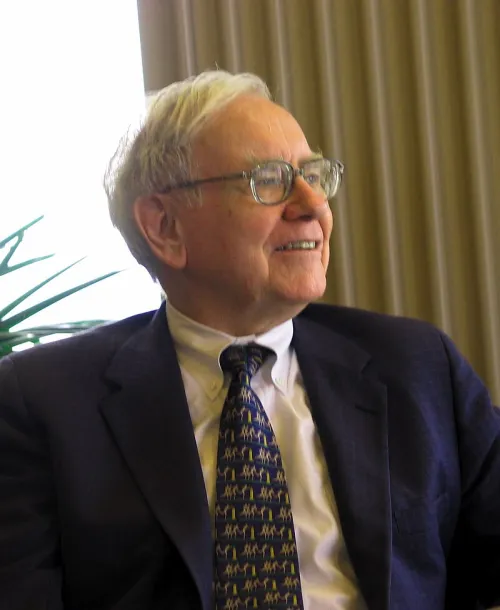
Warren Edward Buffett was born on August 30, 1930, in Omaha, Nebraska, the middle child of Howard Buffett, a stockbroker and Republican congressman, and Leila Stahl Buffett. His father's profession gave him early exposure to financial markets — he first visited the New York Stock Exchange at ten. By eleven he had bought his first stock; by thirteen he was filing his first income tax return, deducting the cost of his bicycle as a business expense for his paper route. His childhood enterprises — selling Coca-Cola door to door, running a pinball machine business, buying farmland at fifteen with his paper route earnings — were not the typical enthusiasms of a child but the systematic activities of a mind that could not help but see economic opportunity in every situation.
Buffett applied to Harvard Business School and was rejected. He enrolled at Columbia Business School specifically to study under Benjamin Graham, whose book The Intelligent Investor had galvanized his thinking about value investing — the practice of identifying companies whose stock price is lower than their intrinsic value. Graham's methodology gave Buffett the systematic framework that would become the foundation of his investment approach. He joined Graham's firm briefly, then returned to Omaha in 1956 to establish his own investment partnership. By 1962, he had purchased a controlling interest in Berkshire Hathaway, a struggling textile company that he gradually transformed into a holding company for his growing portfolio of businesses.
Buffett's investment record over seven decades has been so extraordinary that it defies conventional understanding: Berkshire Hathaway's stock has compounded at approximately 20% per year since 1965, producing returns that make it the most successful long-term investment in the history of publicly traded companies. He has made this record through the consistent application of a small set of principles — buy wonderful businesses at fair prices rather than fair businesses at wonderful prices; only invest in what you understand; be fearful when others are greedy and greedy when others are fearful — applied with absolute discipline through multiple market cycles. His annual shareholder letters are considered among the finest documents in the history of business writing.
Buffett's ISTJ nature explains both his extraordinary success and his equally extraordinary lifestyle. ISTJs have an unusual capacity for sustained adherence to proven methods, even when the surrounding environment is encouraging deviation — and Buffett has maintained his investment framework essentially unchanged for seven decades while markets, technologies, and investment fashions have transformed completely around him. His personal life reflects the same ISTJ consistency: he has lived in the same Omaha house since 1958, drinks Cherry Coke, eats at McDonald's, and has described his daily routine as unchanged for decades. The ISTJ's greatest gift is the ability to see clearly what works and to continue doing it long after others have been distracted by alternatives.