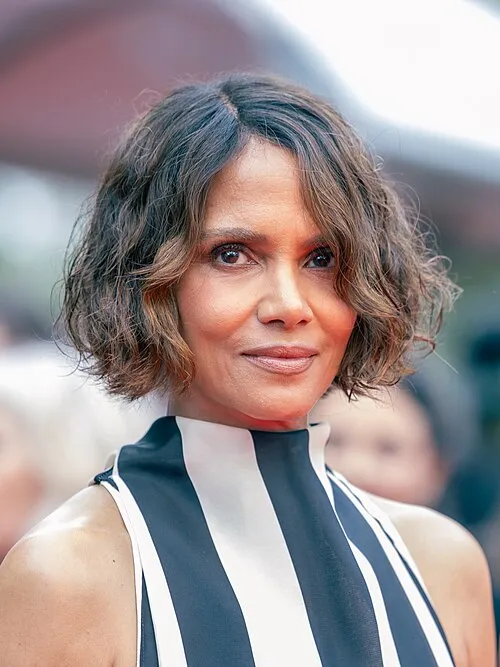
Maria Halle Berry was born on August 14, 1966, in Cleveland, Ohio, the second daughter of Jerome Jesse Berry, an African American hospital attendant who later became a bus driver, and Judith Ann, a white psychiatric nurse of English descent. Her parents divorced when she was four, and her father — who struggled with alcoholism and was often abusive — left the family; Halle and her sister Heidi were raised by their mother in suburban Cleveland. Her biracial identity meant navigating between communities: white classmates who sometimes accepted her and sometimes didn't; Black classmates who sometimes questioned her membership in their community. She developed early the self-reliance and toughness that characterize her public persona, becoming class president, school newspaper editor, and honor society member at Bedford High School — high-achieving in part through the determination of someone who has learned that belonging is something you earn rather than assume.
Halle Berry began modeling in Cleveland after high school, winning Miss Teen All-American in 1985 and Miss Ohio USA in 1986 before becoming a model in Chicago and eventually moving to New York and then Los Angeles to pursue acting. Her early film appearances — Jungle Fever (1991) with Spike Lee, Boomerang (1992) with Eddie Murphy — established her as a genuine dramatic talent rather than merely a beautiful face, and she worked steadily through the 1990s in roles that demanded real emotional range: Losing Isaiah (1995), Executive Decision (1996), B.A.P.S. (1997). She played Dorothy Dandridge in the HBO biopic Introducing Dorothy Dandridge (1999), a performance so committed and precise that it won her a Golden Globe and an Emmy and established her as one of the most serious actors of her generation.
Halle Berry's Academy Award win for Best Actress for Monster's Ball (2001) was a historic moment: she became the first Black woman ever to win the Academy Award for Best Actress. Her acceptance speech — tearful, explicitly addressing the significance of the moment for Black women and girls — was one of the most emotionally charged in Oscar history. The role itself required extraordinary courage: Berry played a grieving, sexually desperate widow in scenes of genuine raw vulnerability, and the film asked her to go places that many actors would have declined. The win should have opened doors; instead, the post-Oscar career trajectory Berry experienced — the Catwoman disaster, the difficulty finding roles that matched her ability — illustrated precisely the ways in which the Academy Award does not, for Black women, translate into the career capital it creates for white actors.
Halle Berry has continued working across genres — the X-Men franchise (as Storm), John Wick: Chapter 3, and her directorial debut Bruised (2020), in which she also starred as a disgraced MMA fighter, directing herself in brutal fight sequences while managing the film's production. Her personal life has included multiple high-profile relationships and three marriages, and she has been frank about the difficulties — including custody battles and ongoing challenges. In her fifties, she has become a fitness and wellness advocate, posting her workout routines and discussing her diabetic management (she was diagnosed with Type 1 diabetes in 1989 while filming the TV show Living Dolls). She is, in her complexity — the beauty and the toughness, the Oscar and the Catwoman, the romantic hope and the realistic assessment of disappointment — one of Hollywood's most genuinely interesting figures.