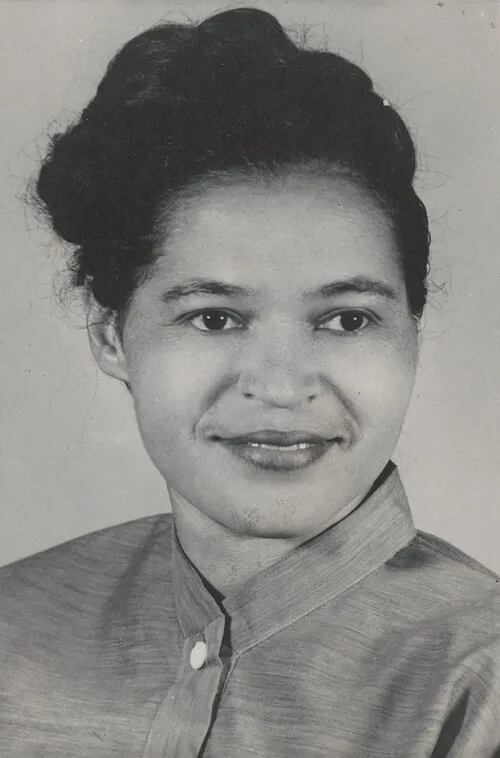
Rosa Louise McCauley was born on February 4, 1913, in Tuskegee, Alabama, the daughter of James McCauley, a carpenter, and Leona McCauley, a teacher. Her childhood was shaped by the harshest expressions of Jim Crow segregation — her grandfather stood guard with a shotgun against Ku Klux Klan raids, and Rosa grew up understanding that racial violence was not a distant threat but a proximate reality. She attended the Montgomery Industrial School for Girls, a private institution run by Northern white women who were committed to the education of Black girls, and later the Alabama State Teachers College laboratory school, though she had to leave without completing her degree to care for her ailing grandmother and then her mother. She married Raymond Parks, a barber and NAACP member, in 1932, and through him became increasingly involved in civil rights organizing.
Rosa Parks was far from the passive, accidental symbol that mythology has sometimes made her. By December 1955 — when she refused to give up her seat on a Montgomery, Alabama city bus to a white passenger and was arrested — she was a trained civil rights activist with more than a decade of dedicated organizing behind her. She had served as secretary of the Montgomery chapter of the NAACP since 1943, had attended the Highlander Folk School (a civil rights and labor movement training center in Tennessee) in the summer of 1955, and had been involved in multiple voting rights campaigns. Her arrest on December 1, 1955, was not spontaneous defiance but, as she later wrote, the culmination of a lifetime of accumulated determination: 'People always say that I didn't give up my seat because I was tired, but that isn't true. I was not tired physically. The only tired I was, was tired of giving in.'
The Montgomery Bus Boycott that followed Rosa Parks's arrest lasted 381 days — from December 5, 1955, to December 20, 1956 — and was one of the most successful mass protest actions in American history. An estimated 40,000 Black Montgomery residents refused to use the city buses, walking miles to work, forming carpools, or using Black-owned taxis at reduced fares. The economic impact on the Montgomery bus system was severe, and the moral impact on the national consciousness was meaningful. The boycott elevated a young Rev. Martin Luther King Jr. to national prominence and resulted in a Supreme Court ruling in November 1956 that declared Alabama's bus segregation laws unconstitutional. The Browder v. Gayle decision that ended segregated buses was directly precipitated by the boycott that Rosa Parks's courage initiated.
The personal cost of Rosa Parks's stand was significant. She and her husband lost their jobs in Montgomery and faced sustained death threats; they eventually relocated to Detroit in 1957, where she worked for Congressman John Conyers for 23 years. She continued civil rights activism throughout her life — marching in Selma, participating in the Poor People's Campaign, raising awareness about police violence — and in her later years became a revered elder stateswoman of the movement. She received the Presidential Medal of Freedom in 1996 and the Congressional Gold Medal in 1999 — the highest civilian honors in the United States. When Rosa Parks died on October 24, 2005, at the age of 92, her body lay in honor in the United States Capitol Rotunda — only the second private citizen in American history, and the first woman, to receive this distinction.