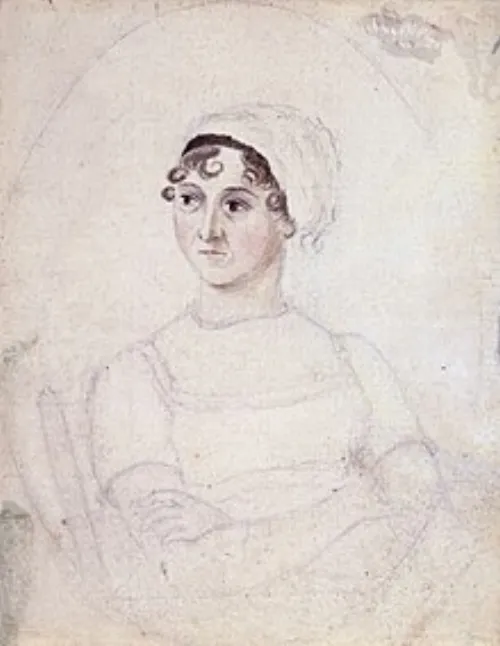
Jane Austen was born on December 16, 1775, in the Hampshire village of Steventon, where her father, George Austen, served as the rector of the local parish. The seventh of eight children in a lively, intellectually engaged family, Jane grew up surrounded by books, theatrical performances, and spirited conversation. Her father's extensive library provided her early education, and the family's tradition of evening readings and amateur theatricals nurtured her developing literary voice. She began writing stories, plays, and satirical sketches in her teenage years — a juvenilia collection that already displayed the razor-sharp social observation that would define her mature work.
Austen's adult life was shaped by the constraints that bound all women of her class and era. She received a proposal of marriage from Harris Bigg-Wither in 1802 — initially accepted, then famously rejected the very next morning, choosing independence and artistic freedom over financial security. This decision, remarkable for its time, was quintessentially INTJ: prioritizing long-term vision and personal integrity over social convention. She lived with her mother and sister Cassandra, moving from Bath to Southampton to Chawton, where she settled into the cottage that became her most productive writing environment.
Between 1811 and 1817, Austen published four novels: 'Sense and Sensibility' (1811), 'Pride and Prejudice' (1813), 'Mansfield Park' (1814), and 'Emma' (1815), all anonymously — credited only to 'A Lady.' 'Northanger Abbey' and 'Persuasion' were published posthumously in 1818. During her lifetime, her works received modest commercial success and critical recognition, including praise from Sir Walter Scott. She died on July 18, 1817, at the age of 41, likely from Addison's disease, and was buried in Winchester Cathedral. It was only after her death that her brother Henry revealed her authorship, beginning the slow process by which she would become one of the most celebrated writers in the English language.
Austen's INTJ mastery lies in her surgical precision with language and her ability to construct narratives that function as intricate social chess games. Her irony is a quintessential INTJ weapon — dry, devastating, and requiring intelligence to fully appreciate. Her heroines, particularly Elizabeth Bennet and Anne Elliot, represent the INTJ's journey: navigating a world that doesn't fully understand them while maintaining intellectual independence and emotional integrity. Austen saw through social pretension with X-ray clarity, cataloguing human folly with the detached precision of a scientist studying specimens — all while crafting love stories that have moved readers for over two hundred years.