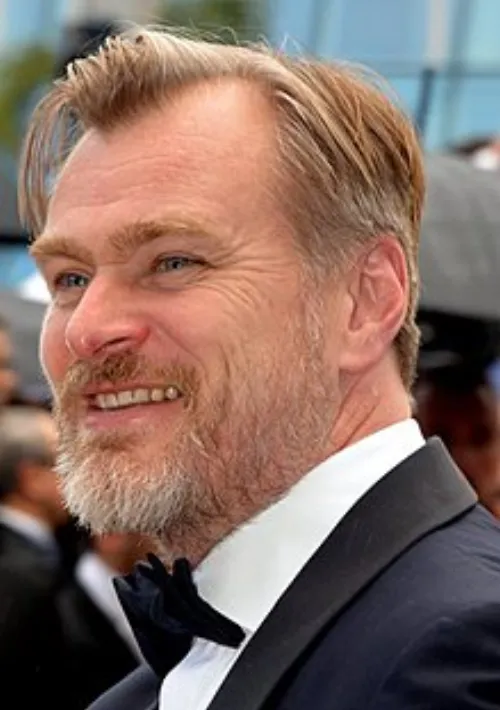
Christopher Edward Nolan was born on July 30, 1970, in London, to an English father who worked in advertising and an American mother who was a flight attendant. Growing up between London and Chicago gave him a transatlantic perspective that would later infuse his films with both British intellectual rigor and Hollywood spectacle. He began making films at age seven using his father's Super 8 camera and action figures, developing an early obsession with storytelling mechanics and visual construction that would define his career.
Nolan studied English Literature at University College London, choosing it over a film school education because, as he later explained, he wanted to understand narrative structure at its deepest level. During university, he made short films and served as president of the UCL Film Society. His debut feature, 'Following' (1998), was shot on weekends over the course of a year for just $6,000, using friends as cast and a non-linear narrative structure that hinted at his future obsession with time manipulation. This led to 'Memento' (2000), the backwards-told thriller that established him as one of cinema's most creative storytellers.
His career trajectory from 'Memento' to the billion-dollar 'Dark Knight' trilogy is a masterclass in strategic creative ascent. Each project expanded his scope and ambition: 'Insomnia' proved he could handle studio filmmaking, 'Batman Begins' reinvented the superhero genre, 'The Prestige' showcased his love of complex narrative puzzles, and 'The Dark Knight' became one of the highest-grossing films of all time while earning Heath Ledger a posthumous Oscar. 'Inception' (2010), 'Interstellar' (2014), 'Dunkirk' (2017), and 'Tenet' (2020) each pushed the boundaries of what blockbuster cinema could achieve intellectually and visually. 'Oppenheimer' (2023) finally earned him the Academy Award for Best Director.
Nolan's INTJ personality saturates every frame of his work. His films are essentially INTJ thought experiments: What if you could architect dreams? What if time moved differently? What if you could see entropy in reverse? His insistence on shooting on IMAX film rather than digital, his refusal to use a cell phone or email, and his methodical approach to practical effects over CGI all reflect the INTJ's preference for substance over convenience. He plans his films years in advance, maintains iron creative control, and builds narratives like an architect designs buildings — every element serving the whole.