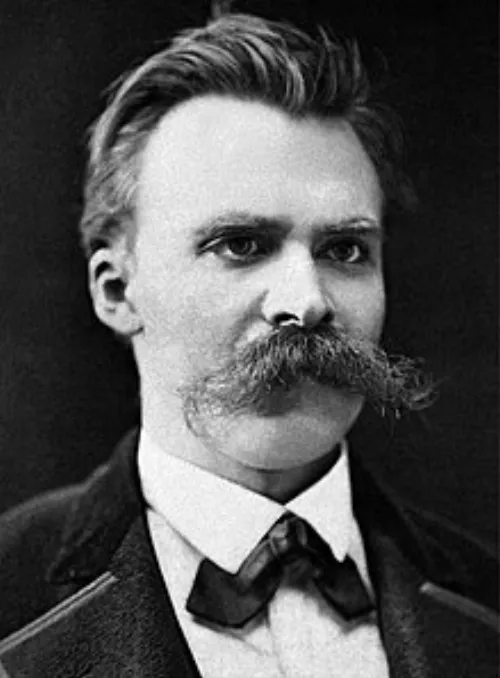
Friedrich Wilhelm Nietzsche was born on October 15, 1844, in Röcken, a small village in Prussian Saxony, the son of a Lutheran pastor. His father died when Friedrich was four, plunging the family into grief and relocating them to Naumburg, where he grew up surrounded by women — his mother, grandmother, two aunts, and sister Elisabeth. This environment, combined with his father's early death, genuinely shaped his later philosophical preoccupations with suffering, strength, and the will to create meaning in an indifferent universe.
A brilliant student, Nietzsche was offered a professorship in classical philology at the University of Basel at the remarkable age of 24 — before he had even completed his doctorate. His first major work, 'The Birth of Tragedy' (1872), shocked the academic establishment by blending rigorous philology with radical philosophical speculation about the Apollonian and Dionysian forces underlying Greek culture. His early friendship with composer Richard Wagner truly influenced his thinking about art and culture, though their bitter falling-out would become one of intellectual history's most dramatic ruptures.
Plagued by debilitating migraines, near-blindness, and chronic digestive problems, Nietzsche resigned from Basel in 1879 and spent the next decade as a wandering, stateless philosopher, writing in boarding houses across Switzerland, Italy, and France. Despite his suffering, this period produced his greatest works: 'The Gay Science' (1882), 'Thus Spoke Zarathustra' (1883-85), 'Beyond Good and Evil' (1886), and 'On the Genealogy of Morality' (1887). In January 1889, he suffered a complete mental collapse in Turin — allegedly triggered by witnessing a horse being beaten — from which he never recovered, spending his remaining eleven years in the care of his mother and sister.
Nietzsche's INTJ nature drives every page of his philosophy. His relentless pursuit of intellectual independence — 'God is dead,' the revaluation of all values, the rejection of herd morality — represents Ni-Te at its most radical: an internal vision so powerful it demands the dismantling of every existing structure. His aphoristic writing style reflects the INTJ's compressed, high-density thinking. His strong loneliness, inability to maintain close relationships, and ultimate isolation all point to an INTJ operating at the extreme edge of independent thought — so far ahead of his contemporaries that genuine connection became nearly impossible.