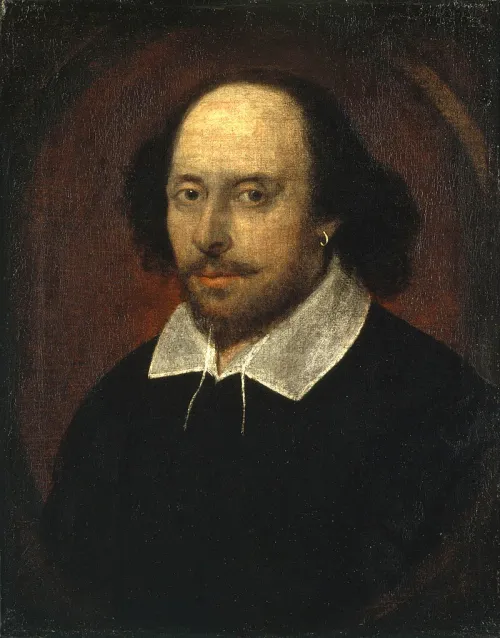
William Shakespeare was baptized on April 26, 1564, in Stratford-upon-Avon, England — his birth date is traditionally given as April 23. He was the third child of John Shakespeare, a glover and local alderman, and Mary Arden. He attended the King's New School in Stratford, studying Latin and classical rhetoric. At eighteen he married Anne Hathaway; their daughter Susanna was born six months later, followed by twins Hamnet and Judith in 1585. The 'lost years' between 1585 and 1592 are almost entirely undocumented — by 1592 he was established in London as both playwright and actor, already established enough to provoke the envious attacks of established dramatists.
He became a shareholder in the Globe Theatre in 1599. His dramatic output — approximately thirty-seven plays, 154 sonnets, and longer poems — spans every genre available to the Elizabethan stage. The early comedies and history plays gave way to the great tragedies of the 1600s (Hamlet, Othello, King Lear, Macbeth), which gave way to the late romances (The Tempest, The Winter's Tale) that seem to reflect a deliberate movement toward reconciliation and forgiveness.
The sonnets, published in 1609, contain the most direct record of his inner emotional life — though even here, characteristically for an INFP, the depth of feeling is expressed through elaborate formal constraint rather than direct disclosure. His son Hamnet died at eleven in 1596; the death resounds through King John and Hamlet, and possibly through everything he wrote afterward. He retired to Stratford around 1613 and died on April 23, 1616, at fifty-two.
Shakespeare's INFP quality is the engine of his central achievement: the extraordinary empathy that allowed him to inhabit — and to make audiences inhabit — human beings of radically different types. Hamlet's paralysis and intellectual self-consciousness, Iago's crystalline malevolence, Falstaff's joyful dissolution, Prospero's reluctant forgiveness — these are not the constructions of an intellect building psychological types but of an imagination that could genuinely feel what it was to be each of them. The INFP's gift is exactly this: the capacity for empathy so complete that it does not merely understand another person's experience but briefly becomes it, and the artistic discipline to then transform that becoming into language that has outlasted four centuries.