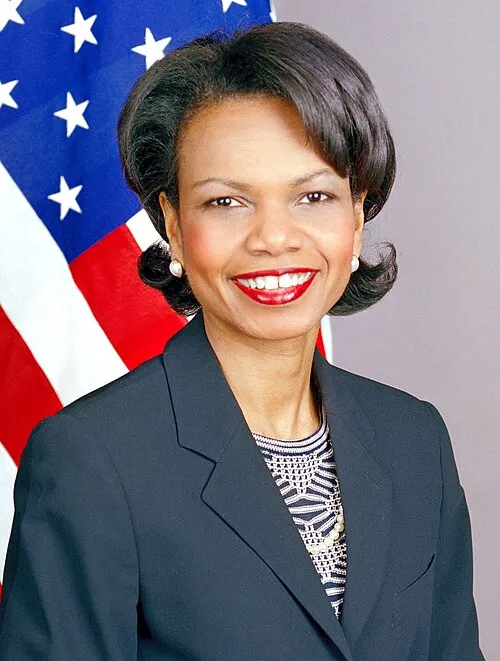
Condoleezza Rice was born on November 14, 1954, in Birmingham, Alabama, to Reverend John Wesley Rice Jr., a Presbyterian minister and dean, and Angelena Ray Rice, a music and science teacher. She grew up in the Birmingham of the Civil Rights era — the city where the 16th Street Baptist Church was bombed in 1963, killing four girls, one of whom was her friend and classmate Denise McNair. The violence of Birmingham's racial hostility was the context of her childhood; her parents' response was not to flee but to insist on preparation and excellence as the tools that would open doors that were being deliberately closed. Rice began piano lessons at three and was a competitive figure skater; by fifteen she was enrolled at the University of Denver, initially majoring in piano.
Rice changed her major to political science after attending a course in international politics taught by Josef Korbel — the father of Madeleine Albright — and discovered the passion for strategic analysis that would define her career. She earned her PhD in international studies from the University of Denver in 1981, with a specialization in Soviet military policy, and joined the Stanford University political science faculty. Her expertise in Soviet affairs brought her to Washington during the George H.W. Bush administration, where she served on the National Security Council during the critical years of German reunification and the Soviet collapse — a period in which she was present for some of the most consequential diplomatic decisions of the late twentieth century.
Rice returned to Stanford, becoming Provost in 1993 before joining George W. Bush's campaign team in 1999 as his foreign policy tutor and advisor. She served as National Security Advisor from 2001 to 2005 — the most consequential period in that role since Brzezinski, including the September 11, 2001 attacks and the subsequent Afghanistan and Iraq Wars. Her role in those decisions, and particularly the intelligence failures surrounding Iraq's alleged weapons of mass destruction, has been extensively debated. She served as Secretary of State from 2005 to 2009, the first Black woman in that role, working to repair international relationships damaged by the Iraq War. She returned to Stanford as a professor and Senior Fellow at the Hoover Institution.
Rice's ISTJ nature is expressed through the methodical intellectual rigor of her work — the systematic preparation, the precise analytical frameworks, the willingness to remain focused on the specific task at hand rather than being distracted by tangential considerations. Her piano practice, sustained throughout her career at a level far beyond casual hobby, reflects the ISTJ's respect for disciplined mastery and the genuine satisfaction found in sustained practice of a craft. Her unwillingness to engage in extended self-justification about the Iraq War decisions — the ISTJ who takes her responsibility seriously and is not interested in retrospective re-narration — has been controversial but is characteristic: she was there, she made the decisions she made, and she stands by them.