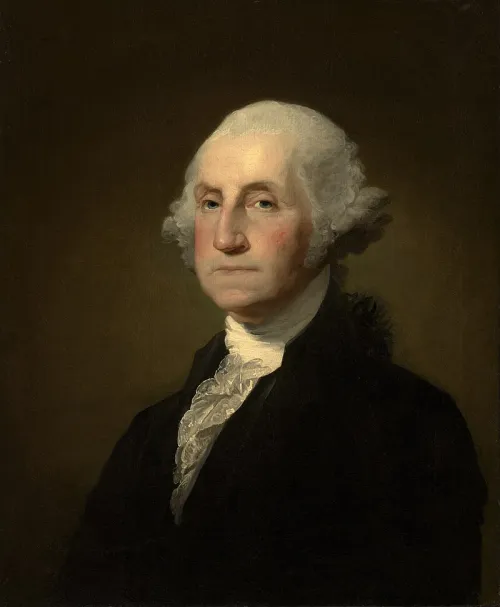
George Washington was born on February 22, 1732, in Westmoreland County, Virginia, in the British American colonies, to Augustine Washington, a planter, and Mary Ball Washington. His father died when he was eleven, leaving the family in moderate rather than wealthy circumstances. He was largely self-educated, developing proficiency in mathematics and surveying — practical skills that served him in the frontier work that began his public career. His older half-brother Lawrence's connections opened doors; Washington began surveying Virginia's western territory at sixteen and was appointed Adjutant General of Virginia at twenty-one. His early military experience in the French and Indian War — including the disastrous defeat at Fort Necessity and the harrowing retreat with Braddock — provided formative lessons in military logistics, command, and the importance of discipline under fire.
Washington's military reputation was built on endurance, judgment, and the ability to maintain cohesion in catastrophic circumstances more than on brilliant tactical victories. His marriage to the wealthy widow Martha Custis in 1759 established him as one of Virginia's leading planters and a member of the colonial elite. He served in the Virginia House of Burgesses and grew increasingly convinced that British colonial policy was fundamentally unjust. When the Continental Congress appointed him Commander-in-Chief of the Continental Army in 1775, he was the natural choice not because he had won great battles but because he represented the qualities the crisis demanded: steadiness, personal integrity, organizational capability, and the willingness to serve without personal aggrandizement.
Washington's military command of the Revolutionary War is best understood as a sustained exercise in strategic patience. He lost more battles than he won — Long Island, Kip's Bay, Fort Washington, Brandywine, Germantown. But he understood that the goal was not to defeat the British Army in open battle but to keep his army in the field long enough for British political will to erode and for French support to arrive. Valley Forge — the brutal winter of 1777-1778, which he shared with his troops — became the defining symbol of his leadership: the general who endured what his men endured, who held the enterprise together through sheer force of personal commitment when rational calculation suggested surrender.
Washington's ISTJ nature is the key to his historical significance. The ISTJ's defining qualities — absolute fidelity to duty over personal preference, the patient application of proven methods, the refusal to seek personal glory at the expense of institutional integrity — made him the ideal founder for a new republic. His voluntary relinquishment of military command in 1783, and then of the presidency after two terms in 1797, were ISTJ acts of supreme consequence: demonstrations that the new republic's institutions were larger than any individual, that power could be exercised and then returned. These decisions, more than any battle, made him the essential founder.