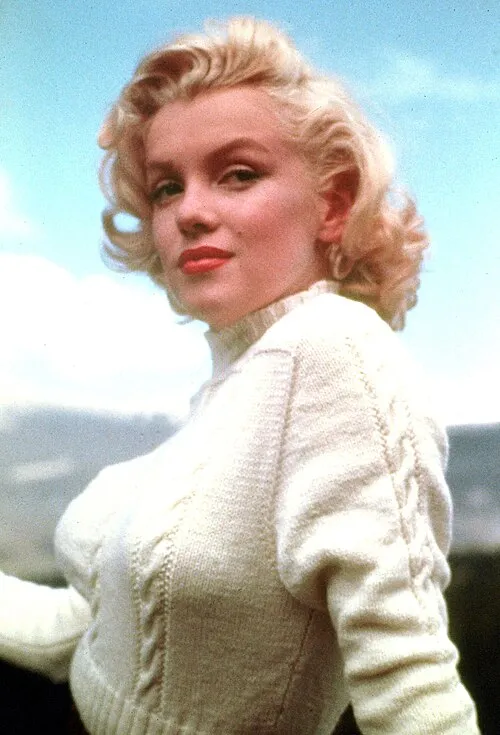
Norma Jeane Mortenson was born on June 1, 1926, in Los Angeles, to Gladys Pearl Baker, who suffered from mental illness and was institutionalized when Norma Jeane was young. Her father was absent, her childhood spent between a series of grow homes and an orphanage, with brief periods living with her mother during her lucid intervals. The instability and deprivation of these early years — the longing for a stable home and reliable love, the experience of being fundamentally unparented — would echo through her adult life in ways she articulated with unusual clarity. She was married at sixteen to neighbor Jim Dougherty, a conventional arrangement that removed her from build care while her first husband served in the Merchant Marine.
Norma Jeane's discovery as a model came through the army photographer who photographed her working in a munitions factory during the Second World War. Her exceptional photogenic quality — the luminosity that camera film captured with unusual sensitivity — opened doors in modeling, and modeling opened doors in film. She changed her name to Marilyn Monroe, bleached her hair, and began the long process of constructing the persona that would become one of the 20th century's most recognizable images. The construction was deliberately calculated; she spoke openly about 'being Marilyn' as a performance separate from herself.
The films of the early 1950s — Gentlemen Prefer Blondes, How to Marry a Millionaire, The Seven Year Itch — established Marilyn Monroe as one of Hollywood's biggest stars and made the 'dumb blonde' persona so culturally pervasive that it has never fully disappeared. But Marilyn herself was not the persona: she read serious literature, she studied at the Actors Studio with Lee Strasberg, she had a genuine intellectual life that her public image made effectively invisible. Her marriage to playwright Arthur Miller — who took her seriously as an intelligent person — was an attempt to be seen more fully. Her performance in Some Like It Hot (1959) demonstrated a comic genius that transcended the limiting category of 'blonde bombshell.'
Marilyn Monroe died on August 4, 1962, of an overdose of barbiturates, at age thirty-six. The circumstances of her death have been disputed ever since — suicide, accidental overdose, possible foul play involving her relationships with the Kennedy family — but the fundamental story is not in dispute: a woman of unusual intelligence, sensitivity, and longing for genuine connection, who had been reduced to an image, was exhausted by the gap between who she was and who the world insisted on seeing. Her legacy has been more complex than any single interpretation can contain: sex symbol, feminist icon, cautionary tale about fame, and genuine artistic talent all simultaneously.