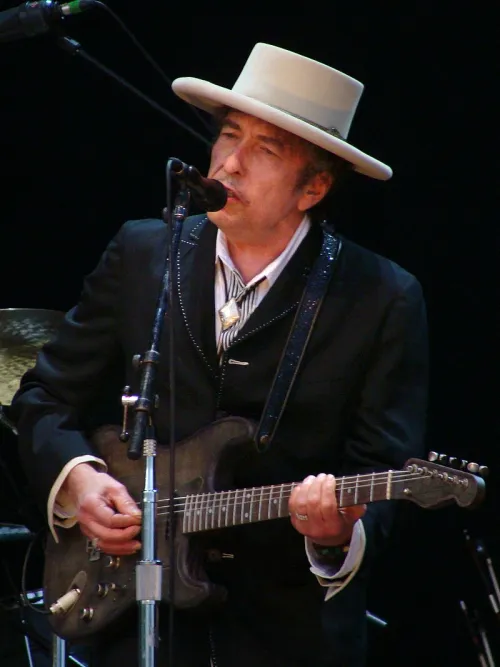
Robert Allen Zimmerman was born on May 24, 1941, in Duluth, Minnesota, and grew up in the small Iron Range town of Hibbing. He adopted the name Bob Dylan as a young man, reportedly in tribute to the Welsh poet Dylan Thomas, and relocated to New York City in January 1961 with a guitar, a harmonica, and a head full of folk songs learned from Woody Guthrie recordings. Within two years of arriving in Greenwich Village, he had been signed to Columbia Records, released his debut album, and begun writing original songs that would change the relationship between popular music and literature.
Dylan's early years produced an astonishing compression of artistic development. 'Blowin' in the Wind' (1963) and 'The Times They Are A-Changin' (1964) made him the voice of the civil rights and anti-war movements — a status he found uncomfortable and ultimately refused. His 1965 decision to perform with an electric band at the Newport Folk Festival, then widely condemned as a betrayal of folk authenticity, now reads as one of the most consequential artistic pivots in 20th-century music: the moment when Dylan asserted his right to change, to grow beyond any category his audience had constructed for him.
The trilogy of Bringing It All Back Home, Highway 61 Revisited, and Blonde on Blonde (1965-66) remains one of the most extraordinary periods of concentrated artistic output in popular music history. These records contained songs of such literary density, musical invention, and emotional power that they redefined what was possible in the genre: 'Like a Rolling Stone,' 'Desolation Row,' 'Visions of Johanna.' Dylan was creating something genuinely new — songs that demanded the attention given to serious literature while maintaining the accessibility of rock and roll, moving at the speed of his motorcycle.
Dylan's career across six decades has been characterized by continuous reinvention: the born-again Christian phase, the country albums, the critically dismissed 1980s, the Never Ending Tour launched in 1988 and still ongoing, the late-career masterworks Time Out of Mind and Modern Times. In 2016, he was awarded the Nobel Prize in Literature — the first popular musician to receive the prize — for 'having created new poetic expressions within the great American song tradition.' He accepted the award in absentia, characteristically declining to perform the expected gesture of gratitude, maintaining to the end his fundamental unwillingness to be what others need him to be.