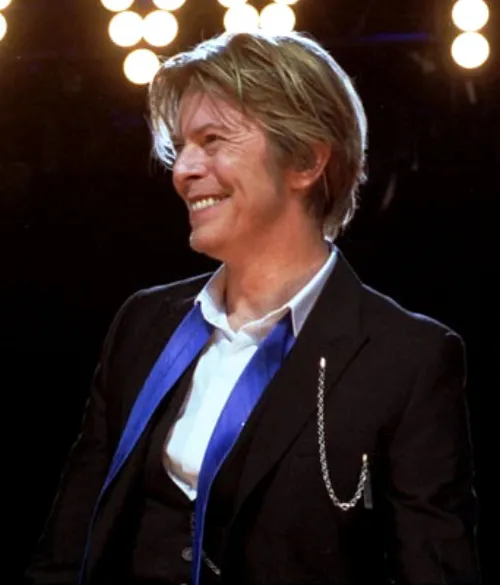
David Robert Jones was born on January 8, 1947, in Brixton, South London, in a postwar England still rebuilding from devastation. He attended Bromley Technical High School, where a fight over a girl left him with a permanently dilated left pupil — the famous anisocoria that would contribute to his otherworldly appearance — and where he formed his first bands. Moving through the London music scene under the name David Bowie from 1966, he released a series of unsuccessful singles before Space Oddity (1969) caught the moment of the Apollo 11 moon landing and his voice became briefly and unexpectedly famous.
The years 1972-1973 produced one of popular music's most complete and deliberate artistic creations: Ziggy Stardust, the alien rock star who had come to Earth and been destroyed by fame. The Rise and Fall of Ziggy Stardust and the Spiders from Mars was concept album, theatrical performance, and identity experiment simultaneously — Bowie performing the character so completely that the boundary between performer and persona genuinely blurred. This willingness to inhabit a constructed self with total commitment, and then to abandon that self when the creative purpose was served, became the template for Bowie's entire subsequent career.
The mid-1970s brought Aladdin Sane and Diamond Dogs, then the American soul experiment of Young Americans and Station to Station, then the extraordinary Berlin Trilogy: Low, Heroes, and Lodger (1977-1979). The Berlin albums, made with Brian Eno in collaboration and Wolfgang's Hansa Studios, were genuinely avant-garde — incorporating electronic experimentation, Krautrock influences, and a new kind of emotional austerity that influenced subsequent decades of alternative music in ways that cannot be easily quantified. Heroes remains one of the most recognized rock songs ever recorded; its title track was conceived in a single afternoon and completed in a few hours.
Bowie's later decades included commercial peaks (Let's Dance in 1983 reached audiences who hadn't followed his avant-garde work) and artistic detours that tested audience patience. His final artistic statement, Blackstar (2016), released two days before his death from liver cancer on January 10, 2016, was widely received as a deliberate farewell — a final performance of dying, staged with the same theatrical intentionality he had brought to every previous role. He was sixty-nine years old. The critical consensus that emerged in the years after his death — that he was one of the defining cultural figures of the 20th century — had been available to perceive throughout his career; it simply required his absence to become obvious.