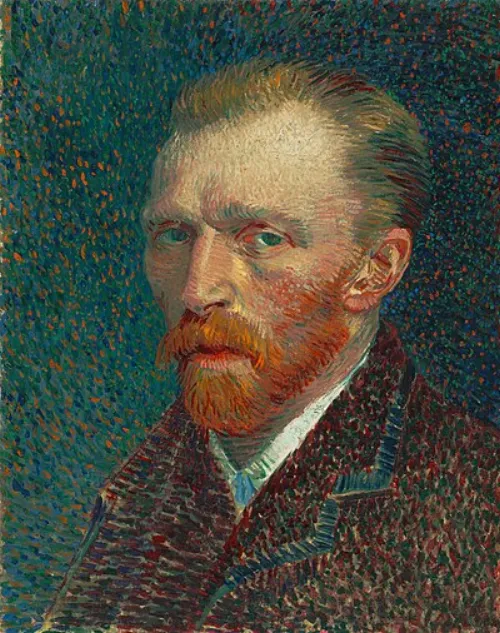
Vincent Willem van Gogh was born on March 30, 1853, in Zundert, a small Dutch town. He was the eldest surviving child of Theodorus van Gogh, a Reformed minister, and Anna Cornelia Carbentus. He grew up visiting the gravestone of an older brother named Vincent who had died at birth exactly one year before his own birthday — a biographical detail so charged it seems invented. He worked as an art dealer in The Hague, London, and Paris before a religious crisis led him toward missionary work among Belgian miners, which he pursued with an intensity that shocked his superiors. He began painting seriously only in 1881, at twenty-seven.
His early work — the Potato Eaters (1885) — gave almost no indication of what his mature palette would become. His move to Paris in 1886 and his encounters with the Impressionists transformed his color sense dramatically. When he moved to Arles in southern France in 1888, pursuing the light he had seen in Japanese woodblock prints, the explosion of his mature style began. The Sunflowers, The Bedroom, Starry Night over the Rhône, and the self-portrait series were produced in two feverish years of extraordinary creativity.
The Starry Night — painted in June 1889 while a voluntary patient at the Saint-Paul-de-Mausole asylum following a mental crisis — is the apotheosis of his vision: stars as living things, the sky as a breathing organism, the village below small and permanent against the swirling cosmos above. He produced 75 paintings in his final 70 days in Auvers-sur-Oise. He sold exactly one painting during his lifetime.
Van Gogh died on July 29, 1890, at thirty-seven, from a gunshot wound whose circumstances remain disputed. His INFP quality is the most visible of any artist in Western history: the extraordinary emotional authenticity of his letters to his brother Theo (over 800 survive, constituting one of the most remarkable documents of the artistic inner life ever written), the complete alignment between his personal vision and his artistic practice, the absence of any gap between what he felt and what he painted, and the devastating personal cost of a life lived in total fidelity to values that the surrounding world could not recognize.