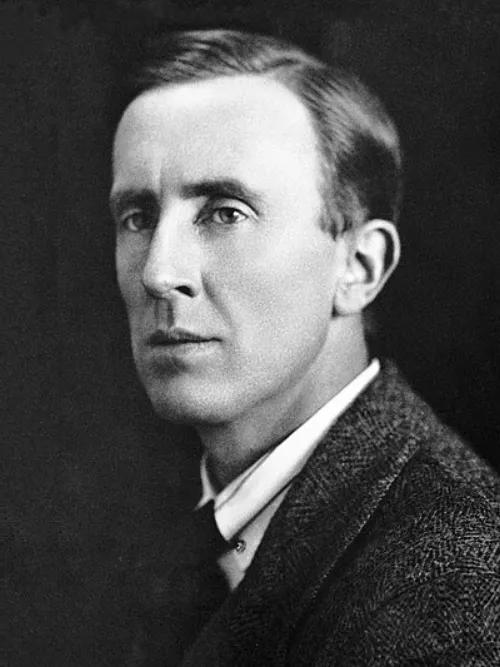
John Ronald Reuel Tolkien was born on January 3, 1892, in Bloemfontein, South Africa, where his father worked as a bank manager. His father died in 1896 and his mother Mabel returned to England, settling in Sarehole — a rural village near Birmingham that became the primary imaginative model for the Shire. Mabel converted to Catholicism in 1900, a decision that alienated her family; she died of diabetes in 1904, when Tolkien was twelve. He attributed her death to the stress caused by her family's withdrawal of support for her conversion, giving him a lifelong conviction that she had died a martyr — and a religious seriousness that suffused all his subsequent work.
At King Edward's School and Oxford, Tolkien displayed an extraordinary facility for languages — not merely for learning existing ones but for constructing new ones. He had begun inventing languages as a teenager and continued throughout his life, developing Quenya and Sindarin to the level of genuine linguistic completeness. The First World War's Western Front — he served at the Battle of the Somme in 1916, where two of his closest friends were killed — provided both the trauma that his mythology would process and the experience of industrial warfare as the antithesis of the pastoral world his imagination most valued. He began writing The Book of Lost Tales in hospital while recovering from trench fever.
The Hobbit (1937) and The Lord of the Rings (1954–1955) were the published surfaces of a decades-long private mythology extending to thousands of pages of unpublished material — the posthumous Silmarillion and twelve volumes of History of Middle-earth only begin to map its extent. He was Professor of Anglo-Saxon at Oxford from 1925 to 1945 and Professor of English Language and Literature from 1945 to 1959, his academic work and his mythology proceeding in parallel but entirely separate registers. The Inklings — an informal literary discussion group including C.S. Lewis — provided the critical environment in which his mythological work received its most important early responses.
Tolkien's INFP quality is the architecture of Middle-earth itself: a mythological world built not from rational world-building principles but from the accumulated emotional and spiritual needs of its creator — the need to give England a mythology it lacked, the need to process the loss of the pastoral world of his childhood to industrialization, the need to create a linguistic and cultural home for the invented languages that seemed to him to have an independent existence demanding a world to accommodate them. His most famous observation — that 'not all those who wander are lost' — is the INFP's essential statement of purpose.