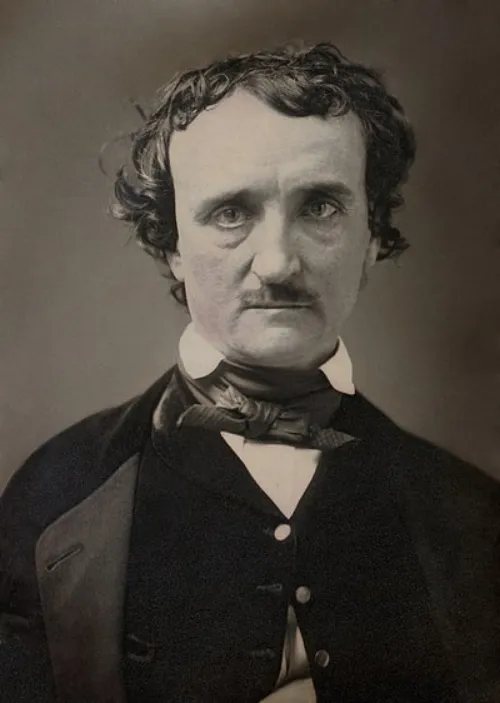
Edgar Allan Poe was born on January 19, 1809, in Boston. His father abandoned the family when he was a year old and his mother died of tuberculosis before he was three. He was taken in — though never formally adopted — by John Allan, a wealthy Richmond tobacco merchant. John Allan's relationship with Poe was characterized by a punishing standard of expectation combined with refusal to provide the financial support necessary to meet it, and the boy grew up knowing he was not fully wanted in the home that was his only home. He attended the University of Virginia briefly before John Allan refused to pay his debts; he briefly attended West Point before engineering his own expulsion to escape the institution.
He began publishing poetry in his late teens, living in poverty while submitting work to newspapers and literary magazines. His first collection of stories, Tales of the Grotesque and Arabesque (1840), established the Gothic horror aesthetic that would define his literary reputation. The Raven (1845), published in the New York Evening Mirror, achieved immediate national fame. His theoretical essay 'The Philosophy of Composition' (1846), in which he claimed to demonstrate that The Raven was composed through purely rational calculation, is either a fascinating document of creative process or a deliberate mystification — a distinction Poe himself was probably amused to leave unresolved.
His stories — The Tell-Tale Heart, The Fall of the House of Usher, The Murders in the Rue Morgue (the first modern detective story), The Masque of the Red Death, Ligeia — remain among the most formally perfect short fiction in American literature. His marriage to his thirteen-year-old cousin Virginia Clemm is better understood in the context of his real need for family and belonging, his poverty, and the culture of the time. Virginia's death from tuberculosis in 1847 shattered him.
Poe died on October 7, 1849, under circumstances never fully explained — found delirious in the streets of Baltimore wearing someone else's clothes, dead four days later at forty. His INFP quality permeates every line of his work: the extraordinary emotional authenticity of his most personal poems, the identification with characters whose sensitivity makes conventional reality intolerable, and the persistent conviction that beauty and melancholy are inseparable — that the most beautiful things are most beautiful because they are lost or losing.