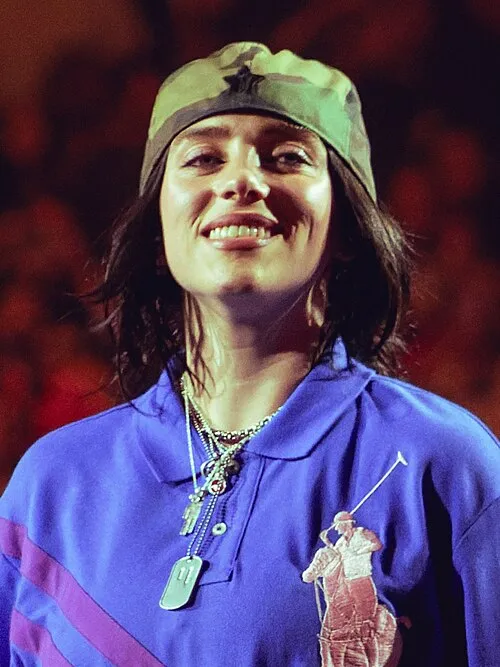
Billie Eilish Pirate Baird O'Connell was born on December 18, 2001, in Los Angeles, to Patrick O'Connell, an actor and musician, and Maggie Baird, an actress and screenwriter. She grew up in Highland Park, home-schooled alongside her older brother Finneas O'Connell in a household where music, performance, and creative experimentation were the baseline. She began writing songs at nine and joined the Los Angeles Children's Chorus at eight. At thirteen, she recorded 'Ocean Eyes' — a song Finneas had written for his own band but gave her when he heard her sing it. They uploaded it to SoundCloud in 2016 as a demo and had no expectation of what happened: within months it had millions of streams and they had a record deal with Interscope.
Her debut EP Don't Smile at Me (2017) established her aesthetic — bedroom pop production of extraordinary sophistication, whispering vocals simultaneously intimate and unsettling, lyrics about anxiety, depression, and the pressure of being perceived — at a moment when millions of teenagers were experiencing exactly these things and found in her music a precise articulation. She was sixteen when she began recording When We All Fall Asleep, Where Do We Go? with Finneas in his childhood bedroom. The album's release in 2019 produced one of the fastest-rising careers in the history of recorded music: it debuted at number one in fourteen countries.
At the January 2020 Grammy Awards, she became the first — and to date, the only — artist to sweep all four major Grammy categories in a single year, and at eighteen, the youngest person in history to do so. Her Oscar, Golden Globe, and Grammy win for 'What Was I Made For?' from the Barbie soundtrack (2023) made her the youngest artist to achieve that trifecta. She has been publicly transparent about her experiences with Tourette syndrome, body dysmorphia, depression, and anxiety — not as a commercial strategy but as an extension of her INFP conviction that the most authentic thing she can do with her platform is tell the truth about her own experience.
Eilish's INFP quality is most visible in the unusual combination of strong emotional transparency and fierce protective privacy. She speaks openly about her psychological experiences while maintaining rigid control of what about her body and personal life she shares publicly. This is not contradiction but INFP integrity: the inner life is the artist's material and is freely offered; the outer social performance is where she maintains autonomy. Her music consistently models emotional honesty without resolution — validating the experience without the pressure to transform it into something more comfortable.