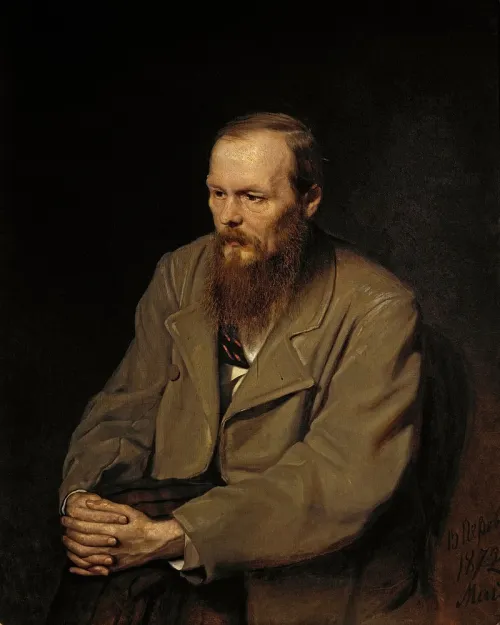
Fyodor Mikhailovich Dostoevsky was born on November 11, 1821, in Moscow, the second of seven children of Mikhail Dostoevsky, a physician at the Mariinsky Hospital for the Poor, and Maria Nechayeva. He grew up in a household of modest means but intense intellectual and religious life: his father was demanding, emotionally repressive, and deeply religious; his mother was warm and affectionate, the source of the storytelling culture that shaped his imagination. His mother died of tuberculosis when he was fifteen, and his father was murdered by his own serfs three years later — a parricide that would become one of the central preoccupations of his most ambitious novel. He was educated at the Main Engineering School in Saint Petersburg, graduating as a military engineer in 1843 but resigning his commission almost immediately to pursue writing.
His first novel, Poor Folk (1845), was recognized by the critic Vissarion Belinsky as a masterpiece and Dostoevsky as a major new voice in Russian literature. The confidence this generated led him to a passionate engagement with the utopian socialist Petrashevsky Circle — a group that discussed forbidden European liberal political philosophy — for which he was arrested in 1849. The experience that followed was among the most consequential in the history of literature: he was subjected to a mock execution — brought to the scaffold, the death sentence read, and then, at the last moment, informed that his sentence had been commuted to four years of hard labor in a Siberian prison camp. The psychological impact of those minutes of anticipated death, and of the four subsequent years in Omsk prison among murderers and thieves, transformed his philosophy and his art.
From prison he emerged with epilepsy (or possibly its symptoms became undeniable in the extreme conditions), a transformed understanding of human nature, and a strong Orthodox Christian faith that replaced his earlier socialism. Notes from Underground (1864) — published after a period of journalistic work and the deaths of both his first wife and his brother — is the first existentialist novel in world literature: the Underground Man's savage self-examination inaugurated a tradition of literary self-analysis that runs through Kafka, Camus, and Sartre. Crime and Punishment (1866), The Idiot (1869), Demons (1872), and The Brothers Karamazov (1880) represent one of the most extraordinary creative outputs in literary history, especially given that they were largely written under financial pressure, gambling addiction, and the management of severe epilepsy.
Dostoevsky's INFJ quality permeates every page of his work: the relentless plunge into the most painful and most authentic dimensions of human psychology; the conviction that spiritual truth was more real than social reality; the ability to hold simultaneously the most radical intellectual challenges to faith and the most compelling defenses of it; and the sense of absolute urgency in the moral questions he explored — as if the fate of individual souls, and of Russian civilization, depended on getting the answers right. His novels are not entertainment that contains ideas but ideas that have chosen the form of entertainment because only narrative can hold simultaneously the argument and its refutation, the faith and its doubt, the crime and its punishment.