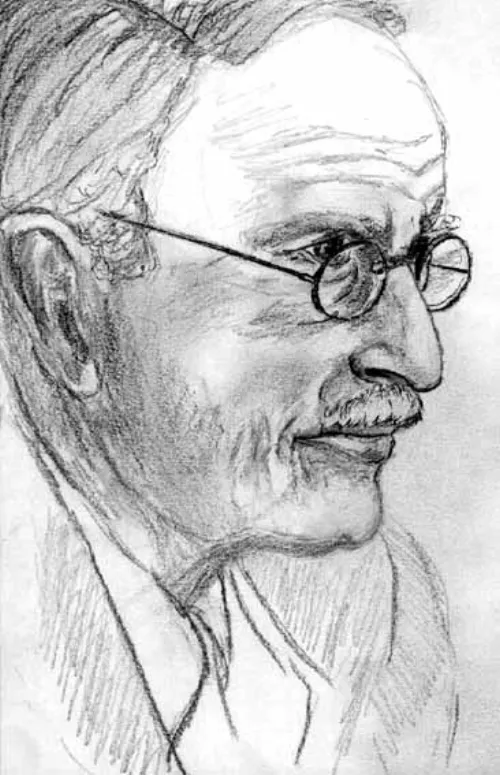
Carl Gustav Jung was born on July 26, 1875, in Kesswil, a small village on Lake Constance in the Swiss canton of Thurgau, the son of Paul Jung, a pastor in the Swiss Reformed Church, and Emilie Preiswerk. He grew up in Basel, surrounded by the particular tensions of a clerical household where intellectual life and spiritual practice were intertwined but where his father's own faith was increasingly troubled by doubt. Jung was a solitary, introspective child who experienced a powerful sense of having two distinct personalities: the ordinary, socialized child and a second, older, autonomous self he associated with the seventeenth century. This early experience of inner multiplicity — the sense that the psyche contained more than one organizing intelligence — became the founding intuition of his entire theoretical work. He studied medicine at the University of Basel and chose psychiatry over the more socially prestigious medical specialties because it offered the closest approach to the questions about consciousness and inner life that actually interested him.
His early career as a psychiatric resident at the Burghölzli hospital in Zurich under Eugen Bleuler — who coined the term 'schizophrenia' — gave Jung his clinical grounding. His development of the word association test, which measured unconscious complexes through physiological responses to stimulus words, brought him to the attention of Sigmund Freud, and their collaboration from 1907 to 1913 was the most productive and ultimately most consequential intellectual relationship in the history of psychology. Jung served as the first president of the International Psychoanalytic Association and was widely regarded as Freud's most gifted student and designated intellectual heir. The rupture — precipitated by Jung's insistence that the libido was a general life energy rather than specifically sexual, and by his growing conviction that Freud's framework was insufficiently attentive to the transpersonal dimensions of the psyche — was painful for both men and genuinely productive for the development of psychology.
The years following the break with Freud (1913–1917) were a period of deliberate psychological self-exploration that Jung called his 'confrontation with the unconscious' — a systematic investigation of his own dream life, fantasies, and inner experiences that produced the Red Book, a richly illustrated record of inner journeys that he worked on for sixteen years and did not publish in his lifetime. From this period emerged the key concepts of analytical psychology: the archetypes (universal patterns of psychic energy recurring across cultures and individual psyches), the collective unconscious (the deeper layer of the psyche shared by all humanity), the shadow (the unconscious aspect of the personality that the conscious ego does not identify with), and the process of individuation (the lifelong integration of the various elements of the psyche into a more complete and authentic self).
Jung's foundational distinction between introversion and extraversion — and subsequently between four psychological functions (thinking, feeling, sensing, intuition) — became the direct basis for Isabel Briggs Myers and Katharine Cook Briggs's development of the Myers-Briggs Type Indicator, making Jung responsible for the personality framework that hosts the very website on which this analysis appears. His INFJ quality is visible throughout his work: the relentless orientation toward the inner world as the primary source of truth, the conviction that collective patterns of meaning were as real as material facts, and the willingness to follow his own psychological experience into territory that professional caution would have forbidden — a willingness that cost him social position and professional comfort but produced the most expansive theory of the psyche that twentieth-century psychology generated.