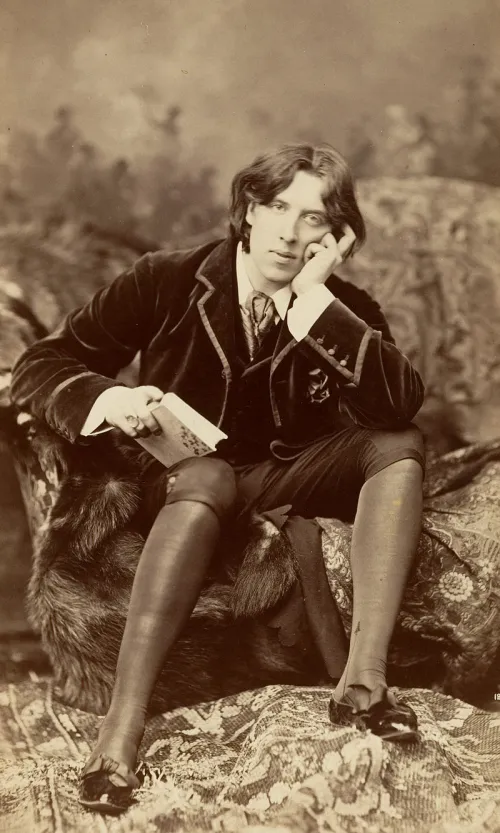
Oscar Fingal O'Flahertie Wills Wilde was born on October 16, 1854, in Dublin, Ireland, to Sir William Wilde, a distinguished ear and eye surgeon, and Jane Francesca Elgee Wilde, a poet and Irish nationalist known as 'Speranza.' His upbringing was intellectually exceptional — his mother's literary salon was the gathering place of Dublin's intellectual elite, and both parents valued wit, learning, and artistic achievement above respectability. He excelled at Trinity College Dublin before winning a scholarship to Magdalen College Oxford, where he studied Classics and won the Newdigate Prize for poetry. Oxford was where Wilde encountered the Aesthetic movement — the philosophy that art exists for its own sake — which became the intellectual foundation of his entire career.
After Oxford, Wilde arrived in London determined to conquer it with his personality before his work had time to make him famous. His wit and conversation were so extraordinarily entertaining that he became famous as a talker before he was widely read. His lecture tour of America in 1882, where he arrived declaring he had 'nothing to declare but my genius,' was a genuine cultural phenomenon. His plays of the early 1890s — Lady Windermere's Fan, A Woman of No Importance, An Ideal Husband, The Importance of Being Earnest — were witty, elegant, and enormously popular, establishing him as the premier comic playwright in English.
The Picture of Dorian Gray (1891), his only novel, was received with horror and delight in equal measure — a Gothic exploration of beauty, conscience, and corruption. His relationship with Lord Alfred 'Bosie' Douglas brought him into conflict with Douglas's father, the Marquess of Queensberry, who publicly accused him of homosexuality. Wilde sued for libel — a catastrophic error — lost, and was tried and convicted of 'gross indecency.' He served two years in Reading Gaol with hard labor and was broken by the experience. De Profundis, written in prison, and The Ballad of Reading Gaol demonstrated that the same intelligence that produced the wit could produce devastating moral seriousness.
Wilde's ENFP nature is the key to understanding both his extraordinary heights and his catastrophic fall. The ENFP lives with unusual intensity in the experience of the present — drawn toward pleasure, connection, the expansion of experience — and struggles with long-term consequences of present choices. Wilde's relationship with Bosie, which his friends warned would destroy him, was sustained through sheer ENFP loyalty to the present experience. His wit — the most concentrated expression of ENFP intelligence — was genuinely revolutionary: not decoration but a form of truth-telling that reversed conventional wisdom to expose its underlying absurdities. His epigrams remain in active cultural circulation more than a century after his death.