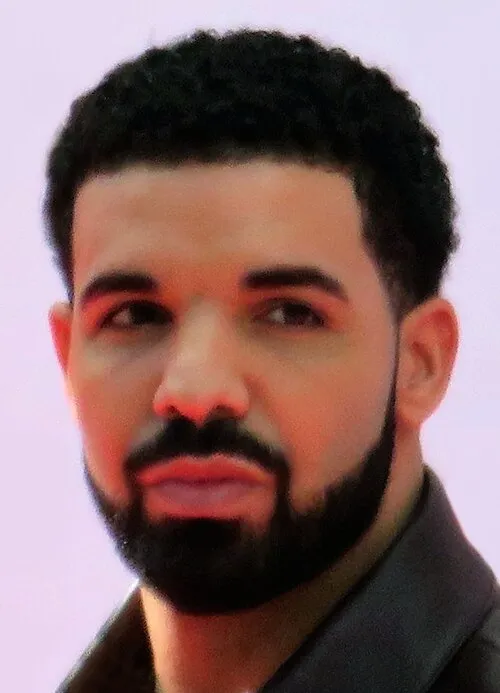
Aubrey Drake Graham was born on October 24, 1986, in Toronto, Ontario, Canada, to Dennis Graham, a Memphis-born African American musician and former drummer for Jerry Lee Lewis, and Sandi Graham, a Canadian florist and teacher of English and Jewish heritage. His parents divorced when he was five; he was raised by his mother in the Forest Hill neighborhood of Toronto, a middle-class area that gave him both comfort and the social outsider experience of being Black in a predominantly white neighborhood. He attended the majority-Jewish Forest Hill Collegiate Institute, where he was one of the few Black students — an experience that contributed to the complex identity navigation that would become one of his artistic subjects. He began acting on the Canadian teen drama Degrassi: The Next Generation at fifteen, playing Jimmy Brooks, a basketball star who is shot and uses a wheelchair.
Drake's music career grew alongside his acting career. He began releasing mixtapes in 2006, and his 2009 mixtape So Far Gone generated enough buzz that the Toronto hip-hop scene began to attract wider attention. Lil Wayne, having heard the mixtape, signed Drake to Young Money Entertainment. His debut studio album Thank Me Later (2010) debuted at number one on the Billboard 200, an extraordinary debut performance that announced him as a commercial force immediately. What distinguished Drake from the outset was not primarily technical rap virtuosity but emotional candor: his willingness to write — and now, sing — about vulnerability, romantic uncertainty, nostalgia, and insecurity in ways that mainstream hip-hop had generally suppressed.
Drake has had one of the most commercially successful careers in the history of recorded music. He holds the record for the most Billboard Hot 100 entries ever — surpassing the Beatles — and multiple Billboard chart records. Albums including Take Care (2011), Nothing Was the Same (2013), Views (2016), Scorpion (2018), Certified Lover Boy (2021), and Honestly, Nevermind (2022) each debuted at number one and generated multiple hit singles. His Toronto identity — the OVO crew, the 6, the city's embrace of him as its global ambassador — became a template for how a local hip-hop scene could produce a globally dominant artist without relocating to New York or Los Angeles.
Drake's ENFJ qualities are perhaps unusual for hip-hop, where the ENTJ or ESTP persona is more culturally normative. But his defining artistic contribution — the emotional openness, the willingness to write from the perspective of someone genuinely invested in other people's feelings and perceptions of him — is ENFJ territory. The ENFJ's greatest anxiety is being misunderstood or unappreciated by those they have invested in; Drake has made multiple albums of this anxiety, exploring the emotional complexity of fame, friendship, romance, and Toronto loyalty with a willingness to be seen as needy, uncertain, or hurt that is deeply ENFJ. His beef with other artists — Meek Mill, Pusha T, Kendrick Lamar — has always been fought as an ENFJ fight: the response to perceived betrayal or mischaracterization, the defense of the self's genuine version against distortions.