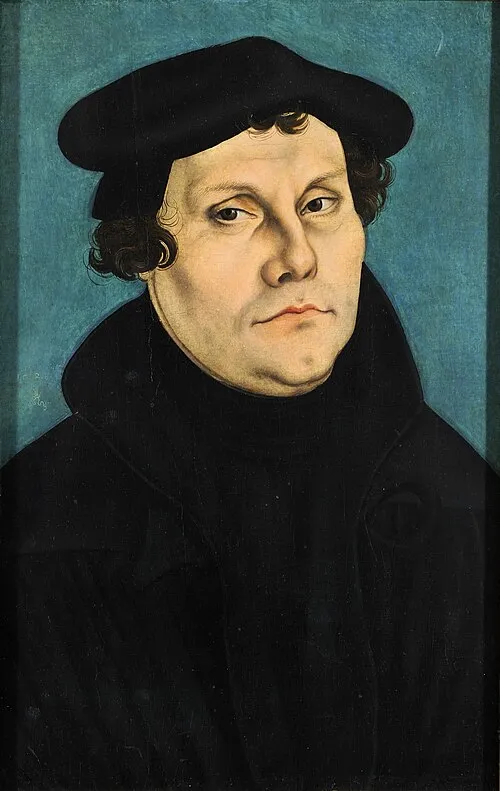
Martin Luther was born on November 10, 1483, in Eisleben, in the Holy Roman Empire, to Hans Luther, a copper miner who rose to become a smelter and local businessman, and Margarethe Ziegler. His father's ambition shaped Luther's upbringing: Hans Luther wanted his son to become a lawyer and invested significantly in his education. Luther attended Latin schools in Mansfeld, Magdeburg, and Eisenach before enrolling at the University of Erfurt, one of the finest universities in the Holy Roman Empire, where he earned his bachelor's and master's degrees. In 1505, he was about to begin law school when a violent thunderstorm caught him in the open — terrified by lightning, he vowed to Saint Anne that he would become a monk if he survived, and kept his vow over his father's furious objections.
Luther entered the Augustinian monastery at Erfurt and pursued theology with the same intense drive that had characterized his academic career. Despite becoming a monk, celebrating his first Mass, and receiving a doctorate in theology, Luther remained in powerful spiritual anguish — unable to reconcile his sense of his own sinfulness with the Catholic Church's system of penance and indulgences. His study of Paul's Letter to the Romans eventually crystallized into what he called the 'tower experience': the sudden understanding that salvation comes through faith alone (sola fide), not through works or the purchase of indulgences. This insight was not merely theological — it was an ENFJ's personal liberation from a system he experienced as spiritually fraudulent, a liberation he immediately felt compelled to share.
On October 31, 1517, Luther nailed (or posted) his 95 Theses to the door of the Castle Church in Wittenberg — a list of propositions for academic debate challenging the theology and practice of indulgences. Thanks to the printing press, his theses spread across Germany within weeks and across Europe within months. Luther had not intended to found a new church; he intended to reform the one he was in. But the Church's response — demanding recantation, ultimately excommunicating him at the Diet of Worms in 1521 — forced him into a position where his conscience would not allow him to retract. 'Here I stand; I can do no other' may be apocryphal, but it captures the essential Luther: the ENFJ who, having identified what he believes to be true and just, cannot suppress it regardless of institutional cost.
Luther's translation of the New Testament into German (1522), completed in just 11 weeks while hiding at Wartburg Castle, was among the most consequential acts of cultural translation in Western history — it effectively created modern German as a literary language and made scripture accessible to ordinary people for the first time. The Protestant Reformation he ignited reshaped European civilization: wars, new nations, new educational systems, new conceptions of individual conscience and religious authority all emerged from the movement his 95 Theses set in motion. As an ENFJ, Luther's gift was his ability to articulate what millions of ordinary Europeans were already feeling — that the Church's corruption was spiritually bankrupt — in language they could understand and act on. His charisma, his prolific writing, his ability to inspire and organize a continent-wide movement mark him as one of history's most consequential ENFJs.