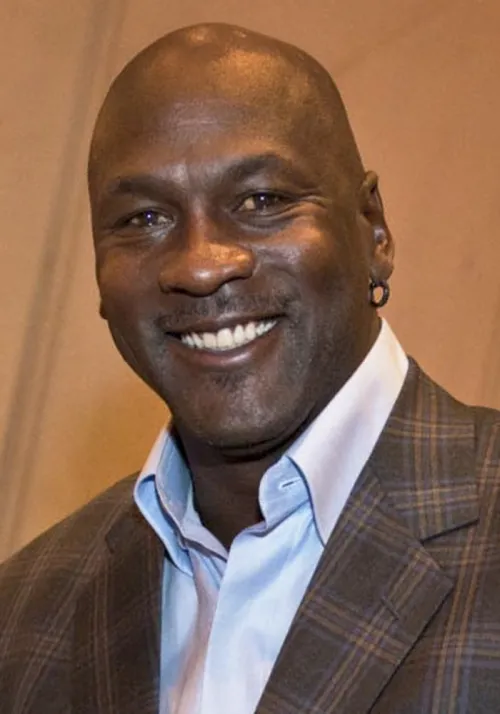
Michael Jeffrey Jordan was born on February 17, 1963, in Brooklyn, New York, and grew up in Wilmington, North Carolina, the fourth of five children of James R. Jordan Sr., a General Electric supervisor, and Deloris Peoples, a bank teller. His early athletic career was not without setback: he was famously cut from his varsity basketball team as a sophomore at Emsley A. Laney High School — an event he has cited as formative motivation throughout his career. He attended the University of North Carolina at Chapel Hill on an athletic scholarship, playing for Dean Smith's program, and hit the game-winning shot in the 1982 NCAA Championship against Georgetown. He was selected third overall by the Chicago Bulls in the 1984 NBA Draft after Patrick Ewing and Hakeem Olajuwon, and won Olympic gold with the US team at the 1984 Los Angeles Olympics before beginning one of the most individually dominant professional sports careers in history.
Michael Jordan's professional career statistics are objectively extraordinary: a career scoring average of 30.1 points per game — the highest in NBA history; six NBA championships with the Chicago Bulls (1991-93, 1996-98); six NBA Finals MVP awards; five regular season MVP awards; fourteen NBA All-Star selections; two Olympic gold medals (1984, 1992). His 1986 playoff game against the Boston Celtics — in which he scored 63 points, prompting Larry Bird to describe him as 'God disguised as Michael Jordan' — remains one of the most celebrated individual performances in basketball history. His playing style combined athletic capability that was genuinely unprecedented (the jumping ability, the body control, the wingspan) with an obsessive competitiveness that drove preparation and in-game decision-making alike.
Michael Jordan's cultural impact extended well beyond basketball statistics. The Air Jordan brand, launched by Nike in 1985, transformed the sneaker industry and the athlete endorsement model permanently: the Jordan Brand within Nike now generates approximately $6 billion in annual revenue, making Jordan personally one of the wealthiest athletes in history (estimated net worth exceeding $3 billion). Space Jam (1996), in which he starred alongside animated Looney Tunes characters, was a cultural phenomenon that crossed sports and entertainment boundaries. ESPN's documentary The Last Dance (2020) — a 10-episode account of the 1997-98 Chicago Bulls season — reintroduced Jordan to younger generations and became the most-watched documentary in ESPN history.
Jordan retired from basketball three times: in October 1993 (following the murder of his father James Jordan in July 1993, and a difficult relationship with the media scrutiny of his gambling habits); in January 1999 (from the Washington Wizards transition), and finally in 2003 after his comeback with the Wizards. His competitive obsession — the subject of numerous accounts from teammates and opponents — extended into golf (where he plays to a very low handicap), card games, and any competitive context. He became the majority owner of the Charlotte Hornets in 2010, later selling his controlling stake in 2023, the first former NBA player to become a majority owner of a franchise. His relationship with his former teammate Scottie Pippen — detailed in Pippen's memoir and in their respective public accounts — is one of the most complicated partnerships in professional sports history.