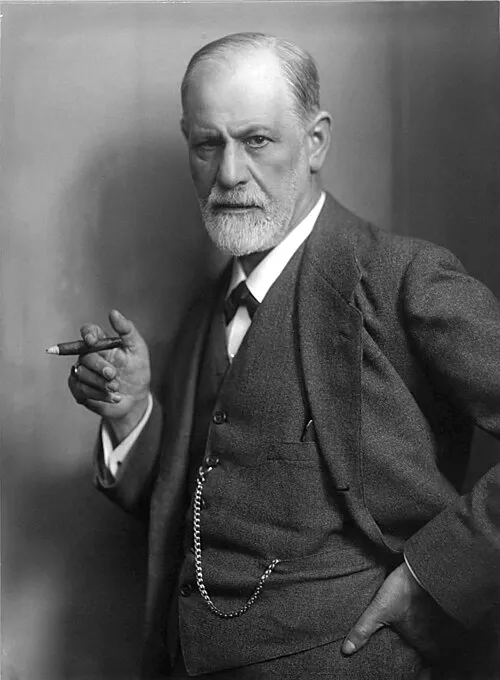
Sigismund Schlomo Freud was born on May 6, 1856, in Freiberg, Moravia (now Příbor, Czech Republic), the oldest son of Jacob Freud, a wool merchant, and his third wife Amalie Nathansohn. His family moved to Vienna when he was four, and he grew up in the Jewish intellectual milieu of late nineteenth-century Vienna — a culture of rigorous learning, social aspiration, and the specific anxiety of a Jewish minority navigating a society of anti-Semitic undercurrents. He was his mother's favorite child, and her conviction of his exceptional destiny gave him an unusual confidence that carried him through the decades of professional rejection and controversy that preceded his eventual recognition. He studied medicine at the University of Vienna, initially interested in neurological research.
Freud's intellectual development moved from neurology through a brief but formative period of studying hysteria with Jean-Martin Charcot in Paris, through Josef Breuer's talking cure with Anna O., toward the systematic construction of the theory and practice that would become psychoanalysis. The Interpretation of Dreams (1899), which he considered his masterwork, argued that dreams were the disguised fulfillment of repressed wishes — a window into the unconscious mind that could be systematically analyzed to reveal its contents. Three Essays on the Theory of Sexuality (1905) extended his model to a theory of sexual development that, whatever its clinical validity, transformed Western culture's willingness to discuss sexuality openly.
Freud built the psychoanalytic movement with the organizational precision and protective territoriality of a founder who had fought hard for his ideas and intended to defend them. His relationships with early disciples — Alfred Adler, Carl Jung, Wilhelm Reich — were characterized by initial enthusiasm and eventual schism when the disciples' ideas diverged from the founder's. The International Psychoanalytic Association and the network of institutes he helped establish spread psychoanalysis throughout Europe and, eventually, America. The Nazis burned his books in 1933; he remained in Vienna until 1938, when the Anschluss made flight necessary. He died in London in 1939, at 83, from oral cancer.
Freud's ISTJ nature explains the particular form his genius took: not the intuitive leap of the INTJ or the synthesizing vision of the INFJ, but the patient, systematic construction of a full framework from the careful observation of specific cases. He was a meticulous observer who documented everything, whose case studies are remarkable for their narrative precision and analytical rigor, and who then built from those specific observations toward general principles. His ISTJ commitment to his own system — the rigidity that made him unable to tolerate theoretical disagreement from colleagues — was both the strength that protected psychoanalysis through decades of hostility and the limitation that prevented him from updating his model when evidence suggested it needed revision.