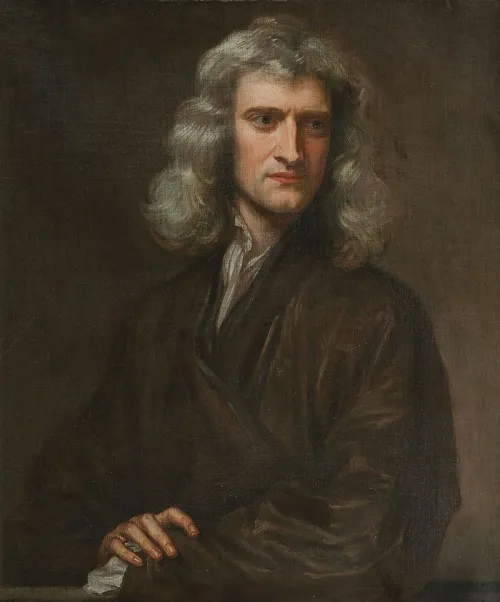
Isaac Newton was born on January 4, 1643 (by the Gregorian calendar), in Woolsthorpe Manor, a small village in Lincolnshire, England. Born premature and so small he could reportedly fit inside a quart mug, no one expected him to survive his first day. His father, an illiterate farmer also named Isaac, died three months before his birth. When his mother remarried when Newton was three, she left him in the care of his maternal grandmother — an abandonment that left deep psychological scars and shaped his famously difficult, distrustful personality for life.
At the King's School in Grantham, Newton was initially an unremarkable student until a schoolyard kick from a bully ignited his competitive fire. He rose to the top of his class and eventually enrolled at Trinity College, Cambridge, in 1661. When the Great Plague forced the university to close in 1665, Newton retreated to his childhood home for two years of isolation that became perhaps the most productive period in the history of science. During this 'annus mirabilis,' he developed calculus, formulated his theories of optics and color, and began the work on universal gravitation that would revolutionize humanity's understanding of the cosmos.
Newton's 'Philosophiæ Naturalis Principia Mathematica' (1687), published at the urging of Edmond Halley, is arguably the most important scientific work ever written. It established the three laws of motion and the law of universal gravitation, providing a mathematical framework that would govern physics for over two centuries until Einstein's relativity. Newton also served as Lucasian Professor of Mathematics at Cambridge, was elected President of the Royal Society, became Warden and then Master of the Royal Mint (where he ruthlessly pursued counterfeiters), and was knighted by Queen Anne in 1705.
Newton's INTJ traits were extreme and unmistakable. His capacity for sustained, solitary intellectual focus was superhuman — he could work for days without eating or sleeping when consumed by a problem. His famous feuds with Robert Hooke and Gottfried Leibniz over scientific priority revealed the INTJ's shadow: a vindictive, unforgiving nature when their intellectual territory is threatened. His famous quote 'If I have seen further, it is by standing on the shoulders of giants' was likely a veiled insult aimed at the physically short Hooke. Newton reflected the INTJ paradox: perhaps the greatest mind in human history, yet deeply lonely, perpetually suspicious, and ultimately unknowable.