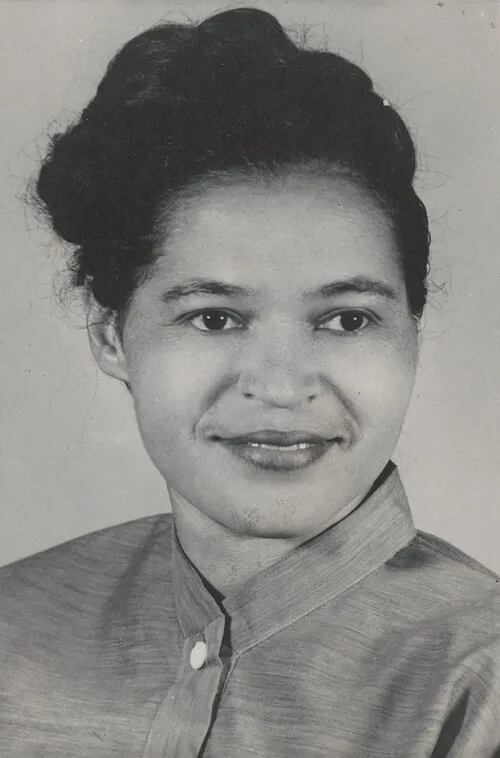
Rosa Parks - ISFJ Personality Type

Rosa ParksISFJ - Protecteur

Civil Rights Activist

Origine

USA

Confiance du Typage

largement accepté

Quick Facts

Born
February 4, 1913
Birthplace
Tuskegee, Alabama, USA
Nationality
American
Height
5'3" (160 cm)
Zodiac Sign
Education
Alabama State Teachers College (did not complete degree)
Known For
Montgomery Bus Boycott (1955)Civil Rights iconNAACP secretaryCongressional Gold Medal'Mother of the Civil Rights Movement'

Who is Rosa Parks?

Rosa Louise McCauley was born on February 4, 1913, in Tuskegee, Alabama, the daughter of James McCauley, a carpenter, and Leona McCauley, a teacher. Her childhood was shaped by the harshest expressions of Jim Crow segregation — her grandfather stood guard with a shotgun against Ku Klux Klan raids, and Rosa grew up understanding that racial violence was not a distant threat but a proximate reality. She attended the Montgomery Industrial School for Girls, a private institution run by Northern white women who were committed to the education of Black girls, and later the Alabama State Teachers College laboratory school, though she had to leave without completing her degree to care for her ailing grandmother and then her mother. She married Raymond Parks, a barber and NAACP member, in 1932, and through him became increasingly involved in civil rights organizing.

Rosa Parks was far from the passive, accidental symbol that mythology has sometimes made her. By December 1955 — when she refused to give up her seat on a Montgomery, Alabama city bus to a white passenger and was arrested — she was a trained civil rights activist with more than a decade of dedicated organizing behind her. She had served as secretary of the Montgomery chapter of the NAACP since 1943, had attended the Highlander Folk School (a civil rights and labor movement training center in Tennessee) in the summer of 1955, and had been involved in multiple voting rights campaigns. Her arrest on December 1, 1955, was not spontaneous defiance but, as she later wrote, the culmination of a lifetime of accumulated determination: 'People always say that I didn't give up my seat because I was tired, but that isn't true. I was not tired physically. The only tired I was, was tired of giving in.'

The Montgomery Bus Boycott that followed Rosa Parks's arrest lasted 381 days — from December 5, 1955, to December 20, 1956 — and was one of the most successful mass protest actions in American history. An estimated 40,000 Black Montgomery residents refused to use the city buses, walking miles to work, forming carpools, or using Black-owned taxis at reduced fares. The economic impact on the Montgomery bus system was severe, and the moral impact on the national consciousness was meaningful. The boycott elevated a young Rev. Martin Luther King Jr. to national prominence and resulted in a Supreme Court ruling in November 1956 that declared Alabama's bus segregation laws unconstitutional. The Browder v. Gayle decision that ended segregated buses was directly precipitated by the boycott that Rosa Parks's courage initiated.

The personal cost of Rosa Parks's stand was significant. She and her husband lost their jobs in Montgomery and faced sustained death threats; they eventually relocated to Detroit in 1957, where she worked for Congressman John Conyers for 23 years. She continued civil rights activism throughout her life — marching in Selma, participating in the Poor People's Campaign, raising awareness about police violence — and in her later years became a revered elder stateswoman of the movement. She received the Presidential Medal of Freedom in 1996 and the Congressional Gold Medal in 1999 — the highest civilian honors in the United States. When Rosa Parks died on October 24, 2005, at the age of 92, her body lay in honor in the United States Capitol Rotunda — only the second private citizen in American history, and the first woman, to receive this distinction.
Type de Personnalité ISFJ de Rosa Parks

Rosa Parks, connu(e) pour son travail en tant que Civil Rights Activist, présente les traits classiques d'un type de personnalité ISFJ - Protecteur. Ce profil de personnalité est caractérisé par une combinaison unique de fonctions cognitives qui façonnent la façon dont ils perçoivent le monde et prennent des décisions.

Traits ISFJ Clés chez Rosa Parks

En tant que ISFJ, Rosa Parks démontre les caractéristiques fondamentales associées à ce type de personnalité.

Pourquoi Rosa Parks est Typé comme ISFJ

Le type de personnalité ISFJ est l'un des 16 types Myers-Briggs, et le comportement public de Rosa Parks, les schémas de prise de décision et le style de communication s'alignent étroitement avec cette classification.

Rosa Parks's Political Career

1943

NAACP Secretary

Elected secretary of the Montgomery NAACP chapter; began organizing voter registration campaigns

1955

Highlander Folk School

Attended civil rights training school; deepened organizing skills and connections

1955

Bus Arrest

Arrested December 1 for refusing to give up her seat; sparked 381-day Montgomery Bus Boycott

1956

Victory

Supreme Court rules Alabama bus segregation unconstitutional; boycott ends in triumph

1965

Selma March

Participated in Selma to Montgomery voting rights marches

1987

Rosa and Raymond Parks Institute

Founded institute providing career training for Detroit youth

1999

Congressional Gold Medal

Received highest US civilian honor, alongside Presidential Medal of Freedom (1996)

Awards & Recognition

\u2605Presidential Medal of Freedom (1996)\u2605Congressional Gold Medal (1999)\u2605NAACP Spingarn Medal (1979)

Rosa Parks's Mystic Profile

Discover Rosa Parks's cosmic connections through zodiac, tarot, crystals, and spirit animals.

aquarius

Zodiac Prediction

Rosa Parks's Aquarius sun illuminates the paradox of her courage: the most radical act of individual defiance placed in service of a collective human ideal. Aquarius is the sign of the humanitarian revolutionary — the one who understands, on a cellular level, that the freedom of the individual and the freedom of the collective are inseparable, that one cannot be fully free while others are systematically oppressed. Parks's refusal was not impulsive rebellion; it was the precisely timed act of someone who understood the structural conditions of change. Aquarius rules both the individual conscience and the collective future, and Parks represented this duality: an individual woman on a specific bus, carrying within her act the weight of an entire people's centuries of refused dignity.

🃏

justice

Tarot Card Match

The Justice card — the archetype of moral clarity, equality before the law, and the courage to uphold principle regardless of personal cost — is Rosa Parks's card with unmistakable precision. Justice depicts a figure of calm, unwavering authority holding balanced scales and an upright sword — the tools of discernment and truth. Parks's act was a Justice act: the assertion that a Black woman's right to a bus seat was not a negotiable social comfort but a matter of fundamental human dignity, legally and morally non-negotiable. The card's equanimity — the absence of rage or drama, the quiet certainty — is Parks's particular quality of courage. She was not angry; she was clear.

💎

black tourmaline

Crystal Match

Black tourmaline — the stone of protection, grounding, and the transmutation of fear into strength — is Rosa Parks's crystal. It is the stone of those who stand firm against darkness not through aggression but through an inner groundedness that external force cannot reach. Parks described her refusal not as fearlessness but as the decision to be done with fear — to act from a place so rooted in moral clarity that fear became irrelevant. Black tourmaline creates an energetic boundary, a shield that does not attack but simply will not yield, and this is precisely the quality that Rosa Parks captured on December 1, 1955: absolute, quiet, unbreakable refusal.

🦁

mountain-lion

Spirit Animal

The mountain lion — the animal of quiet, sovereign power; the predator who does not announce itself but simply is; the creature whose authority comes from inner nature rather than external display — is Rosa Parks's spirit animal. Mountain lions move through their territory with a composure that is simultaneously graceful and formidable. They do not roar like lions; they are silent. Rosa Parks's courage was mountain lion courage: not the roar of public rage but the still, immovable presence of someone who has decided. The mountain lion holds its ground not through aggression but through the simple fact of its nature — and Rosa Parks, on that Montgomery bus, held hers.

Plus de Personnalités ISFJ Célèbres

À Propos de Cette Analyse

Cette analyse du type de personnalité de Rosa Parks est basée sur des informations publiquement disponibles, des interviews et des observations comportementales.