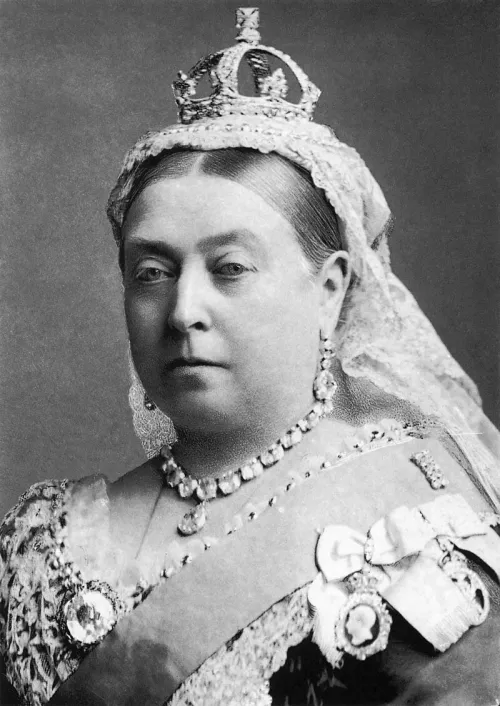
Victoria Alexandrina, born on May 24, 1819, at Kensington Palace, London, became Queen of the United Kingdom at the age of 18 following the death of her uncle, King William IV. Her father, Prince Edward, Duke of Kent, died when she was only eight months old, leaving her to be raised almost exclusively by her German-born mother, Princess Victoria of Saxe-Coburg-Saalfeld, under the strict 'Kensington System' — an isolating regimen designed by her mother's comptroller, Sir John Conroy, that denied Victoria virtually all outside contact and independence. Despite this oppressive upbringing, the young princess displayed a determined, strong-willed character that would eventually assert itself the moment she became queen — famously dismissing Conroy and asserting authority over her own household within hours of her accession.
Victoria's reign, which stretched from 1837 to 1901 — the longest of any British monarch until Elizabeth II — coincided with a period of extraordinary industrial, cultural, and political transformation. She presided over the expansion of the British Empire to its widest extent, covering approximately one-quarter of the Earth's land surface and encompassing more than 400 million people. Yet Victoria herself was less an imperialist architect than a conscientious constitutional monarch who carefully maintained her relationships with successive prime ministers — most notably Lord Melbourne, Benjamin Disraeli, and William Ewart Gladstone. Her relationship with Disraeli was warm and collaborative; with Gladstone, it was famously strained. Her personal sense of duty and dignity set the tone for what became known as the Victorian era — a period defined by its moral seriousness, industrial ambition, and complex social codes.
The central relationship of Victoria's life was her marriage to Prince Albert of Saxe-Coburg and Gotha, whom she married in February 1840. Victoria was deeply, almost urgently in love with Albert — she proposed to him herself, as protocol required — and their partnership was one of genuine intellectual and emotional communion. Albert became her most trusted advisor, introducing administrative order to the royal household and becoming a guiding force in her political judgments. Together they had nine children, whose strategic marriages across European royal houses earned Victoria the nickname 'the grandmother of Europe.' Albert's sudden death from typhoid fever in December 1861, when Victoria was 42, devastated her strongly and permanently. She withdrew from public life for years, wearing black mourning dress for the remaining four decades of her life — an extreme of grief that alienated public sympathy and brought the monarchy to a low point in popular esteem.
Victoria's later years saw a partial return to public life, partly at the urging of Disraeli and partly through her own gradually renewed sense of duty. She became Empress of India in 1876 — a title she cherished. Her close friendship with her Scottish servant John Brown, and later with Abdul Karim, her Indian secretary, raised eyebrows at court and among her children, but Victoria refused to be governed by others' discomfort, maintaining these relationships on her own terms. She died on January 22, 1901, at Osborne House on the Isle of Wight, aged 81, surrounded by her family — with Kaiser Wilhelm II, her eldest grandson, holding her left arm as she passed. Her death ended the Victorian Age and the beginning of a new century felt, to many Britons, like a deep shift in the world's foundations.