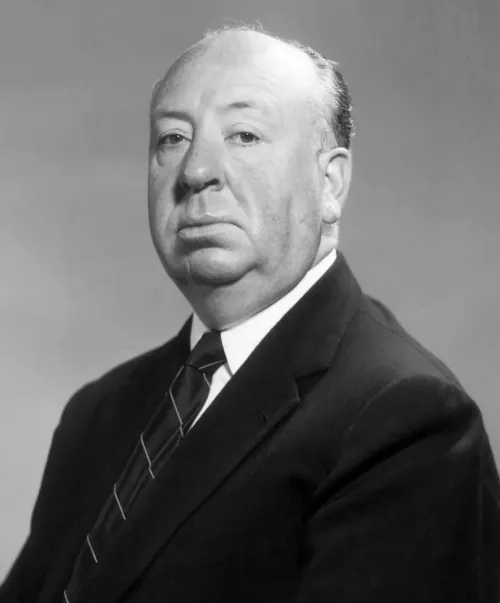
Alfred Hitchcock - ENTP Personality Type

Alfred HitchcockENTP - Débatteur

Film Director

Origine

UK

Confiance du Typage

largement accepté

Quick Facts

Born
August 13, 1899
Birthplace
Leytonstone, London, UK
Nationality
British / American
Height
5'7" (170 cm)
Zodiac Sign
Education
St Ignatius' College, Stamford Hill; London County Council School of Engineering
Known For
PsychoRear WindowVertigoThe BirdsNorth by Northwest

Who is Alfred Hitchcock?

Alfred Joseph Hitchcock was born on August 13, 1899, in Leytonstone, in the East End of London, the youngest of three children of a greengrocer and poulterer. His childhood was marked by strict Catholic schooling and, he later claimed, an episode at age five when his father sent him to the local police station with a note instructing the officer to lock him in a cell for five minutes as a lesson in the consequences of misbehavior. Whether literally true or retrospectively mythologized, the story captures something essential about Hitchcock's adult preoccupations: the arbitrary exercise of institutional authority, the guilt of innocence, the horror of confinement. He was fat, friendless, and deeply introverted as a child, and these qualities — never entirely overcome — became the engine of one of cinema's most meticulously constructed bodies of work.

Hitchcock entered the film industry in 1919 as a title-card designer for a silent film company, working his way through increasingly senior roles in art direction, screenwriting, and editing before directing his first film at twenty-five. The Lodger: A Story of the London Fog (1927) — a proto-thriller about a Jack the Ripper-type suspect — established his fundamental thematic territory immediately: the wrong man, the suspicious appearance of guilt, the mechanisms of surveillance and suspicion. His British films of the 1930s established his international reputation; his move to Hollywood under David O. Selznick in 1939 gave him resources that transformed his technical capabilities. Rebecca (1940) won the Academy Award for Best Picture.

Strangers on a Train (1951), Rear Window (1954), Vertigo (1958), North by Northwest (1959), Psycho (1960), and The Birds (1963) represent a body of work that permanently changed what cinema could do with fear, desire, and audience psychology. Hitchcock understood before any theorist articulated it that the film audience and the film's voyeuristic protagonist were in the same position: watching, powerless to intervene, complicit in what they observed. He used this awareness as a structural principle. Psycho violated every genre convention about where major stars appear in a film's structure, essentially destroying the audience's ability to rely on conventional narrative signals. Rear Window made its audience genuine voyeurs and then implicated them in the moral consequences of what they'd seen.

Hitchcock is the ENTP as total intellectual architect of audience experience: a director who approached filmmaking as an exercise in applied psychology, systematically studying which images, sounds, narrative structures, and editing rhythms produced which specific audience responses, and deploying this knowledge with remarkable precision. He was famously dismissive of actors — not from contempt but from a full theory of cinema in which the actor's expressive instrument was one tool among many, less important than camera angle, cutting rhythm, or Bernard Herrmann's score. He gave four television documentaries about his methods, wrote essays, and gave interviews of remarkable candor about the mechanisms of his craft — the ENTP's characteristic desire to explain not just the work but the system of thought behind it.
Type de Personnalité ENTP de Alfred Hitchcock

Alfred Hitchcock, connu(e) pour son travail en tant que Film Director, présente les traits classiques d'un type de personnalité ENTP - Débatteur. Ce profil de personnalité est caractérisé par une combinaison unique de fonctions cognitives qui façonnent la façon dont ils perçoivent le monde et prennent des décisions.

Traits ENTP Clés chez Alfred Hitchcock

En tant que ENTP, Alfred Hitchcock démontre les caractéristiques fondamentales associées à ce type de personnalité.

Pourquoi Alfred Hitchcock est Typé comme ENTP

Le type de personnalité ENTP est l'un des 16 types Myers-Briggs, et le comportement public de Alfred Hitchcock, les schémas de prise de décision et le style de communication s'alignent étroitement avec cette classification.

Alfred Hitchcock's Career Highlights

1940

Rebecca

Won Academy Award for Best Picture

1954

Rear Window

Masterpiece of voyeurism and suspense

1958

Vertigo

Named greatest film ever made by Sight & Sound (2012)

1959

North by Northwest

Quintessential spy thriller; crop-duster scene iconic

1960

Psycho

Redefined horror cinema; $50M on $800K budget

1963

The Birds

Pioneered ecological horror

Awards & Recognition

\u2605Irving G. Thalberg Memorial Award (Academy Honorary) (1968)\u2605AFI Lifetime Achievement Award (1979)\u2605Knight Commander of the Order of the British Empire (1980)

Alfred Hitchcock's Mystic Profile

Discover Alfred Hitchcock's cosmic connections through zodiac, tarot, crystals, and spirit animals.

leo

Zodiac Prediction

As a Leo, Alfred Hitchcock carried the sign's most theatrical quality: the need for an audience, the compulsion to perform, the pleasure of total command over how one is perceived. Leo rules the stage and Hitchcock made cinema itself his stage — his famous cameo appearances in each of his films were not vanity but signature, the auteur marking his territory. His Leo quality also explains the ego that drove him to treat his actors as props: a Leo director who understands that the real performance is the film, the audience is the subject, and the director is the author.

🃏

the magician

Tarot Card Match

The Magician controls what the audience perceives and uses that control to produce a precisely calculated effect. Hitchcock was cinema's purest Magician: he understood that film is not a window on reality but a machine for producing specific psychological states, and he operated that machine with greater technical self-consciousness than any director of his era. His cameos were the Magician's wink — a reminder that there is a man behind the trick.

💎

obsidian

Crystal Match

Obsidian — volcanic glass, formed from sudden violent transformation, revealing nothing of what lies beneath its surface until it is cut and polished — rings true with Hitchcock's fundamental cinematic aesthetic. His films are obsidian films: dark, controlled, reflecting the audience's own fears back at them with clinical precision. Obsidian is also the stone of truth revealed through shadow, of what becomes visible only in the absence of conventional light.

🦁

raven

Spirit Animal

The raven is the bird of omen, of intelligence operating in shadow, of meaning transmitted through darkness. Hitchcock's cinema is raven cinema: the persistent sense that something is watching, that the ordinary world contains hidden mechanisms of threat and surveillance, that what appears ordinary is the surface of something darker. The raven is also associated in many traditions with the trickster who knows the truth and reveals it not directly but through indirection — which is Hitchcock's essential method.

Plus de Personnalités ENTP Célèbres

À Propos de Cette Analyse

Cette analyse du type de personnalité de Alfred Hitchcock est basée sur des informations publiquement disponibles, des interviews et des observations comportementales.