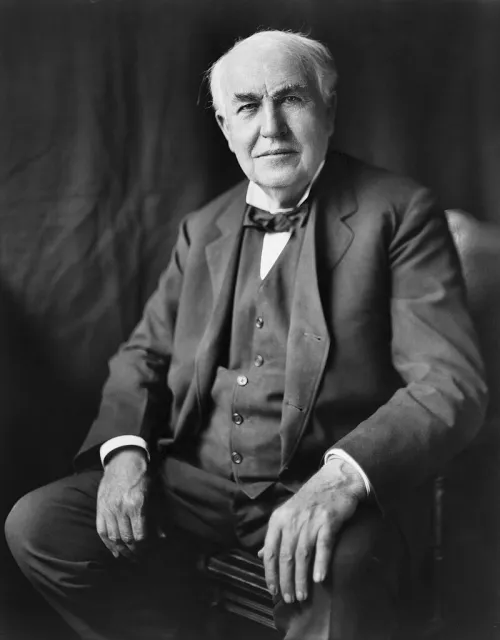
Thomas Alva Edison was born on February 11, 1847, in Milan, Ohio, the seventh and youngest child of Samuel and Nancy Edison. His formal education lasted a grand total of three months — his teacher declared him 'addled' and his mother, a former schoolteacher, pulled him from school and educated him herself. A childhood bout of scarlet fever, combined with recurrent ear infections, left him strongly hearing-impaired by adolescence. Rather than limiting him, his hearing loss contributed to an extraordinary capacity for sustained concentration, filtering out the social ambient noise that distracts most people from deep work. At twelve, he was selling newspapers and candy on the Grand Trunk Railroad, conducting chemistry experiments in a baggage car laboratory until a fire ended that arrangement. At fifteen, he rescued a three-year-old from the path of a freight car, and the grateful father — a station agent — taught him telegraphy in return.
As a telegraph operator through the 1860s, Edison worked the night shift by preference because it left his days free for reading and experimentation, and he turned the job itself into a series of inventive problems. He invented an automatic repeater that sent messages between stations without human assistance, and a device that simultaneously transmitted multiple messages over a single wire. When he arrived in New York City in 1869, broke and sleeping on the floor of a battery room at Western Union, he repaired a broken stock ticker at a critical moment and was hired immediately. His early commercial success selling improved telegraph technology gave him the capital for his first real laboratory.
In 1876, Edison built the world's first industrial research laboratory in Menlo Park, New Jersey — a deliberate factory for invention, staffed by skilled machinists, chemists, and experimenters working systematically toward commercial applications. It was here that he produced the phonograph (1877), the first device to record and reproduce sound, which astounded the scientific world. The incandescent light bulb (1879), developed after thousands of iterations testing different filament materials, was less an individual invention than the culmination of a managed research program. He then built the first commercial electrical power distribution system in lower Manhattan (1882), installing everything from generators to cables to meters — arguably the most consequential infrastructure project in American history. His Kinetoscope (1891) and subsequent work established the technical foundation of motion pictures.
Edison's ENTP fingerprint is visible throughout his career: an insatiable curiosity that leaped between domains, a gift for seeing what a technology could become rather than what it was, and a relentless willingness to challenge received wisdom through direct experimentation rather than theoretical argument. He was also the ENTP in his contradictions — the 'Wizard of Menlo Park' who could be extraordinarily inspiring and extraordinarily ruthless, who championed direct current with bitter stubbornness against Nikola Tesla's more mathematically elegant alternating current (a battle he lost), who could simultaneously credit his teams and appropriate their contributions. He held 1,093 US patents when he died in 1931, a record that stood for sixty years, and his laboratory model — systematic, commercial, collaborative — defined how innovation would be organized for the next century.