
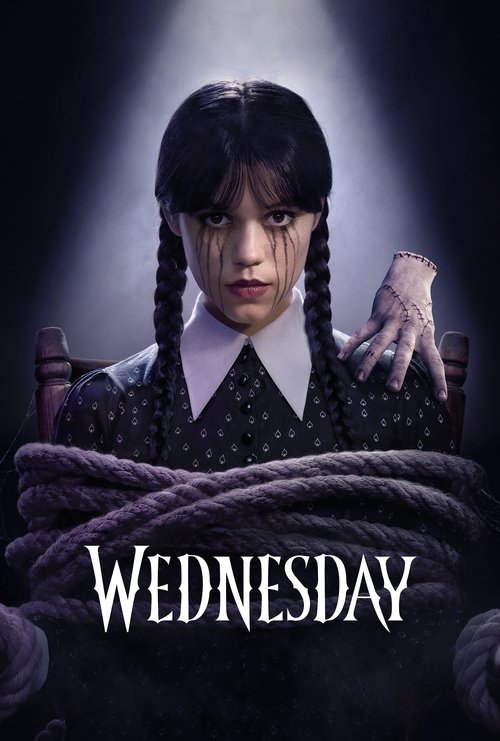
Wednesday / Addams Family
Which Wednesday or Addams Family character matches your MBTI personality type?
Analytiker

Wednesday Addams
AnalystWednesday Addams is the INTJ in her purest, most unapologetic form. Her dominant Ni drives her single-minded pursuit of the monster mystery at Nevermore with laser-focused intensity—she perceives hidden connections between events that others dismiss, follows her visions with absolute conviction, and maintains an internal narrative about reality that proves consistently more accurate than the surface-level assumptions of everyone around her. Her auxiliary Te provides the systematic execution: she gathers evidence methodically, manipulates suspects into revealing information with calculated precision, and organizes her investigation with the efficiency of a seasoned detective. Her tertiary Fi manifests as a deeply personal moral code that operates entirely independently of social convention—she does not care about popularity or approval but holds fierce loyalty to those rare individuals who earn her respect, like Eugene and ultimately Enid. Her inferior Se surfaces in her discomfort with physical vulnerability and sensory overwhelm; her rigid black wardrobe and controlled environment represent an INTJ's attempt to minimize Se unpredictability. Wednesday's relationship with Enid demonstrates classic INTJ growth: the rationalist who insists she does not need emotional connection gradually discovers that her Ni vision is enriched rather than compromised by allowing Fe warmth into her life, even if she will never admit it directly.
“I act as if I don't care if people dislike me. Deep down, I secretly enjoy it.”Learn about INTJ →

Eugene Otinger
AnalystEugene Otinger is the INTP whose dominant Ti drives an all-consuming analytical fascination with bees that goes far beyond casual interest into systematic mastery. He knows bee biology, behavior patterns, colony dynamics, and apiculture statistics with an encyclopedic depth that reflects the INTP's characteristic deep-dive into subjects that capture their intellectual interest. His auxiliary Ne provides the creative connections that make his bee knowledge surprisingly useful—he sees parallels between bee colonies and school social structures, draws unexpected analogies, and applies his specialized knowledge in novel contexts when the plot demands it. His tertiary Si manifests in his meticulous record-keeping, his detailed observational logs, and his ability to recall specific facts and figures from his extensive reading with impressive precision. His inferior Fe is Eugene's most endearing quality: he desperately wants to connect with others, particularly Wednesday, but his social skills lag far behind his intellectual abilities, resulting in awkward earnestness that makes him vulnerable but genuinely lovable. Eugene's friendship with Wednesday works because the INTP and INTJ share a Ti-Te respect for competence and directness while approaching the world from complementary angles. His dedication to helping Wednesday despite the personal risk demonstrates that the INTP's devotion, once earned, is expressed through action and intellectual contribution rather than emotional declaration.
“Did you know that bees are responsible for one out of every three bites of food we eat?”Learn about INTP →

Bianca Barclay
AnalystBianca Barclay is an ENTJ whose dominant Te organizes Nevermore's social hierarchy with commanding efficiency. She holds the queen bee position not through mere popularity but through strategic social engineering—she maintains alliances, manages rivalries, and enforces her authority with a decisiveness that leaves little room for challenge. Her auxiliary Ni provides the strategic foresight to anticipate threats to her position and plan her moves in social chess games well ahead of her peers, always seeing three steps beyond the current social dynamic. Her tertiary Se manifests in her siren powers and her comfort with direct, physical presence—she uses her appearance and charisma as tools of influence, engaging with the tangible social environment with practiced skill. Her inferior Fi is Bianca's most complex dimension: beneath her controlled, strategic exterior lies genuine insecurity about whether people value her for who she truly is or only respond to her siren abilities. Her conflict with Wednesday forces this Fi question to the surface—Wednesday is immune to her powers and sees through her Te-Ni strategic persona, challenging Bianca to discover what she is without the social structures she has built. Bianca's arc reveals that the ENTJ's commanding exterior often protects a hidden vulnerability: the fear that without the systems they control, they might not be enough on their own merits.
“I earned my place at this school. I didn't need a last name to open doors.”Learn about ENTJ →

Uncle Fester
AnalystUncle Fester is the ENTP who thrives in the space between genius and chaos. His dominant Ne generates a constant stream of unconventional ideas, unpredictable approaches, and creative solutions that no one else would consider—from his unorthodox methods of helping Wednesday to his inventive use of electrical abilities in situations that call for finesse rather than brute force. His auxiliary Ti provides the logical framework that makes his Ne ideas occasionally brilliant rather than merely random: he analyzes problems from unexpected angles and arrives at solutions through a chain of reasoning that, while eccentric, holds together internally. His tertiary Fe manifests in his genuine warmth toward his family and his desire to be helpful and connected, expressed through characteristically ENTP means—he shows love through enthusiastic involvement rather than emotional sensitivity. His inferior Si surfaces as his difficulty with routine, convention, and the established way of doing things; he cannot simply follow normal procedures and instead must reinvent every approach from scratch, which sometimes leads to spectacular results and sometimes to spectacular disasters. Fester's role in the Addams family represents the ENTP at their most liberated: in a family that celebrates the unconventional, his natural inclination toward creative disruption is not a flaw to be managed but a gift to be cherished, allowing him to be fully himself without the social friction that ENTPs typically encounter in more conventional settings.
“Normal is overrated.”Learn about ENTP →
Diplomaten

Morticia Addams
DiplomatMorticia Addams is the INFJ matriarch whose dominant Ni provides a serene, almost otherworldly perception that sees through facades to the essential nature of people and situations. She understands Wednesday's darkness not as a problem to be fixed but as a destiny to be guided, perceiving her daughter's inner world with an accuracy that borders on prophetic. Her auxiliary Fe drives her deep, quiet concern for her family's emotional wellbeing—she manages the Addams household's complex dynamics with graceful emotional intelligence, providing warmth and stability without ever losing her mysterious composure. Her tertiary Ti manifests in her sharp, precise observations and her ability to analyze situations with intellectual clarity beneath her poetic exterior, cutting to the logical heart of matters with elegant efficiency. Her inferior Se appears in her carefully controlled aesthetic environment—the dark elegance of her appearance and surroundings represents an INFJ curating sensory experience to match her internal vision rather than engaging with the chaotic physical world as it comes. Morticia's parenting style is quintessentially INFJ: she does not impose rules through authority but guides through understanding, trusting her Ni insight into each family member's nature while using Fe empathy to nurture their growth along paths she intuits are correct. Her relationship with Gomez demonstrates the INFJ's capacity for passionate depth when their Ni-Fe finds a soul truly worthy of their devotion.
“We gladly feast on those who would subdue us.”Learn about INFJ →

Xavier Thorpe
DiplomatXavier Thorpe is the INFP artist whose dominant Fi transforms his inner emotional world into tangible creative expression. His paintings and drawings are not mere skill demonstrations but deeply personal emotional channels—they literally manifest his psychic visions, blurring the line between Fi internal feeling and external reality in a way that is unique to his character. His auxiliary Ne fuels the imaginative quality of his art and his psychic abilities, generating visions that connect seemingly unrelated elements into prophetic imagery, though he struggles to control or interpret these Ne leaps accurately. His tertiary Si manifests in his attachment to his relationship history with Wednesday and his difficulty letting go of past emotional experiences; he remembers slights and connections with vivid detail that colors his present interactions. His inferior Te surfaces as his frustration with being unable to prove his trustworthiness through logical evidence—when Wednesday suspects him, he cannot systematically demonstrate his innocence and instead retreats into wounded Fi pride. Xavier's arc explores the INFP's central struggle: being chronically misunderstood by a world that cannot see the depth and sincerity of his inner experience. His art becomes both his gift and his prison—the very creativity that makes him extraordinary also produces evidence that makes him a suspect, illustrating how the INFP's rich inner world can be profoundly misinterpreted by those who only see its external manifestations.
“My art is the only thing that makes sense to me.”Learn about INFP →

Gomez Addams
DiplomatGomez Addams is the ENFJ whose dominant Fe creates an atmosphere of passionate emotional generosity that defines the entire Addams family culture. He loves with overwhelming intensity—his devotion to Morticia is expressed through grand romantic gestures, his pride in his children is vocalized constantly, and he rallies every person around him into feeling cherished and important. His auxiliary Ni provides the romantic idealism that elevates his emotional expression beyond mere sentiment into genuine vision—he sees his family not just as they are but as the magnificent, extraordinary beings he believes they are destined to be. His tertiary Se manifests in his physical expressiveness and love of sensory experience: fencing, dancing, explosive enthusiasm, and his tactile warmth in embracing everyone he loves with full-bodied energy. His inferior Ti surfaces as his weakness in detached logical analysis—when Wednesday's situation at Nevermore requires strategic thinking, Gomez tends to respond with emotional intensity rather than calculated planning, leaving the more analytical approaches to Morticia. Gomez's approach to fatherhood is the ENFJ ideal realized: he creates an environment where every family member feels unconditionally accepted and celebrated for their authentic nature, using his Fe warmth and Ni vision to build a home where darkness is not feared but embraced as a beautiful expression of who they truly are.
“To live without you, only that would be torture.”Learn about ENFJ →

Enid Sinclair
DiplomatEnid Sinclair is the ENFP whose dominant Ne fills her world with color, enthusiasm, and boundless possibility. She cycles through interests with characteristic Ne breadth—blogging, social media, friendship bracelets, werewolf lore—each pursued with genuine excitement that reflects her insatiable curiosity about the world. Her auxiliary Fi provides the emotional authenticity that makes her the perfect foil for Wednesday: Enid's feelings are real, deeply held, and unapologetically expressed through her rainbow wardrobe, her passionate reactions, and her refusal to pretend she does not care about the people she loves. Her tertiary Te emerges when the situation demands practical action, particularly during the climactic battle where she transforms and fights with surprising effectiveness, showing that beneath the bubbly exterior is someone capable of organized, decisive response. Her inferior Si manifests as her anxiety about the werewolf transformation she has not yet achieved—a failure to meet the established expectations of her family and heritage that haunts her despite her outward confidence. Enid's arc demonstrates the ENFP's unique superpower: her relentless Ne-Fi warmth and refusal to give up on Wednesday eventually cracks through the INTJ's defenses, proving that emotional persistence is its own form of strength. Her wolf-out moment represents the ENFP integrating her inferior Si—finally connecting with her heritage when her Fi values demand it.
“I'm not giving up on you. I never give up on my friends.”Learn about ENFP →
Hüter

Sheriff Galpin
SentinelSheriff Galpin is the ISTJ lawman whose dominant Si creates a worldview firmly rooted in established procedures, conventional explanations, and the lessons of past experience. He investigates crimes through methodical evidence collection, follows the chain of command, and applies the same approaches that have worked in previous cases, becoming visibly uncomfortable when confronted with evidence that falls outside his empirical framework. His auxiliary Te provides efficient, no-nonsense execution of his duties—he processes suspects, files reports, and maintains law and order with practical competence, treating his role as a systematic job to be done correctly rather than a crusade. His tertiary Fi emerges in his complicated personal feelings about Nevermore and its outcast students, revealing biases and resentments that influence his supposedly objective investigations more than he admits, particularly regarding his deceased wife's connection to the outcast community. His inferior Ne is his most pronounced weakness: he cannot entertain the possibility that supernatural explanations might be valid, dismissing Wednesday's theories not because the evidence is poor but because his Si framework literally cannot accommodate such radical departures from normal reality. Sheriff Galpin represents the ISTJ's shadow side when confronted with paradigm-shifting information: rather than integrating new data, he doubles down on established explanations, allowing his Si comfort with the familiar to blind him to truths that demand a completely different framework of understanding.
“I deal in facts, not fairy tales.”Learn about ISTJ →

Thing
SentinelThing embodies the ISFJ's essence of selfless, devoted service distilled to its most fundamental form. His dominant Si manifests in his absolute reliability and consistency—he knows Wednesday's routines, anticipates her needs based on past experience, and provides the same steady, dependable support in every situation, whether tapping out messages, fetching objects, or standing guard through the night. His auxiliary Fe drives his deep emotional attunement to Wednesday's wellbeing; he monitors her mood, provides comfort through physical presence, and takes genuine distress when she is in danger, demonstrating that caregiving does not require words or a face but only a devoted heart. His tertiary Ti provides surprising practical intelligence—he solves problems methodically, operates technology, and gathers information with systematic thoroughness that goes beyond simple obedience into genuine analytical contribution. His inferior Ne surfaces as anxiety when confronted with genuinely novel threats that fall outside his established patterns of support, requiring him to improvise rather than rely on proven methods. Thing's role in the series is the ultimate ISFJ statement: that faithful, behind-the-scenes support is not secondary to heroism but is itself a profound form of courage, and that the most powerful expression of love is simply showing up, consistently and reliably, for the person who needs you most.
“(snaps supportively)”Learn about ISFJ →

Principal Weems
SentinelPrincipal Weems is the ESTJ administrator whose dominant Te drives her systematic management of Nevermore Academy with organizational precision and institutional authority. She enforces rules, maintains schedules, manages public relations crises, and makes practical decisions aimed at protecting the school's operational integrity, treating disruptions as problems to be solved through established protocols. Her auxiliary Si provides the deep respect for Nevermore's traditions and history that shapes her leadership philosophy—she is the guardian of the school's legacy and draws on institutional precedent when navigating new challenges. Her tertiary Ne surfaces as a cautious awareness of the unconventional threats Nevermore faces, allowing her to adapt her normally rigid approach when she recognizes that standard procedures are insufficient for genuinely novel situations. Her inferior Fi creates tension between her institutional role and her personal relationships—her history with Morticia and her complex feelings about the Addams family reveal personal values that sometimes conflict with her Te-Si administrative mandate. Weems's shape-shifting ability is an interesting counterpoint to her ESTJ personality: a power that requires adopting other identities sits uncomfortably with a type that values institutional consistency and authentic authority. Her arc demonstrates the ESTJ administrator's central dilemma: balancing the duty to maintain order with the recognition that some of the people she is trying to control may understand the real threats better than her systems can detect.
“Nevermore has a legacy to uphold.”Learn about ESTJ →

Ajax Petropolus
SentinelAjax Petropolus is the ESFJ whose dominant Fe makes him the warmest, most socially attuned presence at Nevermore Academy. He navigates the school's complex social dynamics with genuine friendliness and a natural desire to maintain harmony, treating everyone with the kind of earnest warmth that makes him universally liked if occasionally overlooked. His auxiliary Si provides a comfortable reliance on established social routines and expectations—he follows the school's traditions, respects the social hierarchy, and finds security in predictable patterns of interaction. His tertiary Ne surfaces in his willingness to pursue an unexpected connection with Enid despite their different social circles, showing a capacity for imaginative leaps when his Fe interest in someone overrides his Si comfort zone. His inferior Ti manifests as his difficulty with complex analytical thinking or strategic maneuvering—he takes people at face value and struggles to detect deception or hidden agendas, which makes him refreshingly genuine but occasionally vulnerable. Ajax's Gorgon powers create an ironic tension with his ESFJ nature: his Fe desperately wants to connect with others and maintain close physical proximity, but his powers can literally turn people to stone, forcing him to manage his most social instincts with constant caution. His relationship with Enid is a sweet ESFJ-ENFP pairing where both types share Fe-Fi emotional warmth expressed through different but complementary energies.
“I just... I really like you.”Learn about ESFJ →
Entdecker

Lurch
ExplorerLurch is the ISTP distilled to his most essential qualities: silent competence, physical precision, and actions that speak louder than any words could. His dominant Ti processes the world through internal logical frameworks that require no verbal expression—he observes, analyzes, and reaches conclusions about what needs to be done without the need to explain his reasoning to anyone. His auxiliary Se manifests as remarkable physical awareness and capability: he performs tasks with precise, efficient movement, responds to environmental cues instantly, and engages with the tangible world through skilled action whether playing the harpsichord, serving at dinner, or intervening in dangerous situations. His tertiary Ni provides an understated perceptiveness that allows him to anticipate the family's needs before they are articulated, suggesting a deeper understanding of patterns and intentions than his minimal communication would suggest. His inferior Fe emerges in subtle but meaningful ways—his musical performances reveal genuine emotional depth, and his loyalty to the Addams family goes beyond mere service into authentic devotion that he expresses through presence rather than words. Lurch embodies the philosophical essence of the ISTP type: the conviction that the world is best understood through direct engagement rather than discussion, that competence needs no advertisement, and that the most profound communication sometimes requires no words at all—just showing up and doing what needs to be done.
“You rang?”Learn about ISTP →

Tyler Galpin
ExplorerTyler Galpin demonstrates the ISFP's complex relationship between authentic self and performed identity. On the surface, his dominant Fi manifests as quiet emotional genuineness—he expresses interest in Wednesday through personal, intimate gestures rather than grand displays, connecting through shared vulnerability at the coffee shop and offering emotional presence rather than solutions. His auxiliary Se shows in his comfort with the physical world of barista work, his easy physicality, and his ability to engage with the present moment in ways that make Wednesday unusually relaxed in his company. His tertiary Ni provides an unsettling undercurrent of hidden perception—he seems to understand more about the situation at Nevermore than he reveals, and his ability to navigate Wednesday's emotional defenses suggests an intuitive understanding of her inner world. His inferior Te surfaces as difficulty with structured authority and institutional expectations, particularly his fraught relationship with his father the sheriff. Tyler's dark revelation recontextualizes his ISFP traits through a shadow lens: the Fi authenticity that made him compelling becomes the question of which self is real, the Se physicality takes on predatory dimensions, and the Ni hidden depths prove literally monstrous. His arc poses the quintessential ISFP question: when a person's authentic inner nature conflicts with moral standards, which truth takes precedence?
“Sometimes the best way to help people is by being there for them.”Learn about ISFP →

Yoko Tanaka
ExplorerYoko Tanaka is the ESTP who navigates Nevermore's social landscape with effortless cool and physical confidence. Her dominant Se gives her an immediate, engaging presence—she is aware of her surroundings, responsive to the energy of every room she enters, and comfortable taking direct action when situations require it, whether in social confrontations or supernatural crises. Her auxiliary Ti provides the analytical sharpness beneath her laid-back exterior: she assesses people and situations with quick, accurate judgment, cutting through pretense with observations that are both logical and cutting. Her tertiary Fe manifests in her social savvy and ability to navigate group dynamics with ease, maintaining friendships and rivalries with the kind of casual emotional intelligence that makes her a natural member of any social circle. Her inferior Ni surfaces as her preference for dealing with what is happening now rather than worrying about deeper meanings or future implications—she takes things at face value and responds to the present moment rather than searching for hidden patterns. Yoko's vampire nature aligns perfectly with her ESTP type: she is a predator in the most charismatic sense, engaging with the world through direct sensory experience and physical confidence. Her role at Nevermore demonstrates that the ESTP's ability to read and respond to social situations in real-time is itself a valuable supernatural-adjacent skill in a school full of powerful outcasts.
“I don't do drama. Well, actually I do. But only the fun kind.”Learn about ESTP →

Pugsley Addams
ExplorerPugsley is the ESFP who lives with gleeful, unreflective immersion in the sensory present. His dominant Se drives his love of explosive experiments, physical rough-housing, and tactile experiences that would horrify normal children but delight him precisely because they engage his senses at maximum intensity—the bigger the bang, the wider his grin. His auxiliary Fi provides genuine emotional warmth and an untroubled inner contentment that makes him remarkably well-adjusted despite his unusual upbringing; Pugsley knows who he is and feels no conflict about it, accepting his nature with the easy self-assurance of a healthy Fi. His tertiary Te surfaces in his surprisingly competent handling of mechanical devices, explosives, and practical tasks, showing an ability to organize physical projects with effectiveness when his interest is engaged. His inferior Ni manifests as his lack of concern for long-term consequences or deeper meaning—he does not brood about destiny or worry about the future but simply enjoys each moment as it arrives. Pugsley's role in the Addams family dynamic illustrates the healthy ESFP's gift: while Wednesday overthinks and Gomez over-feels, Pugsley simply experiences life with direct, physical joy. His uncomplicated happiness serves as a reminder that sometimes the most well-adjusted response to an unusual world is to stop analyzing it and start enjoying the explosion.
“Are we there yet?”Learn about ESFP →
Finde deinen Charakter
Kennst du deinen MBTI-Typ? Finde unten deine Charakterübereinstimmung.
Häufig Gestellte Fragen
Wednesday Addams is an INTJ. Her dominant Ni drives her single-minded pursuit of solving mysteries with strategic precision. Her Te-auxiliary shows in her blunt, efficient communication and her ability to create and execute complex plans. She dismisses social conventions as illogical and values competence above all.
Enid is an ENFP. Her dominant Ne makes her enthusiastic about new interests, people, and possibilities. Her auxiliary Fi gives her warm emotional authenticity and the ability to stay true to herself while accepting others. She is the perfect ENFP foil to Wednesday's INTJ, creating the classic INTJ-ENFP dynamic.
Yes, Xavier is best typed as an INFP. His dominant Fi manifests in his deep emotional world expressed through his art. His Ne fuels his psychic visions and creative imagination. He struggles with being misunderstood, a common INFP experience, and processes his feelings through creative expression.
Morticia is an INFJ. She possesses deep Ni intuition that allows her to see through facades and understand hidden truths. Her Fe makes her an emotionally attuned matriarch who guides her family with wisdom and grace. Her mysterious calm exterior hides real emotional depth and insight.
Weitere Serien erkunden
Finde deinen eigenen Typ
Entdecke deinen MBTI-Persönlichkeitstyp und sieh, welche fiktiven Charaktere deine Merkmale teilen.
Test machen