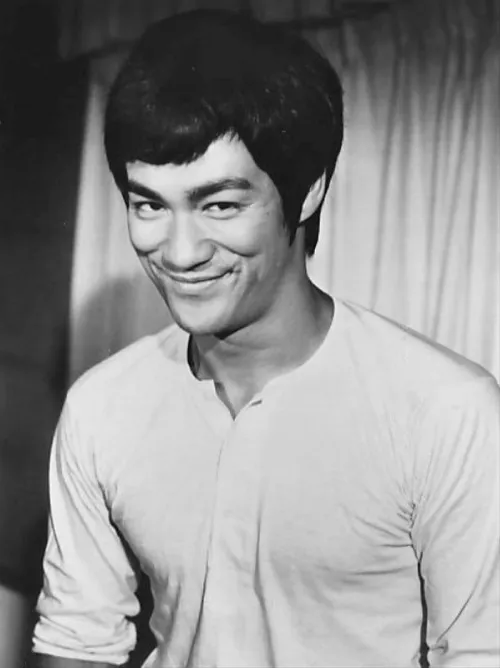
Bruce Lee - ISTP Personality Type

Bruce LeeISTP - Handwerker

Martial Artist, Actor

Herkunft

USA/Hong Kong

Typing-Konfidenz

weithin akzeptiert

Quick Facts

Born
November 27, 1940
Birthplace
San Francisco, California, USA
Nationality
American/British (Hong Kong-raised)
Height
5'7" (171 cm)
Zodiac Sign
Education
University of Washington (philosophy; did not complete degree)
Known For
Jeet Kune Do founderEnter the DragonThe Way of the DragonGame of DeathFirst Asian-American action starPhilosophical writings on martial arts

Who is Bruce Lee?

Lee Jun-fan — known in the West as Bruce Lee — was born on November 27, 1940, in the Chinese Hospital in San Francisco's Chinatown, during his Hong Kong-based parents' visit to the United States. His father, Lee Hoi-chuen, was a Cantonese opera singer and actor; his mother, Grace Ho, was of Eurasian descent. Bruce was taken back to Hong Kong as an infant and raised there, acquiring US citizenship by birth. He grew up in Hong Kong during the Japanese occupation and its aftermath, and his father introduced him to the film industry: he appeared as a child actor in more than 20 Hong Kong films before age 18. He studied Wing Chun kung fu under Yip Man from age 13, began competing in boxing, and developed the beginnings of the martial arts philosophy that would eventually produce Jeet Kune Do.

Bruce Lee moved to the United States in 1959 at age 18, settling in Seattle, Washington, where he taught martial arts and attended the University of Washington, studying philosophy. He opened his first martial arts school in Seattle in 1959, and subsequently opened schools in Oakland and Los Angeles. His appearance at the 1964 Long Beach International Karate Championships — where he demonstrated his one-inch punch and two-finger push-ups and fought in an exhibition that left knowledgeable observers astonished — is widely regarded as the moment that introduced him to the mainstream American martial arts world. He was cast as Kato in the television series The Green Hornet (1966-67), which gave him American television exposure, but the series was cancelled after one season and Hollywood failed to capitalize on the obvious star quality he had demonstrated.

Frustrated by Hollywood's unwillingness to cast him as a leading man in American productions — the lead role of the martial arts television series Kung Fu, which he had helped develop, was given to Caucasian actor David Carradine — Bruce Lee returned to Hong Kong in 1971 and signed with Golden Harvest Productions. The Big Boss (1971) broke Hong Kong box office records. Fist of Fury (1972) broke those records. The Way of the Dragon (1972), which he wrote and directed, broke those records again. Enter the Dragon (1973) — the first co-production between a Hong Kong company and a major Hollywood studio (Warner Bros.) — was completed just before his death and became a global phenomenon, introducing his work to Western audiences at the scale his Hong Kong work had introduced him to Asian audiences.

Bruce Lee died on July 20, 1973, in Hong Kong, at age 32, from cerebral edema — swelling of the brain, attributed in the official autopsy to an allergic reaction to a pain medication he had been prescribed. The circumstances of his death have generated decades of speculation that have not produced alternative explanations that withstand scrutiny. He left behind a body of work — four and a half major films, extensive philosophical writing on martial arts and self-actualization collected in The Tao of Jeet Kune Do (1975, published posthumously), and a teaching legacy through students including Chuck Norris, James Coburn, and Steve McQueen — that has made him one of the most influential figures in 20th century popular culture, credited with transforming both Western understanding of Asian martial arts and the representation of Asian actors in Western entertainment.
Bruce Lees ISTP-Persönlichkeitstyp

Bruce Lee, bekannt für ihre Arbeit als Martial Artist, Actor, zeigt die klassischen Merkmale eines ISTP-Persönlichkeitstyps – Handwerker. Dieses Persönlichkeitsprofil zeichnet sich durch eine einzigartige Kombination kognitiver Funktionen aus, die prägt, wie sie die Welt wahrnehmen und Entscheidungen treffen.

Wichtige ISTP-Merkmale bei Bruce Lee

Als ISTP demonstriert Bruce Lee die Kerneigenschaften, die mit diesem Persönlichkeitstyp verbunden sind. Diese Merkmale haben eine wichtige Rolle in ihrem Erfolg und ihrem öffentlichen Auftreten als Martial Artist, Actor gespielt. Das Verständnis ihres Persönlichkeitstyps gibt Einblick in ihre Motivationen, Stärken und die einzigartige Perspektive, die sie in ihrem Bereich einbringen.

Warum Bruce Lee als ISTP eingestuft wird

Der ISTP-Persönlichkeitstyp ist einer der 16 Myers-Briggs-Persönlichkeitstypen, und Bruce Lees öffentliches Verhalten, Entscheidungsmuster und Kommunikationsstil stimmen eng mit dieser Klassifikation überein. ISTP-Individuen wie Bruce Lee sind für ihren markanten Ansatz zur Problemlösung und zwischenmenschlichen Beziehungen bekannt.

Bruce Lee's Filmography

1966-67
The Green Hornetas KatoTV series
1971
The Big Bossas Cheng Chao-anfilm
1972
Fist of Furyas Chen Zhenfilm
1972
The Way of the Dragon (also director)as Tang Lungfilm
1973
Enter the Dragonas Leefilm
1978
Game of Death (incomplete; released posthumously)as Billy Lo (unfinished)film

Awards & Recognition

\u2605Bruce Lee was not eligible for many major film awards of his era; his legacy is measured in cultural transformation \u2605TIME Magazine — 100 Most Important People of the 20th Century (1999)\u2605Hollywood Walk of Fame Star (2013)

Bruce Lee's Mystic Profile

Discover Bruce Lee's cosmic connections through zodiac, tarot, crystals, and spirit animals.

sagittarius

Zodiac Prediction

Bruce Lee's Sagittarius sun is the philosophical fire at the center of his martial arts vision: the refusal to accept any single tradition as the final word, the commitment to ongoing inquiry, the synthesis across styles and traditions that produced Jeet Kune Do. Sagittarius is the archer, the philosopher-adventurer who seeks the truth across cultures and traditions rather than accepting any single one as complete. Lee's famous instruction — 'Absorb what is useful, reject what is useless, add what is essentially your own' — is a Sagittarius instruction: the traveler who takes the best from each place visited and builds a wisdom that is genuinely his own. Sagittarius also rules the teacher, and Lee's influence on students across half a century after his death is the Sagittarian legacy: the ideas that outlast the individual.

🃏

the magician

Tarot Card Match

The Magician — the tarot archetype of the one who has mastered the complete toolkit and deploys it with precision and intention, who bridges the spiritual and the physical, the idea and the action — is Bruce Lee's card. The Magician has one arm pointed toward heaven and one toward earth: the integration of philosophical principle and physical practice that Lee pursued more explicitly and more rigorously than any martial artist of his generation. His training of students was Magician training: not just the technique but the philosophy; not just the what but the why; not just the body but the whole person. The Magician's number is one — the individual who has integrated all elements into a single coherent whole — and Lee was, in his field, exactly this.

💎

tiger eye

Crystal Match

Tiger's eye — the stone of focused power, of the ability to see clearly in all directions simultaneously, of the precision that comes from complete situational awareness — is Lee's crystal. Tiger's eye is associated with the warrior philosopher: the one who thinks deeply and acts precisely, whose intelligence operates simultaneously in the intellectual and physical domains. Lee's particular gift — the ability to theorize the body's movement and then execute that theory with his own body at extraordinary speed and precision — is tiger's eye integration: the golden-brown stone's bands of light and dark, the theoretical and the practical, always simultaneously present. The stone is also associated with the ability to identify and avoid threats before they materialize — the reactive intelligence of a martial artist operating at Lee's level.

🦁

dragon

Spirit Animal

The dragon — the creature of sovereign power, of the fusion of fire and movement, of the ancient and formidable wisdom that manifests as both physical and spiritual force — is Bruce Lee's spirit animal with perfect aptness. He was 'the Little Dragon' (his Hong Kong nickname) from childhood, and the aptness is not merely biographical: the dragon is the creature that combines the apparently opposed qualities he represented — the philosophical thinker and the physical master; the graceful and the deadly; the gentle teacher and the formidable fighter. The dragon is also the creature of the East that became comprehensible and compelling to the West, which is precisely what Bruce Lee accomplished: the translation of something genuinely ancient and sophisticated into terms a global audience could receive.

Weitere berühmte ISTP-Persönlichkeiten

Über diese Analyse

Diese Persönlichkeitstyp-Analyse von Bruce Lee basiert auf öffentlich verfügbaren Informationen, Interviews, biografischen Berichten und Verhaltensbeobachtungen. Das ISTP-Typing stellt eine fundierte Einschätzung von Persönlichkeitstyp-Enthusiasten und Experten dar, sollte aber nicht als offiziell bestätigt angesehen werden, sofern nicht anders angegeben. Persönlichkeit ist komplex und vielschichtig, und öffentliche Personas können von privaten Persönlichkeiten abweichen.