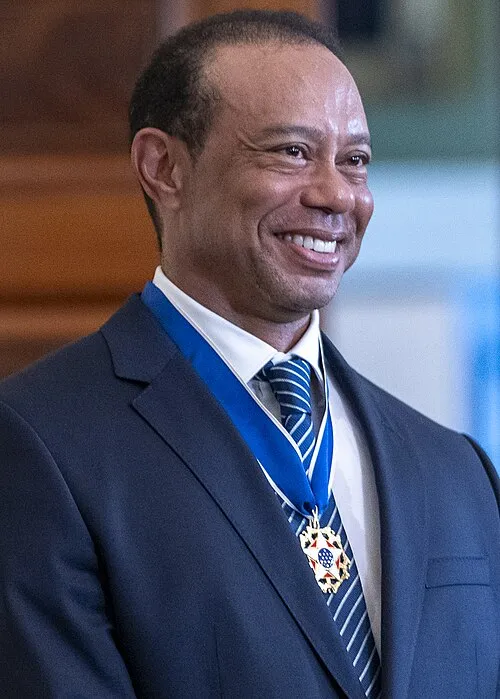
Eldrick Tont 'Tiger' Woods was born on December 30, 1975, in Cypress, California, the only child of Earl Woods, a retired Army lieutenant colonel and former Green Beret, and Kultida 'Tida' Punsawad, a Thai woman Earl had met while stationed in Bangkok. Earl Woods was an amateur golfer and a devoted parent who introduced Tiger to the game before his second birthday; home video footage exists of the toddler Tiger with perfect swing mechanics, which appeared on the Mike Douglas Show and The Tonight Show when Tiger was two. Tiger's racial identity — he describes himself as 'Cablinasian,' acknowledging his Caucasian, Black, Native American, Thai, and Chinese heritage — made his ascent through a predominantly white sport both more complicated and more culturally significant. He won the Junior World Golf Championships six times, won the US Amateur championship three consecutive times (1994-96), and left Stanford after his sophomore year to turn professional in August 1996.
Tiger Woods's professional career between 1996 and 2009 produced statistics that professional golf had never seen and perhaps will never see again. He won the Masters in 1997 by 12 strokes — the largest margin of victory in the tournament's history — becoming the youngest player (21) and the first person of Black or Asian heritage to win the Masters. He would go on to win 14 more Major championships — three more Masters, four more US Opens, three more Open Championships, four more PGA Championships — for a total of 15, second only to Jack Nicklaus's 18. His impact on the sport went beyond the statistics: he changed the physical conditioning expectations of professional golfers, the demographic composition of the viewing audience, and the economic landscape of professional golf in ways that are still being felt. He was named Sports Illustrated Sportsman of the Year four times and Associated Press Male Athlete of the Year four times.
In November 2009, a single-car accident outside his home in Florida — followed by revelations of multiple extramarital affairs — ended what had been one of the most carefully managed public personas in sports. The scandal was followed by a formal statement of apology, divorce from his wife Elin Nordegren in 2010, and a years-long period of personal and professional difficulty that included multiple back surgeries (cervical disc fusion, lumbar microdiscectomy, spinal fusion) and a DUI arrest in 2017. The return to competitive golf — and the 2019 Masters victory, in one of the most dramatic comebacks in sports history — was genuinely emotional for millions of people who had grown up watching him and who had spent a decade observing his very public fall and slow reconstruction. His fist pump after sinking the final putt at Augusta in 2019 remains one of the most resonant images in recent sports history.
Tiger Woods's 2021 car accident — a rollover crash on a California highway that left him with severe leg injuries requiring multiple surgeries and initially raising the possibility that he might never walk normally again — was the most extreme test of his resilience. He returned to competitive golf within 14 months, playing in the 2022 Masters (finishing 47th, remarkable given his injuries), and continues to compete selectively. His legacy is a complicated one: the greatest golfer of his generation by most statistical measures; a figure who transformed a sport's racial demographics and cultural reach; a man whose private life was dramatically, painfully at odds with the public persona he had carefully built; and ultimately an athlete whose commitment to returning to competition after each setback — the injury, the scandal, the accident — has created its own kind of redemption narrative, whatever one thinks of the original failures.