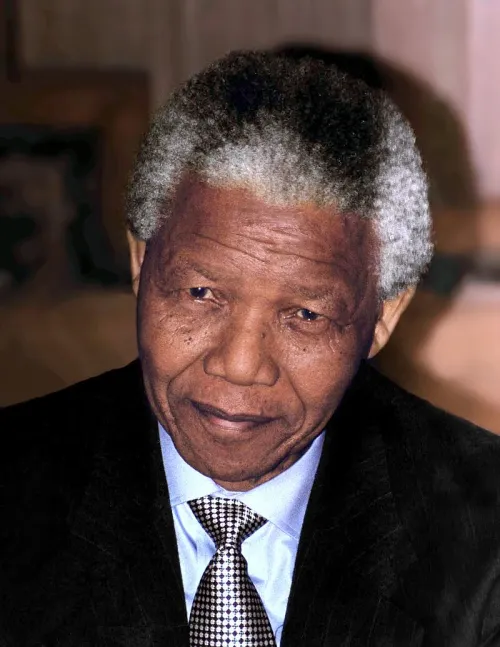
Nelson Rolihlahla Mandela was born on July 18, 1918, in the small village of Mvezo in the Cape Province of the Union of South Africa, the son of Nkosi Mphakanyiswa Gadla Mandela, a local chief, and Nosekeni Fanny, the chief's third wife. His first name Rolihlahla means 'pulling the branch of a tree' — colloquially, 'troublemaker' — a designation that proved predictive. He was given the English name Nelson by a teacher on his first day of school, following the colonial educational convention of assigning English names to Black children. After his father's death, Mandela was placed under the guardianship of the Thembu regent, Jongintaba Dalindyebo, and received an education that combined traditional Thembu culture with Western schooling, attending Clarkebury Boarding Institute and Healdtown College before enrolling at the University of Fort Hare, the only university open to Black South Africans at the time.
Mandela was expelled from Fort Hare for participating in a student strike and subsequently moved to Johannesburg, where he completed his BA by correspondence while beginning law studies at the University of the Witwatersrand. He co-founded the African National Congress Youth League in 1944, and through the 1950s became increasingly central to the ANC's leadership. The Defiance Campaign of 1952 — the ANC's first major non-violent resistance campaign — and the Freedom Charter of 1955 were turning moments in his political formation. The government's response to the Sharpeville Massacre of 1960 — in which sixty-nine peaceful protesters were killed and the ANC was banned — convinced Mandela that nonviolent resistance alone was insufficient and that a limited armed campaign targeting infrastructure rather than people was morally justifiable. He co-founded Umkhonto we Sizwe ('Spear of the Nation') in 1961 and went underground.
Arrested in 1962 and subsequently charged with sabotage in the Rivonia Trial of 1963–1964, Mandela made his closing statement — 'I am prepared to die' — with the calm authority of a man who had made his peace with the consequences of his commitment. He was sentenced to life imprisonment and spent twenty-seven years on Robben Island and Pollsmoor Prison, where he continued to serve as a moral and strategic anchor for the anti-apartheid movement from his cell. The transformation he achieved within prison — maintaining his dignity, continuing his education, and refusing to trade his release for the renunciation of armed struggle — became as politically significant as any external campaign. His release on February 11, 1990, was watched by an estimated one billion people worldwide.
Mandela's four years of negotiation with the apartheid government (1990–1994) — in which he managed the ANC's internal divisions, the threat of violent breakdown, and the legitimate fears of South Africa's white minority with remarkable strategic patience — led to the first democratic elections in South African history in April 1994, in which he was elected president. His single term in office was defined by the Truth and Reconciliation Commission — which chose national healing over retributive justice — and by his extraordinary personal commitment to demonstrating that reconciliation was not merely a political strategy but a genuine possibility for a country that had every historical reason to fracture along racial lines. His INFJ quality was the engine of his greatest achievement: the absolute clarity of a long-term vision sustained through twenty-seven years of imprisonment and four years of the most delicate political negotiation, without losing either the vision or the patience.