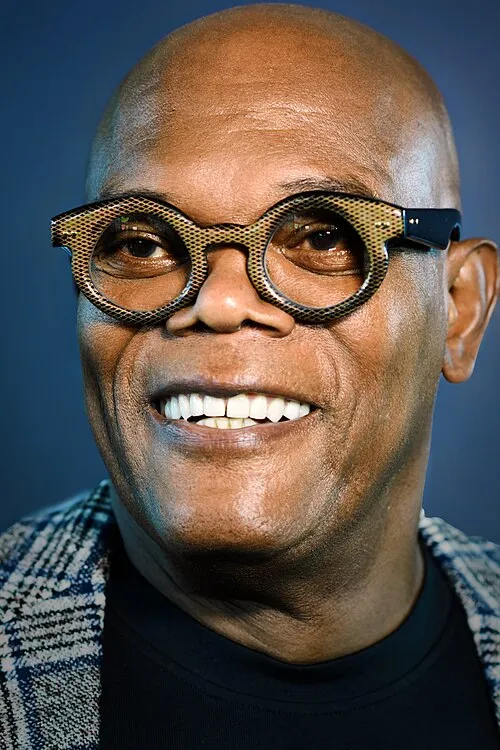
Samuel Leroy Jackson was born on December 21, 1948, in Washington, D.C., and was raised in Chattanooga, Tennessee, by his mother Elizabeth and his grandparents, as his father Roy was absent from his life. He grew up during the Jim Crow era in the American South, experiencing segregation firsthand and developing the political consciousness that would later manifest in his activism. He attended Morehouse College in Atlanta, where he participated in the civil rights movement — he was among the students who held a group of Morehouse trustees hostage in 1969 to protest the board's composition and the school's failure to address student concerns. He studied drama at Morehouse and graduated in 1972.
Jackson's early career was a long development through theater in New York, where he performed with the Negro Ensemble Company and studied at the Actors Studio. A serious cocaine and heroin addiction in the 1980s — from which he recovered in the early 1990s — threatened to derail his career permanently. His recovery coincided with his breakthrough: a supporting role in Spike Lee's Jungle Fever (1991) earned him the Best Supporting Actor Award at Cannes, a festival-level recognition that announced his arrival. The role of Jules Winnfield in Quentin Tarantino's Pulp Fiction (1994) established him as one of the defining screen presences of his generation.
The Jules Winnfield performance — the Biblical quotation, the righteous fury, the moral philosopher in a hitman's body — became immediately iconic and launched one of the most extraordinary careers in Hollywood history in terms of sustained productivity and box office success. Jackson has appeared in over 150 films, making him one of the highest-grossing actors of all time; his association with the Marvel Cinematic Universe as Nick Fury has added a new generation of audiences to his fanbase. His relationship with director Quentin Tarantino — Jackie Brown, Django Unchained, The Hateful Eight — has produced some of his most significant work.
Samuel L. Jackson's public persona — the directness, the refusal of Hollywood's social politeness requirements, the forthright political engagement, the evident enjoyment of his own career — reflects the ESTP quality of authentic immediate presence. He has spoken candidly about his addiction and recovery, about the racism he has experienced in Hollywood and in American life, about his political views, with a straightforwardness that is both unusual in the film industry and consistent with his performances, in which concealment is never the operating strategy. At seventy-six, he continues working at a pace that younger actors find difficult to match.