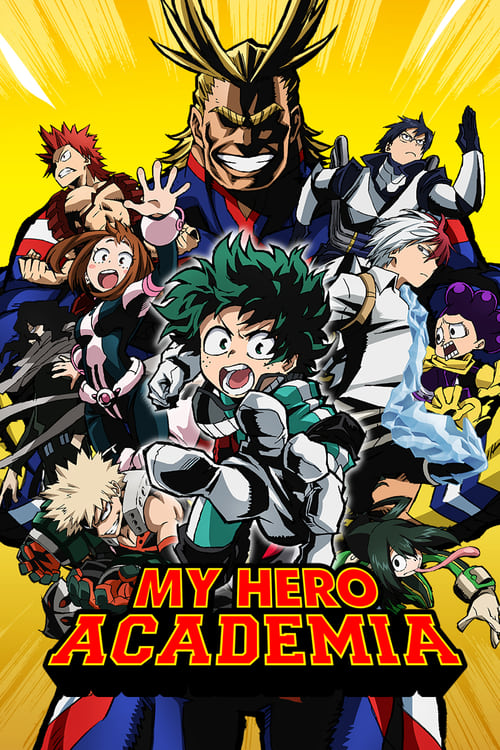
My Hero Academia
Explore the MBTI personality types of My Hero Academia characters in Kohei Horikoshi's landmark superhero series. From Deku's INFJ analytical empathy to Bakugo's explosive ENTJ drive, MHA presents one of anime's most carefully constructed ensembles for personality typing. The series' central question — what makes a true hero — is answered differently by every cognitive function stack in the cast.
المحللون
All For One
AnalystAll For One leads with dominant introverted intuition (Ni) that has operated across centuries — his patient, multi-generational strategy to destroy hero society and create a successor vessel for his will is Ni at its most extreme long-range expression. He perceived the trajectory of hero society from its inception and engineered its downfall through plans that span generations, treating historical events as moves in a strategy game only he can see in full. His cultivation of Shigaraki as a vessel was not improvised but Ni-planned decades in advance, identifying Nana Shimura’s grandson as the symbolically perfect instrument of destruction. His auxiliary extraverted thinking (Te) deploys the entire League of Villains as a system of instruments serving his Ni vision, treating every human being — Shigaraki, Kurogiri, the Nomu — as functional components to be optimized, replaced, or sacrificed based on strategic necessity. His tertiary introverted feeling (Fi) manifests as a deeply personal, almost artistic satisfaction in the destruction he engineers; his relationship with his brother and the original One For All suggests private emotional investments that his Ni-Te surface never acknowledges. His inferior extraverted sensing (Se) emerges during direct confrontation — his battle with All Might at Kamino reveals formidable physical combat ability that his puppet-master reputation understates. All For One represents INTJ villainy in its most complete form: a being whose Ni-Te stack has had centuries to refine itself into an instrument of absolute strategic dominance, making him the definitive shadow counterpart to All Might’s ENFJ heroism.
“I have been waiting centuries for this moment.”Learn about INTJ →
Katsuki Bakugo
AnalystBakugo leads with dominant extraverted thinking (Te) in its most unfiltered, explosive form — his competitive drive, command instinct, and expectation of absolute excellence from himself and everyone around him are Te operating without any social moderation. His rage when others fail to meet his standards is not emotional volatility but Te’s genuine intolerance for inefficiency and mediocrity. His auxiliary introverted intuition (Ni) is easy to miss behind the explosions but is consistently demonstrated: his extraordinary strategic read of battles during the Provisional License Exam and his long-range vision of becoming the Number One hero shape every tactical decision he makes. His Ni perceives optimal combat trajectories several moves ahead, which is why his battle improvisation appears instinctive but is actually deeply strategic. His tertiary extraverted sensing (Se) provides the explosive physical power and combat awareness that make his Te-Ni strategy devastatingly effective in practice — his Quirk mastery represents Se refined to an art form through relentless Te-driven training. His inferior introverted feeling (Fi) is his growth edge and the source of his deepest character development. The scene where he breaks down crying to Deku, confessing his guilt about All Might’s retirement, reveals Fi values so deeply buried that even Bakugo did not know they existed until the pressure became unbearable. His character arc is the ENTJ learning to integrate Fi: recognizing that the drive to be Number One must coexist with genuine care for the people he is competing alongside, transforming rage into purpose without losing the Te intensity that defines him.
“I'll be number one. That's always been the goal.”Learn about ENTJ →
Hawks
AnalystHawks leads with dominant extraverted intuition (Ne), and his entire double-agent existence is a masterclass in Ne’s ability to hold multiple contradictory possibilities simultaneously without resolving them into a single identity. As the Number Two hero infiltrating the League of Villains, he maintains several incompatible personas — loyal hero, sympathetic ally to Dabi, carefree celebrity — with an ease that only Ne’s comfort with ambiguity and multiple simultaneous framings can sustain. His humor and charm are Ne’s social lubricant, masking a deeply complex internal landscape that he reveals to no one. His auxiliary introverted thinking (Ti) processes the moral calculus of infiltration and sacrifice with a detachment that reads as callousness but is actually Ti doing honest ethical math. His decision-making during the infiltration arc demonstrates Ti weighing outcomes with cold precision while Ne generates escape routes and contingency plans faster than opponents can predict. His tertiary extraverted feeling (Fe) is more developed than his casual demeanor suggests; his genuine mentorship of Tokoyami and his concern for Endeavor reveal Fe investment in others’ development that goes beyond strategic utility. His inferior introverted sensing (Si) is his vulnerability — he struggles with the accumulated weight of past moral compromises because Si processes these experiences as a growing archive of guilt that his Ne cannot outrun. Hawks’s character arc explores the cost of ENTP cognitive flexibility pushed to its limit: the ability to see every possibility simultaneously becomes a burden when some of those possibilities involve genuine moral harm, and his Ti must ultimately choose a position that his Ne would prefer to leave open.
“I just want a world where heroes have time to be lazy.”Learn about ENTP →
الدبلوماسيون
Izuku Midoriya (Deku)
DiplomatDeku leads with dominant introverted intuition (Ni), and his hero analysis notebooks are the most literal representation of Ni in shonen anime — a compulsive synthesis of observed patterns into deep, actionable insight that he cannot stop producing even before he has a Quirk to apply them to. His Ni perceives the essential structure of every hero’s fighting style, identifying weaknesses and optimization paths that the heroes themselves often miss. During the Sports Festival, his Ni-driven analysis of opponents’ Quirks allows him to develop counter-strategies that compensate for his physical limitations. His auxiliary extraverted feeling (Fe) drives his entire heroic purpose: he does not want power for himself but to use it in service of others. His emotional attunement to Eri’s suffering, Todoroki’s trauma, and even Bakugo’s wounded pride demonstrates Fe’s capacity to perceive and respond to others’ deepest emotional needs. His tertiary introverted thinking (Ti) develops through his increasingly sophisticated tactical analysis during combat, moving from instinctive Ni pattern recognition to deliberate Ti deconstruction of opponents’ strategies. His inferior extraverted sensing (Se) is his persistent weakness: his body cannot keep up with his Ni-Fe vision, and One For All’s physical demands constantly remind him that Se mastery requires development his cerebral orientation naturally resists. Deku’s character arc is the INFJ growth journey: learning to trust Ni’s vision, deploy Fe’s empathy as strength rather than vulnerability, and develop enough Se to physically manifest the heroism his cognitive functions have always perceived as possible.
“I'm not going to be your footstool for the rest of my life.”Learn about INFJ →
Tomura Shigaraki
DiplomatShigaraki begins as a wounded Fi-dominant (Fi), his entire destructive impulse originating from a deeply personal, unprocessed emotional wound that he cannot articulate beyond the desire to destroy everything. His childhood trauma — accidentally killing his family with his Decay Quirk while no hero came to save him — shattered his Fi so completely that destruction became his only remaining value. The hands he wears are Si artifacts: physical remnants of past trauma that he clings to because they are the only connection to his obliterated emotional world. His auxiliary extraverted intuition (Ne) expresses as chaotic, unfocused violence and an inability to commit to coherent strategy in early arcs. His Ne generates destructive possibilities without Fi providing the stable value framework needed to organize them, resulting in the League’s initially haphazard villainy. His tertiary introverted sensing (Si) is corrupted into traumatic fixation rather than healthy tradition: he does not draw stability from the past but relives its horror compulsively. His inferior extraverted thinking (Te) is the function All For One deliberately cultivates, and Shigaraki’s forced evolution through the Nomu modifications represents a violent cognitive inversion — Te rising to dominance while Fi is suppressed. Late-series Shigaraki feels like a fundamentally different character because he is: his Fi has been overwritten by Te’s systematic, methodical destruction. This makes his arc one of anime’s most disturbing depictions of shadow possession, where a wounded INFP’s authentic pain is weaponized into an ENTJ’s calculated annihilation of the society that failed him.
“I want to destroy everything.”Learn about INFP →
All Might (Toshinori Yagi)
DiplomatAll Might is the most iconic ENFJ in shonen anime — his dominant extraverted feeling (Fe) expressed as the Symbol of Peace, a hero whose entire purpose was to inspire hope across an entire society through the sheer force of his emotional presence. His smile in the face of danger is not bravado but deliberate Fe strategy: he understood that a hero’s emotional impact on the public is as important as his combat victories, and he constructed his entire public persona around maximizing inspirational effect. His auxiliary introverted intuition (Ni) gave him the foresight to identify Deku as One For All’s successor, perceiving the boy’s essential heroic character beneath his Quirkless exterior when no one else could see it. This Ni vision extended beyond immediate succession to a generational strategy: All Might was consciously building a legacy that would outlast his physical limitations. His tertiary extraverted sensing (Se) provided the overwhelming physical power that made his Fe vision credible — his combat feats were not separate from his inspirational purpose but the physical proof that validated his message of hope. His inferior introverted thinking (Ti) is his blind spot: he struggled to teach systematically, often relying on emotional encouragement rather than structured instruction, which is why his mentorship of Deku required supplementation from more Ti-oriented teachers like Aizawa and Gran Torino. All Might’s character arc is the ENFJ at the end of his power: learning that the Symbol of Peace was never his physical strength but his Fe capacity to make others believe in themselves, which his retirement proves by showing that the hope he transmitted continues through Deku and Class 1-A.
“I am here!”Learn about ENFJ →
الحراس
Tsuyu Asui (Froppy)
SentinelTsuyu is an ISTJ with one of the clearest demonstrations of Si-Te integration in the series — she says exactly what she observes to be factually true without social filtering, which is Te serving Si’s concrete data with no embellishment or diplomatic softening. Her signature phrase about always speaking her mind is not rudeness but Te’s honest external processing of Si’s carefully observed reality. Her dominant introverted sensing (Si) provides the unshakeable calm under pressure that makes her one of Class 1-A’s most reliable members: she has internalized emergency protocols and crisis responses so thoroughly that panic is nearly impossible. During the USJ attack, her composed response demonstrates Si’s ability to access practiced responses even in unprecedented situations. Her auxiliary extraverted thinking (Te) manifests as practical judgment and direct communication that cuts through emotional noise to identify what needs to be done. Her tertiary introverted feeling (Fi) is real but deeply private — her breakdown after the rescue mission, where she admits she tried to stop her classmates from saving Bakugo, reveals Fi guilt so intense that her normally composed Si-Te exterior cannot contain it. This moment demonstrates that her directness is not emotional absence but emotional control. Her inferior extraverted intuition (Ne) is her limitation in brainstorming sessions and creative problem-solving, though her Si database is extensive enough to compensate in most situations. Tsuyu’s character represents the ISTJ at their most admirable: reliable, honest, practically competent, and emotionally genuine beneath a surface of methodical composure.
“I always say what's on my mind, okay?”Learn about ISTJ →
Ochaco Uraraka
SentinelUraraka leads with dominant extraverted feeling (Fe), attuned to group harmony, relational dynamics, and the emotional states of everyone around her. Her instinct to cheer up struggling classmates, mediate conflicts, and celebrate others’ successes reflects Fe’s natural orientation toward communal wellbeing. During the battle trials, her first instinct is collaborative rather than competitive, and her emotional investment in her classmates’ welfare is genuine rather than performative. Her auxiliary introverted sensing (Si) grounds her Fe in practical, family-rooted motivation that gives her heroism unusual specificity: her desire to become a hero is explicitly connected to earning money for her parents’ struggling construction company, making her compassion materially concrete rather than abstractly idealistic. Si anchors her Fe in remembered images of her parents’ hardship that drive her forward when motivation falters. Her tertiary extraverted intuition (Ne) emerges in her surprisingly creative combat strategies, particularly her zero-gravity meteor shower attack against Bakugo in the Sports Festival — a moment where Ne’s pattern-generating capacity produces a genuinely innovative tactical approach. Her inferior introverted thinking (Ti) is her least developed function, visible in her difficulty processing her feelings for Deku analytically; she experiences her attraction through Fe’s relational framework rather than Ti’s logical analysis, which is why she struggles to separate her heroic purpose from her emotional attachment. Uraraka’s character arc is the ESFJ learning to fight for herself while maintaining her Fe commitment to others — discovering that personal ambition and communal care are not contradictory but complementary.
“I want to earn money and give my parents an easy life.”Learn about ESFJ →
المستكشفون
Shota Aizawa (Eraserhead)
ExplorerAizawa is one of MHA’s most clearly typed characters — his dominant introverted thinking (Ti) evaluates students and situations purely by results and practical capability, entirely disregarding the emotional variables that most teachers would consider. His Quirk Assessment Test on the first day of class, where he threatens to expel the lowest performer, is Ti establishing a framework where the only relevant data is measurable competence. His teaching philosophy strips away sentiment to expose whether students can actually function under pressure, which is Ti’s refusal to let Fe distort accurate assessment. His auxiliary extraverted sensing (Se) makes him a devastating in-the-moment combatant who responds to physical reality with precise, unhurried efficiency. His capture weapon technique demonstrates Se mastery refined through years of practice into an extension of his body’s awareness, and his combat style against the USJ villains shows Se operating at peak effectiveness under life-threatening conditions. His tertiary introverted intuition (Ni) provides strategic foresight that informs his apparently impulsive Se responses — his decisions about which students to expel and which to nurture reflect Ni’s quiet assessment of long-term potential. His inferior extraverted feeling (Fe) is his most carefully suppressed function, yet it drives his most powerful character moments: his fierce protection of Class 1-A during the USJ attack, his grief over Oboro Shirakumo, and his sacrifice of his eye for Eri reveal Fe devotion so intense that his Ti-constructed detachment cannot fully contain it. Aizawa’s character represents the mature ISTP who has learned that Ti’s honest assessment and Fe’s genuine care are not contradictory but complementary approaches to protecting the people who matter.
“You only have three years. Logical deception is a valid hero strategy.”Learn about ISTP →
Minoru Mineta
ExplorerMineta leads with dominant extraverted sensing (Se) operating at its most shallow and self-serving — he is relentlessly present-focused, pursuing immediate sensory gratification with virtually no consideration for how his behavior impacts others or his future reputation. His constant inappropriate behavior toward female classmates is Se fixated on physical stimulation without any moderating function providing ethical feedback. His auxiliary introverted feeling (Fi) operates at its lowest developmental level, producing self-centered values rather than the authentic moral framework that characterizes healthy ESFP Fi. His motivations are transparently selfish: he wants to be a hero because it is the fastest path to popularity and attention, not because he holds genuine heroic values. His tertiary extraverted intuition (Te) is surprisingly functional when activated by survival pressure — his strategic use of his Pop Off Quirk during the Final Exam against Midnight demonstrates real tactical intelligence that his Se-driven impulsiveness normally suppresses. His inferior introverted intuition (Ni) means he cannot envision future consequences, plan ahead, or develop the long-range vision that would transform his genuine Se-Fi capability into mature heroism. Mineta’s character represents the cautionary extreme of ESFP cognitive development: when Se dominance operates without Fi maturation, external experience-seeking becomes compulsive rather than enriching. His rare moments of genuine courage — standing up during genuinely life-threatening situations — prove that the Se-Fi foundation for real heroism exists but requires developmental work he has not yet committed to undertaking.
“Being a hero is the fastest way to popularity!”Learn about ESFP →
ابحث عن شخصيتك
تعرف على نوع MBTI الخاص بك؟ ابحث عن الشخصية المطابقة أدناه.
الأسئلة الشائعة
Deku is an INFJ. His hero analysis notebooks are the most visible expression of dominant introverted intuition in shonen anime — a compulsive drive to synthesize observed patterns into deep, predictive insight. His auxiliary extraverted feeling is the engine of his heroic motivation: he does not desire power for himself but to use it in service of others, and his emotional attunement to others' pain — Eri, Todoroki, even Bakugo — drives many of the series' most significant plot decisions.
Bakugo (ENTJ) and Todoroki (INTJ) share the Ni-Te axis but differ critically in their dominant orientation. Bakugo's Te is extraverted and dominant — he leads with force, command, and external results, expressing his Ni vision through explosive external action. Todoroki's Ni is dominant — he leads with internal vision and selective engagement, deploying his Te in service of a privately held principle. Bakugo's arc is Te learning to integrate Fe; Todoroki's arc is Ni-Te learning to integrate Fe from the outside in, through Deku's emotional intervention.
All For One's defining cognitive pattern is dominant introverted intuition — his multi-century strategy is organized around a singular, internally held vision that he never fully reveals to anyone. An ENTJ would externalize strategy through visible command structures and direct domination; All For One operates through layers of concealment, operating from a hidden Ni center that manipulates external reality without revealing its full shape. His Te is auxiliary — it builds systems (the League, Shigaraki) in service of the Ni vision rather than being the primary driver.
Shigaraki begins as a deeply wounded INFP — his Fi is dominant but completely unintegrated, expressing only as destructive impulse and an inability to articulate his pain beyond the desire to destroy. His auxiliary Ne produces chaotic, unfocused villainy. His forced evolution through All For One's influence and the Nomu modifications represent a violent inversion to Te-dominance, which is why late-series Shigaraki feels like a different character: his Fi has been suppressed and Te has taken the dominant position. Both typings are correct at different points in his arc.