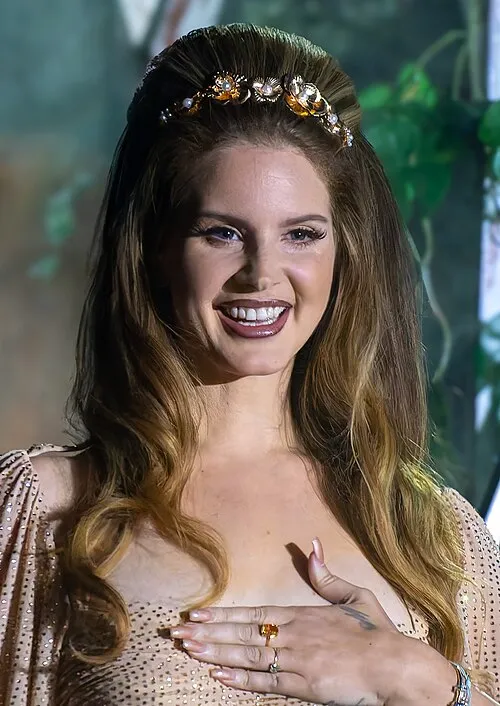
Elizabeth Woolridge Grant was born on June 21, 1985, in New York City, and grew up in Lake Placid, upstate New York. She was sent to Kent School in Connecticut at age fifteen after struggling with alcohol dependency, where she found stability and developed her musical interests. She studied philosophy at Fordham University in the Bronx, graduating in 2005, and spent her mid-twenties playing small New York venues under various names, self-releasing music that attracted little attention. The persona and sound she was developing — a fusion of Americana, cinematic melancholy, and vintage glamour — would require years of refinement before it found its moment.
The 2012 release of 'Video Games' changed everything. The song and its accompanying self-made video — grainy footage of vintage Hollywood, of women swimming, of fireworks and ordinary moments elevated to the status of memory — captured something about digital-age nostalgia that spoke to immediately and globally. Lana Del Rey became famous overnight, generating the particular kind of online intensity that accompanies artists who seem to have been discovered rather than marketed. Her debut album Born to Die (2012) became a phenomenon, its combination of orchestral arrangements, hip-hop beats, and her distinctive low, humid vocal style creating a new genre category that critics struggled to name.
The critical reception to Lana's early work was complicated by debates about authenticity: her constructed persona (the name, the aesthetic, the apparent nostalgia for an America she had never actually inhabited) attracted accusations of artifice from critics who wanted artists to be transparently 'real.' The accusations misunderstood the artistic project entirely. Lana was working in the tradition of cinematic self-invention — the same tradition as Madonna, Bowie, Garbo — creating not a false self but a heightened poetic identity through which genuine emotional material could be expressed at a register unavailable to ordinary autobiography.
Her subsequent albums — Ultraviolence (2014), Honeymoon (2015), Lust for Life (2017), Norman Fucking Rockwell! (2019), Chemtrails Over the Country Club (2021), Blue Banisters (2021), Did You Know That There's a Tunnel Under Ocean Blvd (2023) — have deepened and complicated her aesthetic, moving increasingly toward literary songwriting of genuine distinction. Norman Fucking Rockwell! in particular drew near-universal critical acclaim as a statement of artistic maturity, its engagement with American mythology and contemporary disillusionment regarded as one of the most fully realized albums of the 2010s. She has built one of the most distinctive and artistically coherent bodies of work in contemporary popular music.