Frida Kahlo - ISFP Personality Type

Frida KahloISFP - المغامر

Artist

الأصل

Mexico

مستوى الثقة في التصنيف

مقبول على نطاق واسع

Quick Facts

Born
July 6, 1907
Birthplace
Coyoacán, Mexico City, Mexico
Nationality
Mexican
Height
5'3" (160 cm)
Zodiac Sign
Education
National Preparatory School, Mexico City
Known For
Self-portrait paintingsMexican folk art fusionFeminist iconDiego Rivera marriage

Who is Frida Kahlo?

Magdalena Carmen Frida Kahlo Calderón was born on July 6, 1907 — though she later claimed 1910, the year of the Mexican Revolution, as if her birth should coincide with national transformation — in Coyoacán, a suburb of Mexico City. At age six she contracted polio, leaving her right leg thinner than her left and beginning a lifetime relationship with physical pain and medical intervention. At eighteen, she was involved in a catastrophic bus accident that fractured her spinal column, collarbone, ribs, and pelvis; shattered her right leg; and drove a metal handrail through her hip and out through her vagina. She spent three months in a full body cast, and it was during this recovery that she began to paint, working on a specially constructed easel that allowed her to work while lying down.

Frida Kahlo met Diego Rivera, the famous Mexican muralist, at the National Preparatory School when she was fifteen and he was painting a mural there. They met again in 1928, and their subsequent marriage — passionate, tumultuous, mutually unfaithful, briefly dissolved and then resumed — became both the central relationship of her life and a dominant subject of her art. Rivera, thirty years her senior and already famous, initially overshadowed her career; it was her independent engagement with the Surrealists in Paris in 1939, and André Breton's enthusiastic reception of her work, that established her as a significant artist in her own right. She always rejected the Surrealist label, claiming her paintings depicted her own reality rather than her unconscious.

Kahlo's approximately 150 paintings — of which about fifty are self-portraits — constitute one of the most personal and visually distinctive bodies of work in 20th-century art. She painted her pain literally: The Broken Column shows her corseted body split open to reveal a crumbling ionic column in place of her spine; The Two Fridas shows her doubled, one version connected to her ex-husband Diego by an artery he has severed; My Birth shows her own birth in close biological detail. The imagery drew on Mexican folk art traditions, pre-Columbian iconography, and European painting, creating a visual language that was simultaneously highly personal and rooted in specific cultural traditions.

Frida Kahlo died on July 13, 1954, at age forty-seven, of what was officially recorded as pulmonary embolism, though Rivera and others believed it was intentional overdose. Her last diary entry read: 'I hope the exit is joyful — and I hope never to return.' The posthumous construction of Kahlo as a feminist and political icon has in some ways obscured the specificity of her actual work and person: she was deeply particular, deeply political in ways that cannot be reduced to contemporary categories, and deeply committed to her own vision of Mexico's indigenous heritage. Her house, La Casa Azul in Coyoacán, is now a museum and receives over 25,000 visitors monthly.
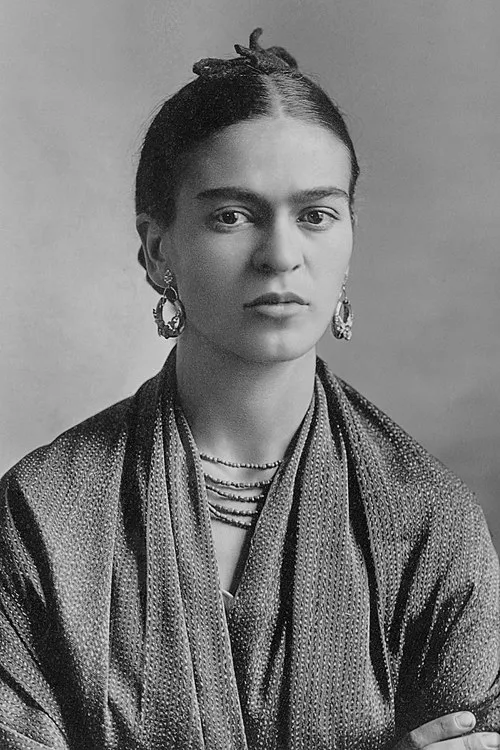
نوع شخصية Frida Kahlo: ISFP

Frida Kahlo، المعروف/ة بعمله/ها كـArtist، يُجسّد سمات نوع الشخصية ISFP - المغامر.

السمات الرئيسية لـISFP في Frida Kahlo

كـISFP، يُجسّد Frida Kahlo الخصائص الجوهرية المرتبطة بهذا النوع.

لماذا يُصنَّف Frida Kahlo كـISFP

السلوك العام لـFrida Kahlo وأنماط القرارات وأسلوب التواصل يتطابق مع هذا التصنيف.

Frida Kahlo's Notable Works

1932

Henry Ford Hospital (La Cama Volando)

Critical self-portrait processing miscarriage

1939

The Two Fridas

Major exhibition at Gallery of Mexican Art

1944

The Broken Column

Response to her second spinal surgery

1945

Without Hope

Painted during severe medical deterioration

1953

Solo Exhibition in Mexico City

First solo show in Mexico, attended from her hospital bed

Awards & Recognition

\u2605National Prize for Arts and Sciences, Mexico (1946)\u2605Inducted into Smithsonian American Art Museum Collection (1990)\u2605Mexican postage stamp dedication (1984)\u2605Google Doodle honoree (2012)

Frida Kahlo's Mystic Profile

Discover Frida Kahlo's cosmic connections through zodiac, tarot, crystals, and spirit animals.

cancer

Zodiac Prediction

Frida Kahlo's Cancer sun is the foundation of her entire artistic project: the sign of the body as home, of the physical self as the seat of identity and experience, of the one who processes emotional experience through the body rather than around it. Cancer rules the personal, the intimate, the close-up examination of one's own experience — which is precisely what Kahlo's self-portraits enact. Her Cancer quality is her willingness to go into the wound rather than away from it, to paint her pain rather than transcend it, to make the private body public without flinching. The Moon, which rules Cancer, is the mirror that reveals rather than illuminates — and Kahlo's self-portraits are exactly this: the unflinching mirror.

🃏

the strength

Tarot Card Match

Strength — the tarot archetype of inner courage, of the gentle mastery of fear and pain through love rather than force, of the one who bends the lion without breaking it — is Kahlo's card. The Strength card shows a figure calmly opening the mouth of a lion: not dominating it through external power but through the quality of presence that makes aggression unnecessary. Kahlo's relationship to her physical suffering was this kind of strength: not the suppression of pain but its transformation through artistic witness, not the denial of difficulty but its integration into beauty. Her paintings are acts of strength in the deepest register: the courage to look at what is hardest to see and render it visible.

💎

malachite

Crystal Match

Malachite — the banded green stone of transformation, of the willingness to go through darkness in order to reach clarity, of the healing that requires passing through rather than around — is Kahlo's crystal. Malachite is associated with the heart and with change that cannot be achieved gently: it draws out what needs to be released, amplifies what needs to be confronted, accompanies the difficult work of genuine transformation. Kahlo's paintings have malachite energy — they do not comfort but catalyze; they do not reassure but challenge; they open rather than close. The stone's deep green reflects the earth's own power of regeneration: the buried thing that becomes, through time and pressure, something extraordinary.

🦁

hummingbird

Spirit Animal

The hummingbird — the smallest bird capable of sustained flight, the creature of extraordinary speed and precision, of the ability to hover in apparent stillness while working at maximum intensity, and a significant figure in Mexican indigenous traditions — is Kahlo's spirit animal. In Aztec mythology, hummingbirds were associated with warriors and were believed to be the reincarnations of fallen heroes; dead hummingbirds were worn as amulets to bring luck in love. Kahlo incorporated hummingbirds into her self-portraits — in Self-Portrait with Thorn Necklace and Hummingbird (1940), a dead hummingbird hangs at her throat alongside the thorns drawing blood. The hummingbird is both beauty and endurance: the impossibly small creature that nonetheless travels vast distances on wings that beat too fast to see.

مزيد من مشاهير ISFP

حول هذا التحليل

يستند تحليل شخصية Frida Kahlo إلى معلومات متاحة للعموم ومقابلات وملاحظات سلوكية.